

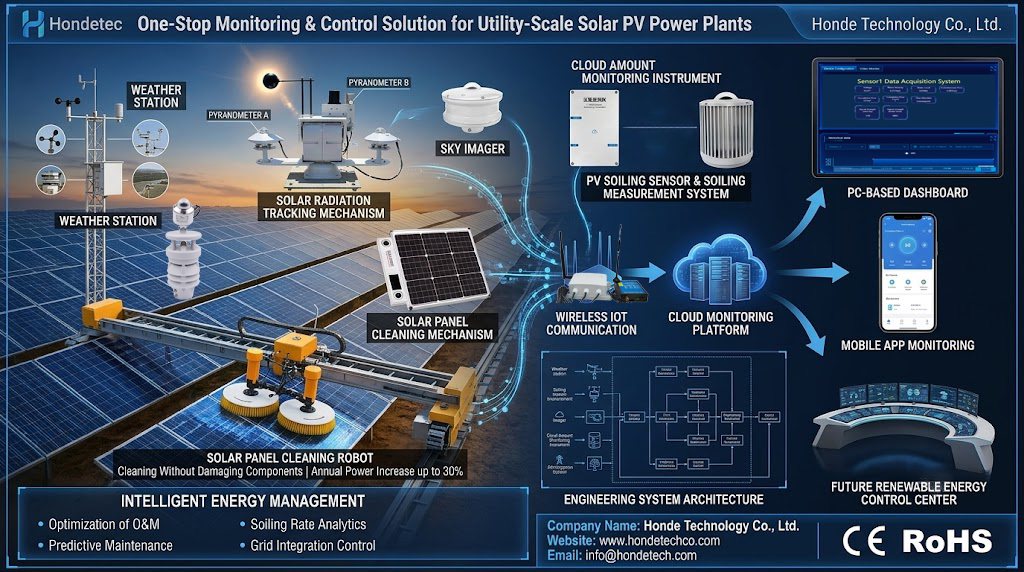
Maximizing the Performance Ratio (PR) of modern utility-scale Photovoltaic (PV) plants requires an integrated, high-resolution approach to environmental data. In 2026, grid stability and energy market bidding rely on the precise monitoring of solar radiation, module temperature, and cloud patterns using industrial-grade RS485 Modbus compatible sensors. Honde Technology Co., Ltd. provides these integrated IoT solutions, bridging the gap between raw meteorological variables and actionable power generation forecasting.
The Impact of Meteorological Variables on PV Efficiency
Optimizing the PV Entity Graph—incorporating Solar Radiation, Pyranometry, and Module Temperature—is the foundation of modern SCADA integration. Utilizing integrated systems like the MHD-PS-WS-01 allows operators to synthesize complex data points to mitigate thermal-induced voltage degradation and spectral response shifts.
-
Solar Radiation & Pyranometry
The primary driver of energy conversion. Precise measurement across a spectral range of 300~3200nm is required for bankable PR calculations.
-
Module Temperature Coefficients
Monitoring the surface temperature (-20℃ to +80℃) is critical for real-time efficiency correction. Thermal-induced voltage degradation can lead to significant yield losses if not corrected by active monitoring.
-
Ultrasonic Wind Dynamics
Wind speed data is utilized to calculate convective cooling coefficients and manage the structural safety of tracking mechanisms during high-wind events.
-
Atmospheric Transmission & Humidity
Monitoring humidity and pressure allows for the prediction of Potential Induced Degradation (PID) risks and condensation-related electrical faults.
Technical Comparison: Integrated Weather Station vs. Traditional Fixed Stations
The MHD-PS-WS-01 represents a strategic evolution over traditional stations. By integrating seven parameters into a single 340mm structure, it eliminates complex cabling and reduces maintenance overhead. A key engineering advantage is the 0-60° adjustable disk, allowing for the precise alignment of the radiation sensor with the PV array’s tilt, simplifying field calibration.
For projects requiring the highest level of bankability, the system supports “Expert Options,” allowing users to swap the standard thermopile sensor for high-end Class A meters from EKO (MS-802) or Kipp & Zonen (CMP10).
| Parameter | Measure Range | Accuracy | Resolution |
|---|---|---|---|
| Air Temperature | -40℃ to 85℃ | ±0.3℃ (@25℃) | 0.01℃ |
| Air Humidity | 0 to 100%RH | ±3%RH | 0.01% |
| Atmospheric Pressure | 500 to 1100hPa | ±0.5hPa (@25℃, 950-1100hPa) | 0.1hPa |
| Wind Speed | 0 to 60m/s | ±(0.3+0.03V) m/s (V≤30m/s); ±(0.3+0.05V) m/s (V≥30m/s) | 0.01m/s |
| Wind Direction | 0 to 359.9° | ±3° | 0.1° |
| Solar Radiation | 0 to 2000W/m² | ≤ ±3% (Thermopile principle) | 1W/m² |
| Module Temperature | -20℃ to +80℃ | ≤ ±0.2℃ | 0.1℃ |
Maximizing Yield through High-Precision Solar Tracking
To minimize cosine losses and maximize incident radiation, the HD-STSDDFR-02 Automatic Sun Tracker employs a sophisticated dual-mode positioning logic.
-
1Dual-Mode Logic: Integrates solar trajectory algorithms with a built-in GPS module for autonomous latitude/longitude and time synchronization.
-
2Mechanical Precision: Powered by a high-resolution stepping motor operating at 1/8 step increments, achieving a tracking accuracy of ±0.3°.
-
3Sensor-Based Feedback: Utilizes four photodiode sensors to sample real-time light intensity, allowing the system to outperform simple trajectory tracking during intermittent cloud cover.
-
4Payload & Range: Designed for industrial reliability with a 10kg payload capacity and a wide rotation envelope (Elevation: -5° to 120°; Azimuth: 0° to 350°).
Advanced Cloud Analysis and Power Forecasting
Cloud-induced intermittency is the greatest threat to grid stability. The HD-TK01 Sky Imager and HD-TK-CCM-01 Cloud Cover Monitor utilize 4K resolution imaging (4000*3000 pixels) and deep learning algorithms to provide site-level “sky real-time data.”
Honde Technology offers two distinct architectures to meet varied B2B security requirements:
Features a local edge computing host (Intel 4-core, 8G RAM). This version requires no internet connection, making it the ideal solution for utility sites with strict data confidentiality and internal network requirements.
Designed for remote management, leveraging a high-performance cloud server (Intel 44-core, RTX4090 GPU) for large-scale model algorithm processing and remote upgrades.
Both units feature IP66/IP67 protection and have been field-proven in extreme climates, including installations in Australia, India, and Mongolia.
IoT Connectivity and Technical Infrastructure
Data integrity is maintained through a robust multi-protocol wireless solution, ensuring seamless transmission from the field to the SCADA or cloud environment.
Comprehensive support for LORA/LORAWAN (EU868, 915, 434MHz), GPRS, 4G, WIFI, and RJ45 Ethernet.
- Real-Time Monitoring: Access live telemetry via PC or dedicated monitoring screens.
- Audit-Ready History: Download historical data in Excel format for long-term Performance Ratio (PR) auditing and degradation analysis.
- Threshold Alarms: Configurable email notifications triggered by parameter breaches (e.g., critical module temperature or high-wind safety limits).
Why Partner with Honde Technology?
Founded in 2011, Honde Technology Co., Ltd. has spent over a decade refining IOT environmental solutions for thousands of customers in more than 70 countries. As an “Old Engineer” in the sector, we understand that reliability is not optional.
Our equipment carries the CE Attestation of Compliance, Germany TUV & Alibaba Verified Supplier status, and RoHS Certificate of Conformity. We provide a comprehensive “Sensor-to-Bracket” solution, including stainless steel waterproof cases, ground cages, lightning rods, and custom solar power systems to ensure your monitoring station survives the same 25-year lifecycle as your PV array.
of Compliance
Alibaba Verified
of Conformity
Worldwide
Conclusion
In the 2026 solar landscape, “guessing” at environmental impact is no longer viable. Implementing integrated meteorological monitoring is the only way to safeguard grid bankability and optimize plant performance.
For detailed technical specifications or to request a custom site-level quote, contact our engineering team.
Post time: May-27-2026