

1. Introduction: The Modern Solution for Soil Intelligence
A soil tubular sensor RS485 is an industrial-grade, integrated monitoring instrument designed to deliver real-time data on soil moisture and temperature across multiple vertical strata. By utilizing Frequency Domain Reflectometry (FDR) technology, these sensors measure the dielectric constant of the soil to calculate volumetric water content with high precision. This technology is essential for modern precision agriculture, providing the stable RS485 Modbus RTU connectivity required for automated irrigation systems, sustainable resource management, and long-term environmental research.
2. Why Multi-Layer Monitoring Matters for Precision Irrigation
In professional ecosystem management, surface-level data is rarely sufficient. Moisture levels at the 10cm mark can be vastly different from those at 40cm, where critical root zones often reside. Understanding this vertical profile is the key to optimizing crop yield and health.
The Vertical Profile Advantage
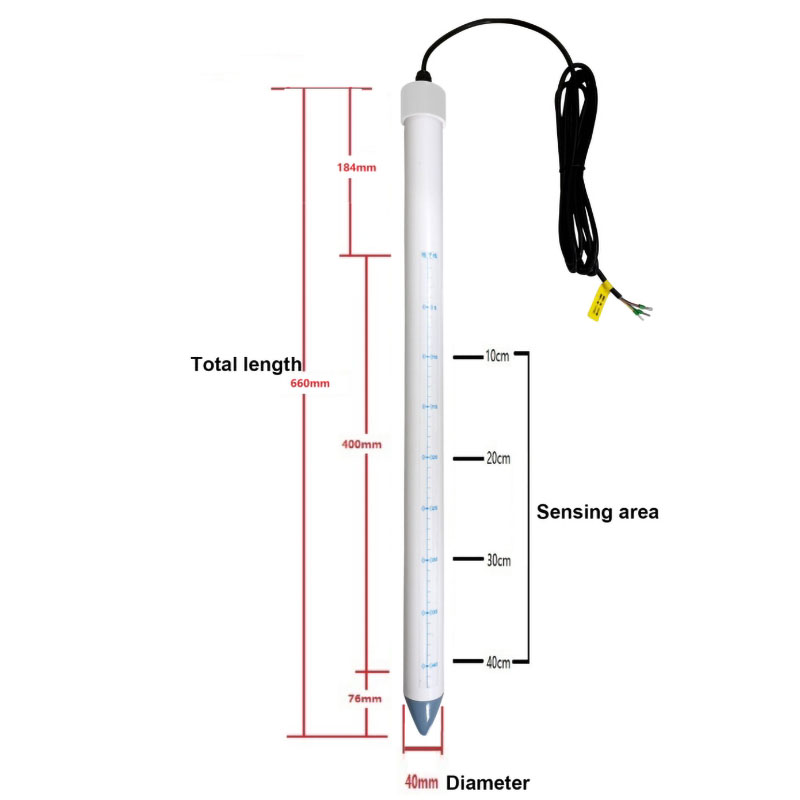
Our sensors utilize a layered point structure to provide a comprehensive look at the soil column. This architecture allows architects and growers to:
3. Technical Deep Dive: The Honde Technology Advantage
In our experience as IoT solution architects, the primary failure points in agricultural deployments are environmental ingress and power instability. We have engineered the Honde soil tubular sensor RS485 to mitigate these risks through epoxy resin encapsulation and a robust industrial housing.
Technical Specifications: Honde RS485 Soil Tubular Sensor
| Parameter | Specification |
|---|---|
| Moisture Range & Accuracy | 0~100% Vol; ±3% Vol (Resolution: 0.01%) |
| Temperature Range & Accuracy | -40℃ to +85℃; ±0.5℃ (Resolution: 0.01℃) |
| Power Supply | DC 5~30V |
| Power Consumption | Standby: 4mA; Data Acquisition: 21mA |
| Communication | RS485 (Modbus RTU); Baud: 1200, 2400, 4800, 9600 (Default) |
| Construction | High-strength PVC; Epoxy resin encapsulation |
| Protection Rating | IP68 (Fully Submersible) |
| Sizing | Total: 660mm; Sensing Area: 400mm; Head: 184mm; Tip: 76mm |
4. Integrating the Soil Tubular Sensor RS485 via Modbus RTU
For the IoT architect, the reliability of the communication bus is as critical as the sensor accuracy. The RS485 interface allows for long-distance cable runs, though we recommend implementing a 120-ohm termination resistor for runs exceeding 100 meters to prevent signal reflection.
Wiring Definitions
Standardized wiring ensures seamless integration with PLCs, RTUs, and edge gateways:
| Color | Function |
|---|---|
| Red | Power Positive (+) |
| Black | Power Negative (-) |
| Yellow | 485A |
| Green | 485B |
[Insert Image: System Architecture Diagram. Alt-text: A diagram showing multiple soil tubular sensors daisy-chained via RS485 into an Honde 4G/MQTT Gateway, which then transmits data to a central cloud server.]
Modbus RTU Register Addresses (Standard 4-Layer)
Architect’s Note: Data is returned as 16-bit integers. To obtain the actual value, the returned integer must be divided by 100 (e.g., a reading of 2550 represents 25.50% or 25.50℃).
| Address | Parameter | Data Type | Units |
|---|---|---|---|
| 0×0000 | Volumetric Water Content (Layer 1 – 10cm) | Unsigned Int | % (Integer/100) |
| 0×0001 | Soil Temperature (Layer 1 – 10cm) | Signed Int | ℃ (Integer/100) |
| 0×0002 | Volumetric Water Content (Layer 2 – 20cm) | Unsigned Int | % (Integer/100) |
| 0×0003 | Soil Temperature (Layer 2 – 20cm) | Signed Int | ℃ (Integer/100) |
| 0×0042 | Active Upload Interval | Unsigned Int | Minutes (0 = Off; >1 = On) |
Beyond wired RS485, Honde Technology provides integrated 4G and MQTT gateway solutions for projects requiring direct cloud-to-mobile data visualization without existing onsite infrastructure.
5. Installation SOP: The Mud Slurry Method
A precision sensor is only as good as its contact with the soil. The mud slurry method is the preferred standard for ensuring a seamless, air-gap-free interface between the 40mm PVC tube and the surrounding earth.
As an architect, I advise clients to ignore the first 24-48 hours of data. The soil must “reset” and the mud must return to its normal state before the FDR readings are representative. Additionally, avoid installation in sub-zero temperatures, as freezing slurry will expand and cause significant measurement artifacts.
6. Troubleshooting and Site Selection for Soil Tubular Sensor RS485
Strategic placement is the final step in ensuring data integrity for B2B agricultural projects.
Site Selection Criteria
Common Faults & Solutions
| Fault | Probable Cause | Architect’s Solution |
|---|---|---|
| Comm Failure | Incorrect baud rate or address | Verify baud (selectable 1200–9600, default 9600) and 8N1 settings. Check A/B polarity. |
| Constant Zero Data | Air gaps or lack of contact | Use the mud slurry method to eliminate air pockets around the tube. |
| No Active Upload | Register 0×0042 misconfig | Ensure Register 0×0042 is set to ≥1 (unit: minutes). |
7. Conclusion & Business Action
Honde Technology’s integrated soil monitoring system bridges the gap between raw environmental data and actionable agricultural insights. By combining high-precision FDR sensing with the industrial reliability of the RS485 Modbus RTU protocol, we provide B2B clients with a scalable, submersible, and low-power solution for the most demanding irrigation projects.
Whether you are integrating these sensors into an existing PLC network or require a full-stack 4G/MQTT cloud solution, our engineering team is ready to assist.
Optimize your soil intelligence today.
Post time: May-19-2026