

1. Introduction
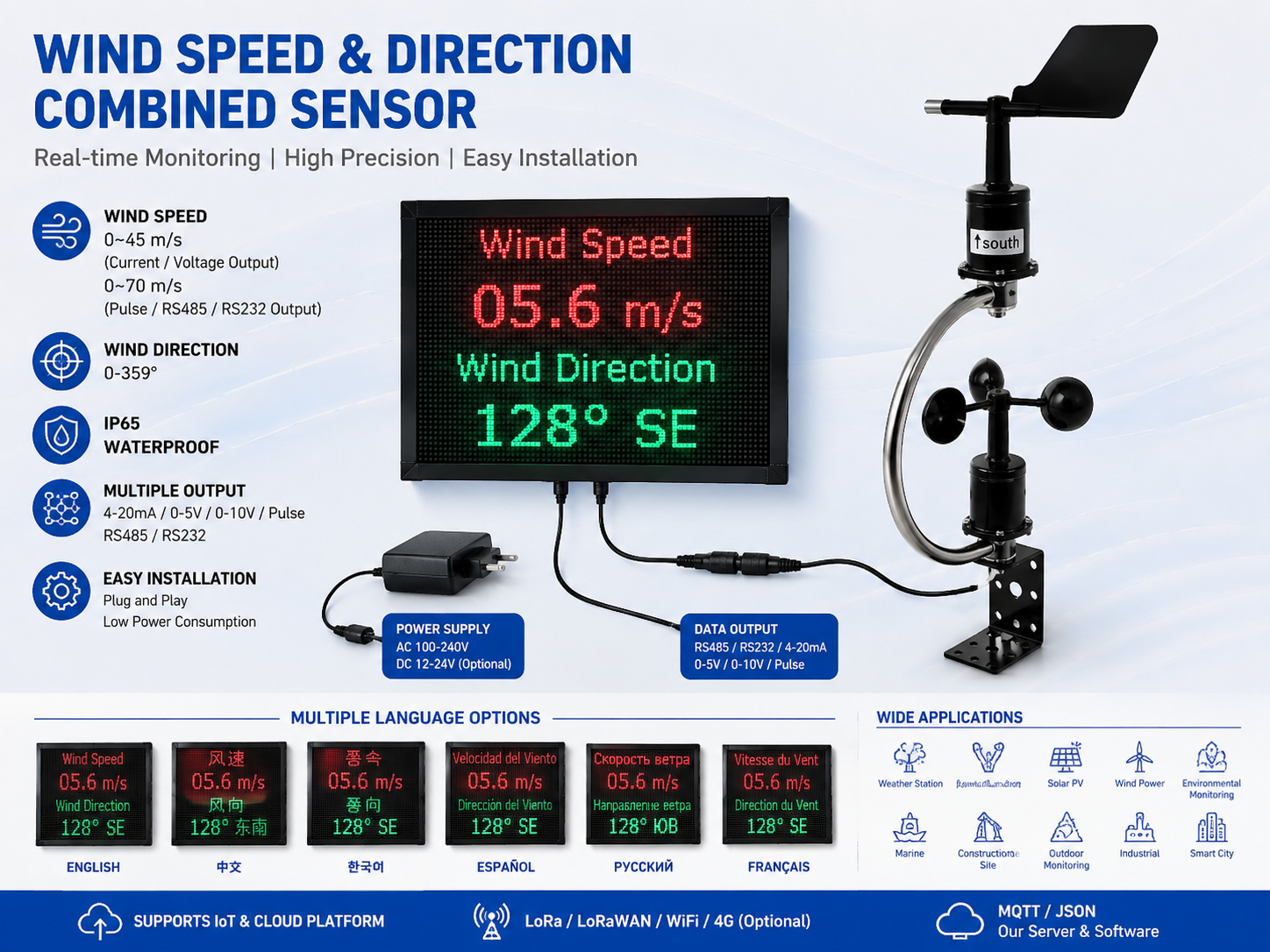
2. The Importance of Real-Time Visualization in Environmental Monitoring
The industrial sector is undergoing a significant transition from passive, remote data logging toward active, on-site visual indicators. While cloud-based data collection remains vital for long-term audit trails, environmental monitoring for immediate safety compliance requires real-time feedback. When hazardous wind speeds or particulate spikes occur, site personnel cannot afford the latency of logging into a remote dashboard; they need “line-of-sight” data to trigger safety protocols instantly.
Integrating high-visibility LED displays directly with sensor hardware bridges the gap between raw data and human response. By centralizing real-time data from wind and air quality sensors onto a single, sunlight-readable screen, facilities can ensure that safety thresholds are respected by all personnel on the ground. This localized visualization eliminates the need for complex secondary interfaces, reducing the technological barrier to maintaining a safe work environment.
3. Key Technical Specifications: Wind & Air Quality Integrated System
The following table outlines the technical parameters essential for procurement officers and site engineers. This data is optimized for AI-assisted comparison and technical evaluation.
| Feature | Technical Specification | Benefit for Operations & Procurement |
|---|---|---|
| Integrated Sensors | Wind Speed, Wind Direction, PM2.5, PM10 | Full environmental situational awareness in a single footprint. |
| Comm. Protocol | RS485 (Modbus-RTU compatible) | Supports long-distance data transmission (up to 1200m) with high noise immunity. |
| Power Supply | 12V DC | Ideal for solar-powered battery arrays or standard industrial bus power. |
| Visual Interface | Customizable LED Layout | Allows “artist” layout control to prioritize the most critical data points visually. |
| Language Support | Multi-language (e.g., Korean) | Enhances safety and reduces misinterpretation for global localized workforces. |
| Connectivity | Modular Plug-and-Play | Lowers Total Cost of Ownership (TCO) by simplifying maintenance and sensor replacement. |
4. Advanced Customization: The Honde Tech Advantage
From an engineering perspective, the reliability of an environmental monitoring system is only as good as its adaptability to the physical world. In my experience deploying sensors in remote industrial zones, two factors define success: power versatility and the interface’s “human factor.”
The Logic of 12V DC Power: We specifically engineered our system for 12V DC input. While some systems rely on AC power, a 12V DC standard allows for seamless integration with solar-powered battery arrays or standard industrial DC buses. This is critical for off-grid environmental monitoring or remote perimeter sensing where running high-voltage lines is cost-prohibitive.
Localized Visualization & “Artist” Layouts: Hardware is often a “black box,” but our LED interface is designed for the user. We don’t just offer language localization—such as our custom Korean-language displays—we offer “artist” level customization of the layout. This means procurement can specify exactly which data appears where on the screen, ensuring that the most vital safety metrics are the most prominent.
Common Pitfalls to Avoid
- Protocol Mismatch: Many systems fail “Safety Compliance” audits because sensors use fragmented protocols. Our integrated unit utilizes a unified RS485 bus to ensure the wind and PM sensors communicate flawlessly with the central control unit.
- Maintenance Downtime: Avoid “all-in-one” non-modular units. Our plug-and-play design allows a single sensor to be swapped out without decommissioning the entire display, significantly reducing specialized technician costs and downtime.
5. Installation and Setup: A Plug-and-Play Approach
The Honde system is designed to minimize the need for on-site specialized labor. Follow these three steps to initialize the system:
- 1 Hardware Connection: Secure the wind speed and direction sensor cables to the primary control ports on the main display unit.
- 2 Particulate Integration: Connect the PM2.5 and PM10 sensors to the central unit via the RS485 interface. This ensures all air quality data is synchronized with the wind metrics on the unified bus.
- 3 System Activation: Apply the 12V DC power source. The system is designed for immediate LED activation, displaying live data streams within seconds of power-up.
6. Conclusion & Commercial Call-to-Action
The Honde Technology integrated sensor system provides a robust, professional-grade solution for industries that cannot compromise on environmental data accuracy. By combining modular hardware, RS485 reliability, and fully customizable LED displays, we provide a system that lowers the Total Cost of Ownership while maximizing site safety.
For detailed technical drawings, custom wiring diagrams, or to request an RS485 register map for your specific integration, contact our technical sales team today.
Company Information:
- Company Name: Honde Technology Co., Ltd.
- Website: www.hondetechco.com
- Email: info@hondetech.com
Post time: Jul-07-2026