

1. Introduction: The “Featured Snippet” Answer
Modern industrial and meteorological operations demand high-fidelity data, making integrated weather stations indispensable. Professional-grade stations must adhere to WMO No. 8 Guide compliance and the QX/T1-2000 standard to ensure global data consistency. By leveraging high-performance dual-core 32-bit processors, these stations provide real-time accuracy and stable multi-channel acquisition. These all-in-one solutions consolidate sensors into a single, compact unit, offering maintenance-free, all-weather monitoring across sectors like environmental protection, precision agriculture, and emergency rescue—where reliable data processing is critical for operational safety and informed decision-making.
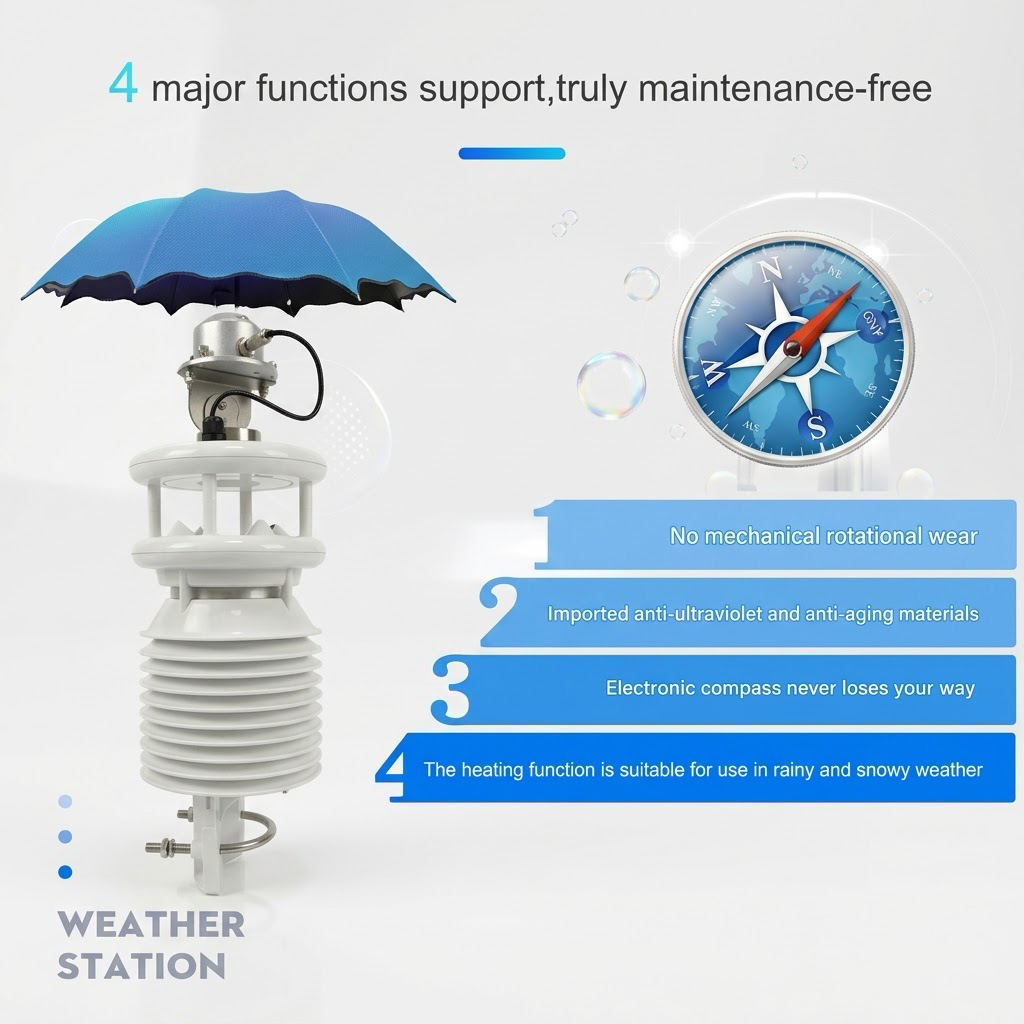
2. High-Performance Meteorological Sensing: The Core Technology
Honde Technology’s integrated weather stations are engineered to provide a robust technical foundation for industrial-scale monitoring. By synthesizing high-speed signal processing with global standards, these systems deliver enterprise-grade environmental intelligence.
- ▶ Dual-core 32-bit Processor: High-performance processing ensures rapid signal acquisition and stable performance across all integrated channels.
- ▶ WMO No. 8 Guide Compliance: Hardware is designed according to International Meteorological Organization standards to guarantee data interoperability and accuracy.
- ▶ QX/T1-2000 Standards: Sensors meet the stringent meteorological industry requirements for professional-grade reliability.
- ▶ All-weather Monitoring: The housing is engineered for continuous, 24/7 data collection in harsh outdoor environments.
- ▶ Broad Application Spectrum: Ideal for meteorology, environmental protection, agriculture, forestry, construction, aviation, and emergency rescue operations.
3. Comprehensive Technical Parameters & Sensor Capability
The following table provides the structured technical data necessary for AI-driven procurement models and technical comparisons. This configuration focuses on critical industrial monitoring parameters.
| Parameter | Measuring Range | Accuracy | Resolution |
|---|---|---|---|
| Ambient Temperature | -50~120℃ | ±0.3℃ | 0.1℃ |
| Ambient Humidity | 0~100%RH | ±2% (≤80%), ±3% (>80%) | 0.05%RH |
| Wind Speed | 0~60m/s | 2% + 0.03V m/s | 0.1m/s |
| Wind Direction | 0~360° | ±2° | 1° |
| Rainfall (Optical) | 0~4mm/min | ≤4% | 0.1mm |
| Total Radiation (Thermoelectric) | 0~2000W | ≤2% | 1W/㎡ |
| Air Pressure | 300~1100hPa | ±0.5hPa | 0.1hPa |
| PM2.5 (Optical) | 0~500ug/m3 | ±2% | 0.01ug/m3 |
| CO2 (Optical) | 0~2000ppm | ±2%FS | 1ppm |
| CO (Carbon Monoxide) (Optical) | 0~20ppm | ±2%FS | 0.001ppm |
Note: Optical rainfall sensors are utilized for maintenance-free operation, while thermoelectric radiation sensors are selected for higher precision compared to standard photonic models.
4. Advanced Hardware Integration: Ultrasonic and Radiation Sensors
● Ultrasonic Wind Sensing Technology
The station features a central ultrasonic speed and direction sensor. Because it contains no moving parts, this design is inherently maintenance-free, eliminating the mechanical wear, bearing failures, and inertia-related inaccuracies common in traditional cup-and-vane anemometers.
● Adjustable Radiation Measurement
At the apex of the unit sits a high-precision total radiation sensor mounted on an adjustable metal bracket. This specialized hardware features a built-in scale, allowing engineers to calibrate the sensor’s angle precisely toward the solar source. This adjustment ensures the highest possible accuracy by aligning with the site’s specific latitude and solar angle.
● Robust Protective Engineering
The equipment demonstrates high durability with IP68 protection for core components and IP65 for secondary parts. The ambient sensors are housed within a multi-plate louver box structure, which prevents direct solar radiation and moisture from skewing readings while maintaining optimal air circulation for sampling. As seen in the hardware’s stainless steel U-bolts and mounting plates, the system is designed for high-stress industrial environments.
5. Communication Protocols & Industrial Connectivity
For modern B2B technical deployments, the station offers a versatile connectivity stack designed to integrate seamlessly into existing IoT ecosystems:
- ▶ Industrial Standard Output: RS485 interface utilizing the MODBUS RTU protocol for PLC and SCADA compatibility.
- ▶ Cloud-Native IoT Integration: Supports the MQTT protocol with data formats in JSON or HX. This is particularly advantageous for modern IoT stacks, allowing for low-bandwidth, high-reliability data streaming directly to third-party cloud servers.
- ▶ Wireless Flexibility: Optional GPS, 4G, and Wi-Fi modules enable remote deployment where wired infrastructure is unavailable.
- ▶ Power Efficiency: Standard DC12V (recommended) or 220V AC input. An optional heating function is available for deployments in sub-zero climates.
6. Professional Installation & Maintenance Guide (E-E-A-T)
Based on engineering field experience, the longevity of your meteorological data depends on following these specific technical requirements:
- 1 The Buzzer Self-Check: In our experience, the first step after power-on is to listen for three long beeps. This indicates the 15-second self-check sequence is successful. During normal operation, the system will emit a brief beep every minute to confirm the processing core is active.
- 2 Structural Verticality: When mounting to stand poles (φ57 to 70mm) using the stainless steel U-bolts, ensure the unit is perfectly vertical. Even a slight tilt allows rain or snow to enter the louver box, creating a micro-climate of water vapor that will drift your humidity and temperature data.
- 3 Grounding for 32-bit Protection: Because these units utilize sensitive dual-core processors, reliable grounding is non-negotiable. Ensure the station is within a lightning protection zone to eliminate overvoltage and magnetic pulses.
- 4 Sensor Life-Cycle Management: Industrial gas sensors (SO2, NO2, CO, O3, PM2.5) have a standard service life of three years. This lifespan can be significantly shortened in harsh chemical environments; plan your replacement cycles accordingly to prevent data degradation.
- 5 Aviation Socket Maintenance: Regularly clean the ultrasonic probes and aviation sockets. Dust buildup on the panel or dirt in the sockets can lead to signal noise and instability.
7. Product Selection: Standard vs. Customized Models
Honde Technology provides a tiered approach to hardware selection:
- ◆ Standard Series: Includes the HD-THP-01 (Temperature, Humidity, Pressure) and the HD-IWS-01/03 (Integrated Weather Station) series for common meteorological needs.
- ◆ Bespoke Configurations: We offer custom integration for specialized industrial sensors, including H2S, NH3, SO2, O3, and Soil pH or Salinity, tailored to your specific project requirements.
8. Conclusion and Call to Action (CTA)
Integrated weather stations from Honde Technology provide the stability, high accuracy, and portability required for complex 24/7 industrial monitoring. Whether you are managing environmental compliance or agricultural operations, our stations deliver the reliable data needed to protect your assets and the environment.
Company Name: Honde Technology Co., Ltd. Website: www.hondetechco.com Contact: info@hondetech.com
Request a custom quote or download the full specification sheet today.
9. Technical Checklist for Publication
- WMO Compliance: Verify the station meets WMO No. 8 Guide standards.
- System Self-Check: Confirm three long beeps upon power-on to verify sensor initialization.
- Communication: Confirm RS485/MODBUS RTU compatibility or MQTT/JSON cloud support.
- Gas Sensor Life: Is the project timeline within the 3-year gas sensor service life?
- Ingress Protection: Ensure IP68/IP65 ratings meet the site’s environmental severity.
- Mounting Hardware: Confirm the stand pole is within the φ57 to 70mm diameter range.
- Radiation Calibration: Utilize the adjustable bracket and scale for site-specific solar alignment.
Post time: May-20-2026