

The Evolution of Soil Data Acquisition
Modern agricultural and environmental monitoring require high-precision data with minimal setup complexity. To bridge the gap between field-grade industrial monitoring and efficient PC-based configuration, RS485 soil sensors are now evolving to include integrated Type-C ports. By embedding a USB-to-RS485 bridge chip directly into the sensor housing, these devices allow engineers to bypass traditional wiring hurdles and external converters during the testing phase. This guide covers the 3-in-1 soil temperature, moisture, and EC sensors, as well as the specialized Capsule-type soil monitoring sensors from Honde Technology, highlighting their standard Modbus RTU compatibility.
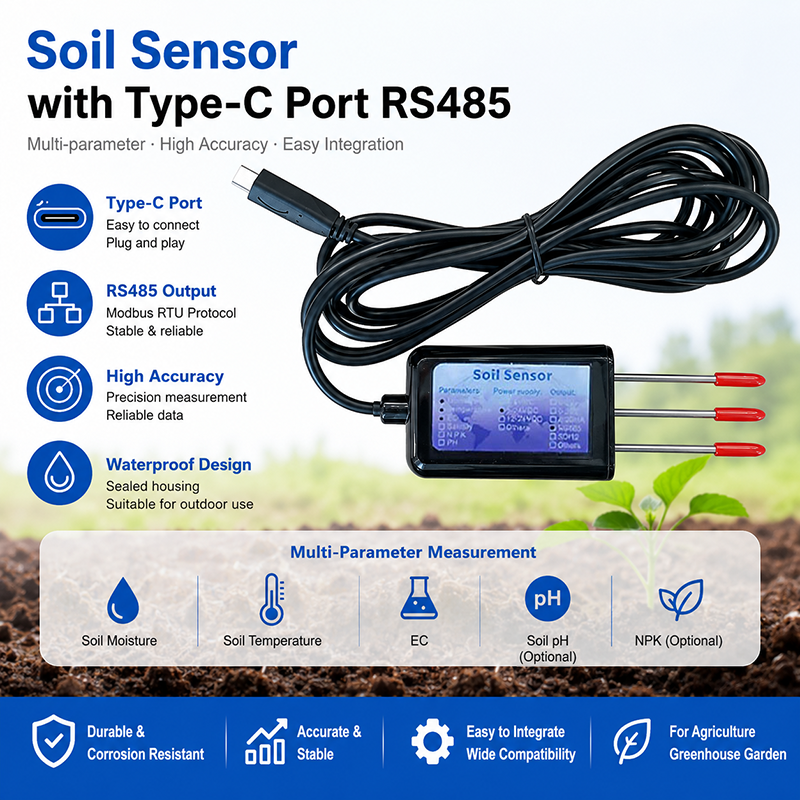
Why Type-C Matters for RS485 Soil Sensors
Integrated Hardware Bridge
The inclusion of an internal USB-to-TTL/RS485 bridge chip means no external RS485-to-USB converters are required, reducing hardware overhead.
Direct PC Connectivity
Standardizes the interface between rugged field sensors and modern computing hardware, enabling immediate “plug-and-play” functionality for configuration.
Rapid Data Validation
Allows for instantaneous feedback via standard server software, ensuring the device is calibrated and operational before permanent field installation.
Simplified Debugging
Enables engineers to quickly verify Hexadecimal response strings and adjust communication parameters without disrupting established field wiring loops.
Technical Specifications & Entity Graph Data
| Feature | Specification Details |
|---|---|
| Sensor Types | 3-in-1 Soil Monitor (Temp, EC, Moisture); Capsule Soil Temperature Sensor |
| Interface | Integrated Type-C Port (Internal USB-to-RS485 Bridge) |
| Protocol | Standard Modbus RTU / RS485 |
| Baud Rate | User-configurable via Comport settings |
| Data Configuration | 8 Data Bits, 1 Stop Bit, Parity: None |
| Communication Format | Hexadecimal Instruction Strings (Modbus RTU Command Frames) |
| Hardware Design | Ruggedized integrated housing for industrial field deployment |
Step-by-Step Guide: Testing Your Soil Sensor via PC
1
Insert
Connect the soil sensor directly to your PC’s USB port using a standard Type-C cable.
2
Launch
Open your preferred Modbus polling software and select the identified Comport.
3
Configure & Send
Set parameters to 8-1-None and transmit Hexadecimal command frames.
4
Verify
Observe the Hexadecimal data packets representing real-time physical values.
Professional Experience: The Honde Technology Edge
At Honde Technology, our engineers integrated the Type-C port specifically to solve the “configuration bottleneck” often encountered with traditional RS485 devices. In the past, testing a sensor required external power supplies and wiring converters before a single data point could be verified. By embedding the bridge chip directly into our 3-in-1 and Capsule-type monitors, we have removed this friction. Our lab tests ensure that once a Hexadecimal instruction string is sent to the comport, the feedback is instantaneous. This architecture allows our B2B clients to move from unboxing to full-scale data analysis in minutes, providing a significant ROI advantage in large-scale agricultural deployments.
Conclusion & B2B Call to Action
The integration of Type-C ports into RS485 soil sensors represents a major advancement in making industrial-grade environmental monitoring more accessible. By combining the reliability of the Modbus RTU protocol with the convenience of modern consumer interfaces, Honde Technology provides a future-proof solution for smart agriculture and environmental research.
Request a technical datasheet or get a custom quote for your project today.
- Company Name: Honde Technology Co., Ltd.
- Website: www.hondetechco.com
- Email: info@hondetech.com
Post time: Jul-08-2026