

Date: June 10, 2026
Keywords: Wastewater Monitoring System, Online COD BOD Sensor, MLSS Suspended Solids Probe, Industrial Effluent Monitoring, Auto-cleaning Water Sensor, RS485 Modbus Water Quality.
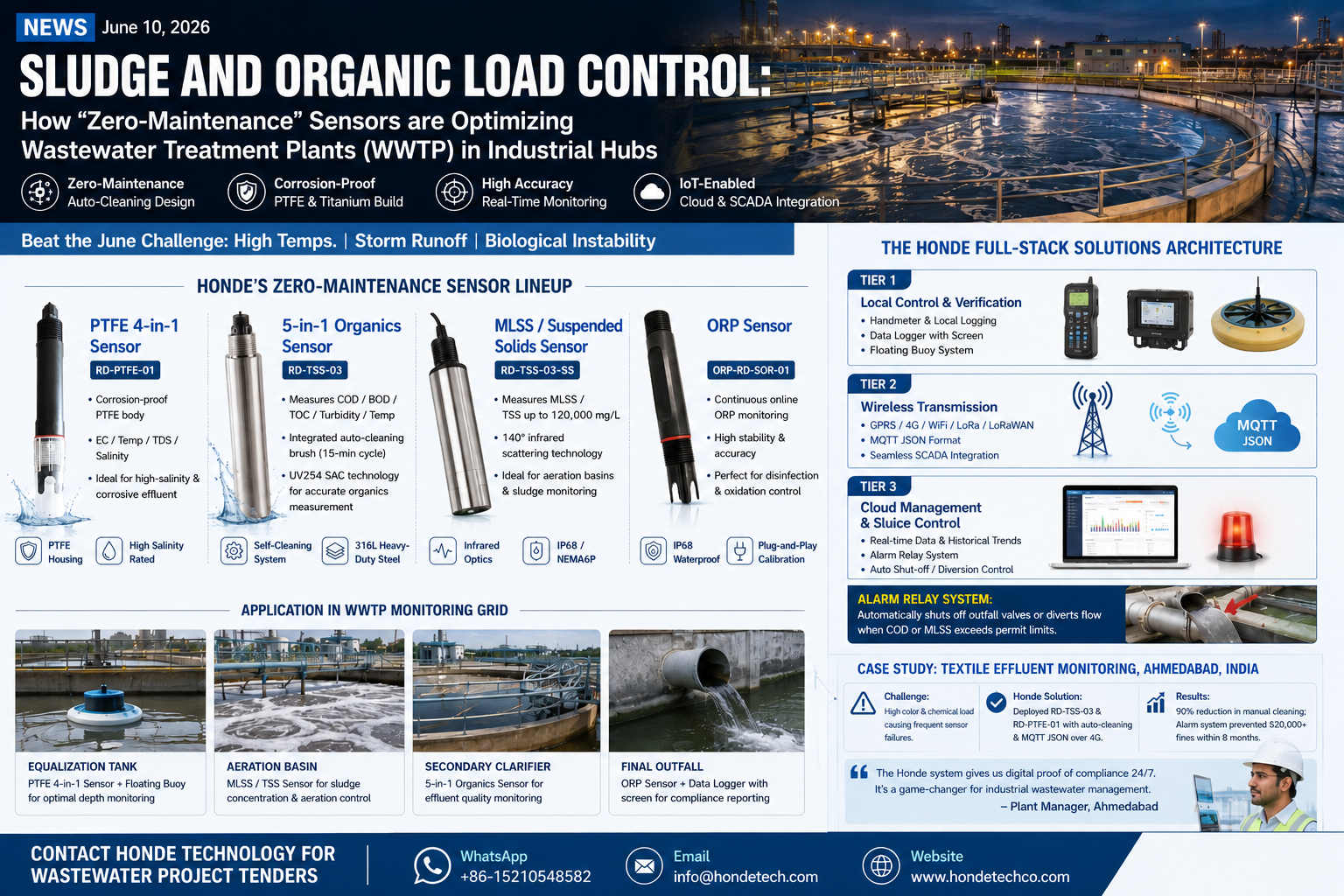
The June Challenge: Peak Loads and Biological Instability
In June 2026, many industrial clusters in India (Ganges Basin), Vietnam (Binh Duong), and Thailand (Chonburi) are facing a dual pressure: High Ambient Temperatures accelerating microbial activity in aeration basins, and Pre-monsoon Storms causing sudden influxes of industrial runoff. For wastewater treatment plant (WWTP) managers, maintaining the delicate balance of the Activated Sludge Process is the difference between legal compliance and massive environmental fines.
The Engineering Bottleneck:
Traditional sensors in wastewater fail not due to electronics, but due to Bio-fouling and Corrosion. In organic-rich sewage, a sensor without cleaning becomes “blind” within 48 hours. Furthermore, high acidity in chemical wastewater can melt standard plastic probes.
The Honde Perception Layer: Hardened for Harsh Environments
Based on Honde’s latest Wastewater Monitoring Solutions, we have deployed a “Corrosion-Proof & Self-Cleaning” sensing shield:
1 The PTFE (Teflon) 4-in-1 Probe (RD-PTFE-01)
Specifically designed for high-salinity and corrosive industrial effluent.
- The Material Edge: The entire probe body is encased in PTFE (Teflon), providing near-total resistance to acids, bases, and organic solvents that would destroy typical sensors.
- Parameters: Simultaneously tracks EC, Temperature, TDS, and Salinity, crucial for managing “Zero Liquid Discharge” (ZLD) recovery loops.
2 The Multi-Parameter Organic Sensor (RD-TSS-03)
Utilizing the UV254 SAC (Spectral Absorption Coefficient) principle to measure organic load without chemicals.
- 5-in-1 Integration: Instantaneously provides COD, BOD, TOC, Turbidity, and Temperature.
- Maintenance-Free: Features an Integrated Automatic Cleaning Brush that wipes the optical window at a 15-minute cycle, ensuring bio-fouling never drifts the data.
3 Industrial MLSS / Suspended Solids (RD-TSS-03-SS)
Designed for aeration basins, this probe tracks Mixed Liquor Suspended Solids (MLSS) up to 120,000 mg/L. It uses 140° infrared scattering to provide accurate sludge concentration data, essential for optimizing pump cycles and aeration energy use.
The Honde Full-Stack Solutions Architecture
Managing a complex industrial WWTP requires more than just raw data; it requires a tiered operational architecture:
Tier 1: Local Control & Verification
- Handmeter & Local Logging: Maintenance teams utilize our Handmeter for rapid cross-verification during daily rounds.
- Local Terminals: Discharge outfalls are equipped with our Data Logger with screen, providing local operators with real-time graphs and 30-day historical trends on-site without needing cloud access.
- In-Pit Deployment: For equalization tanks or large settling ponds, the Floating Buoy system is utilized to keep the multi-parameter probes suspended at the optimal sampling depth, ensuring the Automatic cleaning brush remains active to handle high solids.
Tier 2: The Wireless Nervous System (Transmission)
- Industrial-Ready Connectivity: Data is transmitted from remote outfalls using GPRS/4G/WIFI/LORA/LORAWAN wireless modules.
- The MQTT Logic: For industrial integrators, data is transmitted in MQTT Json format. This ensures the effluent data feeds directly into the factory’s SCADA system or the national pollution control platform without custom drivers.
Tier 3: Cloud Management & Sluice Control (The Safety Loop)
- All data is centralized on the Cloud server and software, visualizing the real-time data and history data of the entire facility’s organic and sludge load.
- The Alarm Relay System: This is the critical ROI tool. If COD or MLSS levels spike beyond the legal discharge permit, the platform triggers an Alarm Relay system to automatically shut off the outfall valve or divert the flow to an emergency buffer tank—preventing a potential $20,000 environmental fine in one single event.
Real-World Case Study: Textile Effluent Monitoring in Ahmedabad, India
A major textile dyeing facility in Ahmedabad required a 24/7 monitoring grid to comply with the Central Pollution Control Board (CPCB) mandates. The high color and chemical load of their wastewater had previously caused sensors to fail within weeks.
The Honde Intervention:
Installed the RD-TSS-03 COD/BOD 5-in-1 Sensor and RD-PTFE-01 Corrosion-Proof EC Sensor.
The Automatic cleaning brush reduced manual cleaning visits by 90%. Using the MQTT Json format over 4G, the factory owner was able to show real-time “Digital Proof” of compliance to inspectors via the Honde Cloud Platform.
Within 8 months, the Alarm Relay System saved the facility twice by automatically halting discharge during a treatment plant malfunction, avoiding severe legal penalties.
Contact Honde Technology for Wastewater Project Tenders
For more sensor information and customized IoT solutions, please contact Honde Technology Co., LTD.
Post time: Jun-18-2026