

Introduction: The Power of Integrated LoRaWAN Monitoring
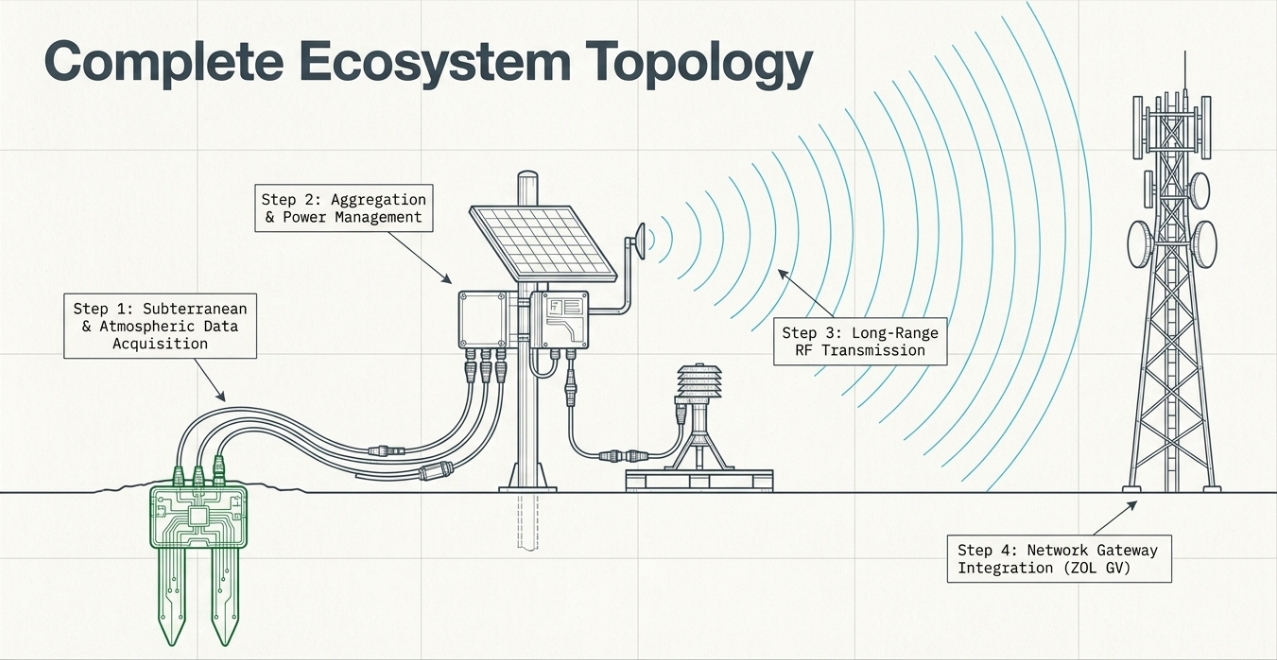
The Integrated LoRaWAN Monitoring System is a professional-grade, turnkey solution engineered to mitigate infrastructure limitations in remote or off-grid topographies. This system converges high-precision environmental sensing with energy-independent telemetry, utilizing a solar-powered LoRaWAN collector equipped with an internal rechargeable battery. By integrating an 8-in-1 soil sensor (Moisture, Temp, EC, N, P, K, and pH) and a 3-in-1 air sensor (Temp, Humidity, and Illumination), it provides comprehensive subterranean and atmospheric insights. This architecture eliminates connectivity gaps, enabling real-time, data-driven decision-making for precision agriculture and environmental conservation.
Deep Dive: The Soil 8-in-1 and Air 3-in-1 Sensor Capabilities
Agricultural Data Accuracy with the Soil 8-in-1 Sensor
Achieving optimal crop yields requires granular visibility into the rhizosphere. The system utilizes a high-precision 8-in-1 probe to monitor the biochemical and physical state of the soil. These parameters are essential for closed-loop irrigation and nutrient management:
- ●Volumetric Water Content (Moisture): Critical for precision irrigation scheduling and water conservation.
- ●Soil Temperature: Monitors thermal conditions affecting seed germination and microbial activity.
- ●Electrical Conductivity (EC): Measures soil salinity and total dissolved solids.
- ●Nitrogen (N), Phosphorus (P), and Potassium (K): Direct quantification of primary macronutrients for targeted fertilization.
- ●Soil pH: Essential for assessing nutrient bioavailability and soil health trends.
Environmental Monitoring via the Air 3-in-1 Sensor
To account for the impact of microclimates on crop transpiration and disease vectors, the system incorporates an integrated atmospheric sensing suite. The air sensor is mounted via a specialized install pallet to ensure stable field placement.
- ●Air Temperature: Tracks growing degree days (GDD) and identifies frost or heat stress risks.
- ●Relative Humidity: A primary metric for disease forecasting and calculating Vapor Pressure Deficit (VPD).
- ●Illumination (Light Intensity): Quantifies solar radiation levels to optimize planting density and monitor photosynthetic potential.
Technical Specifications: LoRaWAN Collector and Power System
The hardware is designed for long-term reliability in harsh agricultural environments, featuring a modular interface and robust power management.
| Feature | Technical Description |
|---|---|
| Model Designation | Integrated LoRaWAN Node |
| Power Management | Integrated solar harvesting panel with internal high-capacity rechargeable battery. |
| Network Protocol | LoRaWAN; optimized for long-range, low-power wide-area network (LPWAN) telemetry. |
| Sensor Interface | Dual high-reliability waterproof connectors; non-sequential “plug-and-play” architecture. |
| Field Activation | One-touch physical toggle switch for immediate system initialization. |
| Mounting Hardware | Specialized install pallet included for secure air sensor positioning. |
| Provisioning | Device-specific QR code for rapid UID/EUI input into the LoRaWAN network server. |
| Diagnostic Port | RS485-compatible port for local parameter configuration and manual charging. |
Implementation Guide: Setting Up Your Remote Monitoring Node
Deploying node follows a streamlined engineering workflow designed for rapid field mobilization and high E-E-A-T (Experience, Expertise, Authoritativeness, and Trustworthiness) standards.
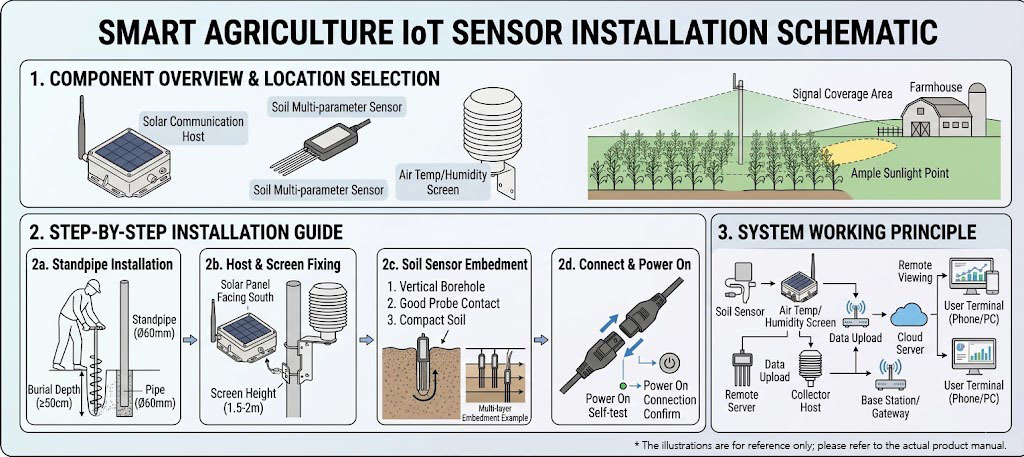
- 1 Mount the air sensor using the provided install pallet to ensure atmospheric exposure is unobstructed.
- 2 Attach the high-gain LoRaWAN antenna to the primary collector terminal to establish the wireless uplink.
- 3 Interface the soil 8-in-1 and air 3-in-1 sensors with the collector’s dual waterproof connectors. The system architecture supports non-sequential connection; either sensor may be linked to either port.
- 4 Activate the node by engaging the physical toggle switch. Deployment is confirmed by the system’s immediate entry into its broadcast cycle.
- 5 Provision the device by scanning the integrated QR code, which automates the input of hardware profiles and calibration data into the management gateway.
- 6 Verify local signal strength and data integrity; if field adjustments are required, the RS485-to-USB spare cable can be utilized for local polling.
Troubleshooting and Maintenance: Insights from the Field
The included RS485-to-USB spare cable is a vital diagnostic tool for Senior IoT Architects. Beyond its utility as a secondary charging method for units stored in low-light conditions, this cable serves as a diagnostic bridge. If a node fails to report, use the cable to connect the sensor directly to a PC. This allows for local sensor polling and Modbus-level debugging, enabling you to isolate whether a fault exists within the sensor transducer or the LoRaWAN transmission node itself. This bypass method is essential for field-level parameter configuration and firmware verification.
Conclusion and Strategic Implementation
The integration of the LoRaWAN solution offers a high-ROI pathway for modern agricultural enterprises by reducing the total cost of ownership (TCO) associated with field sensing. Honde Technology Co., Ltd. provides a robust hardware ecosystem that simplifies the complexities of remote telemetry. By consolidating soil and atmospheric monitoring into a single, solar-autonomous node, operators gain the actionable intelligence required for large-scale precision farming.
For technical inquiries regarding custom sensor integration or to request a project-specific quotation, please visit our website or contact our solutions architecture team.
Company Information & Contact
Post time: May-06-2026