

1. Introduction: Intelligent Water Governance for Effluent Compliance
European wastewater treatment plants (WWTPs) must achieve strict effluent compliance to satisfy the mandates of the EU Urban Wastewater Treatment Directive (UWWTD). Modern “Intelligent Water Governance” relies on the integration of high-precision, non-contact radar flowmeters and multi-parameter digital sensors. By utilizing reagent-free optical analysis and radar-based metrics, Honde Technology provides industry-standard solutions for real-time monitoring of final effluent, ensuring continuous regulatory compliance and avoiding heavy fines in even the most aggressive industrial wastewater environments.
2. The Challenge: Why Conventional Monitoring Fails in Corrosive Outfalls
In my years consulting on European infrastructure, I have observed that standard contact-based sensors consistently fail when subjected to the requirements of the Industrial Emissions Directive (IED). European sewage outfalls present a perfect storm of “pain points” for engineering teams:
- ⚠ Corrosive Gases: High concentrations of hydrogen sulfide (H2S) rapidly degrade metallic components and standard electronics.
- ⚠ Physical Obstructions: Thick sludge and variable surface debris can snag or bury submerged sensors, causing measurement drift.
- ⚠ Steam and Foam Interference: Traditional ultrasonic sensors frequently “blind” in these conditions, as acoustic signals are absorbed by foam or refracted by dense steam.
- ⚠ Maintenance Risks: Entering confined spaces for sensor cleaning or calibration presents significant safety hazards, necessitating a shift toward non-contact solutions.
3. Solution Part 01: Precision Non-Contact Flow & Level Monitoring
To ensure effluent compliance, we prioritize non-contact radar technology that measures flow and level from a safe distance above the water line, remaining immune to surface conditions.
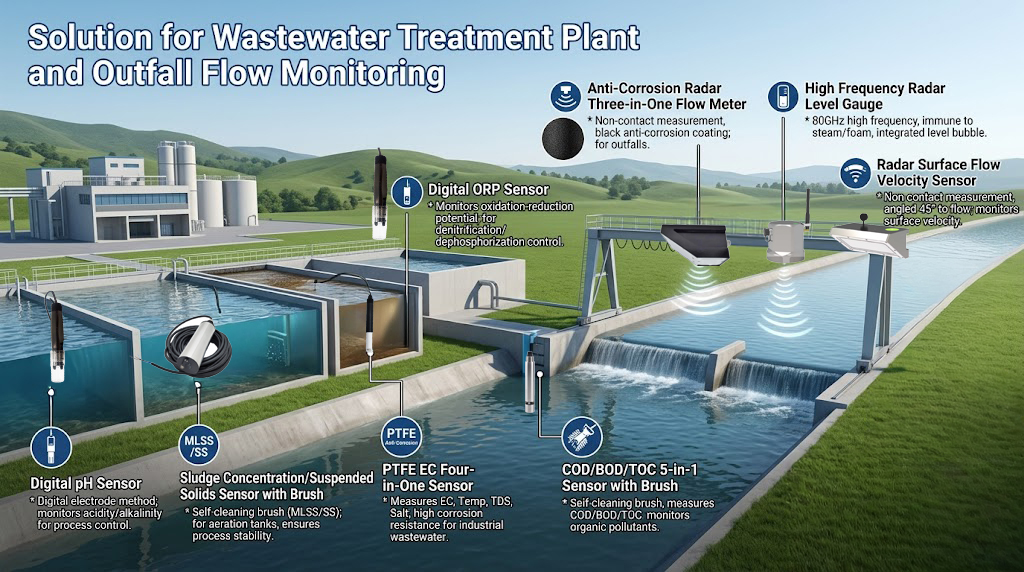
- ▴ Anti-Corrosion Radar 3-in-1 Flowmeter (RD-600S-02): Specifically engineered for sewage outfalls, this unit features a specialized black anti-corrosion coating. It utilizes hybrid radar (24GHz for velocity and 60GHz for level) to calculate total flow. Its IP68-rated housing includes built-in Bluetooth, allowing for smart setup and debugging via mobile devices without requiring confined-space entry.
- ▴ High-Frequency Radar Level Meter (RD-RWL30-Z-02): This 80GHz microstrip array antenna provides an ultra-narrow beam capable of piercing through volatile gases and thick surface foam—a critical advantage over ultrasonic alternatives. It features a design life of over 5 years and an extended measuring range of up to 80m for deep pump stations.
- ▴ Radar Surface Velocity Sensor (RD-200-01): Designed for high-velocity tracking in open channels, this 24GHz K-Band sensor handles ranges up to 20m/s. It features smart bi-directional recognition and automatically corrects for installation angles to ensure data integrity during sudden flow spikes.
4. Comparison Table: Core Technical Parameters of Radar Sensors
| Model | Primary Function | Technical Highlight | Protection / Safety |
|---|---|---|---|
| RD-600S-02 | 3-in-1 Flow Monitoring | 24GHz/60GHz Hybrid Radar; Bluetooth Debugging | IP68; Anti-Corrosion Coating |
| RD-RWL30-Z-02 | Level Measurement | 80GHz Frequency; Customizable 80m Range | IP68; Integrated Spirit Level |
| RD-200-01 | Surface Velocity | 20m/s Range; Bi-Directional Recognition | IP68; 6KV Lightning Protection |
5. Real-Time Water Quality Sensing for Effluent Compliance
Beyond flow volume, the chemical composition of the discharge must be monitored continuously. We utilize digital sensors that bridge the gap between process control and environmental reporting.
- ⬤ 5-in-1 COD/BOD/TOC/Turbidity/Temp Sensor (RD-WQ-COD-01): This sensor utilizes the reagent-free UV254 absorption method for instant organic load analysis. Constructed from rugged 316L stainless steel, it includes an optical anti-fouling brush to prevent biofilm buildup.
- ⬤ Turbidity & MLSS/TSS Sensor (RD-TSS-03): Equipped with a high-frequency motorized wiper, this sensor monitors Mixed Liquor Suspended Solids (MLSS) in aeration tanks or Total Suspended Solids (TSS) at final outfalls to ensure process stability.
- ⬤ PTFE 4-in-1 Multi-Parameter Sensor (RD-PTFE-01): For highly aggressive industrial wastewater, this solid Teflon (PTFE) construction provides an ultimate chemical shield while simultaneously capturing Electrical Conductivity (EC), TDS, Salinity, and Temperature.
- ⬤ Digital pH (RD-PH-WE-01) & ORP (ORP-RD-SOR-01) Sensors: These serve as the “Nutrient Removal Compass.” While pH provides baseline process control, the ORP sensor is the critical indicator for controlling denitrification and dephosphorization (phosphorus release) in anoxic and anaerobic tanks.
6. The E-E-A-T Anchor: Expert Engineering Tips for Installation
In our experience managing large-scale European IoT deployments, we’ve found that the most common failure point isn’t the sensor itself, but the physical alignment and signal management.
- 1 Alignment Precision: Always utilize the Integrated Spirit Level (standard on the RD-RWL30-Z-02) during mounting. Even a 3-degree tilt in a narrow channel can result in significant level errors.
- 2 Cable Management: When deploying sensors at multiple depths (e.g., 5m and 10m), use specialized cable clips or waterproof tape to organize vertical runs. This prevents submerged cables from becoming a snagging hazard for debris.
- 3 Signal Protocol: We strictly recommend RS485 (Modbus RTU) for all sensor outputs. This digital protocol eliminates the signal loss common with analog 4-20mA signals over the long cable runs found in large treatment facilities.
- 4 Wireless Efficiency: To reduce infrastructure costs, we deploy LoRaWAN gateways. In a typical outfall configuration, a single LoRaWAN collector can reliably handle 4 to 5 multi-parameter sensors, transmitting data wirelessly up to 300 meters to a central hub.
7. Data Ecosystem: From Sensor to HONDE Cloud
The monitoring architecture follows a robust hierarchy designed for “Intelligent Water Governance”:
- 1 Core Monitoring Units: High-precision radar and water quality sensors capture raw metrics at the source.
- 2 Wireless Transmission: Data is aggregated and sent via LoRaWAN, 4G GPRS, or WiFi.
- 3 HONDETECH Cloud Ecosystem: Our secure server provides a multi-platform view (Web/App/Tablet) for historical report analysis and automated alert notifications, ensuring you are the first to know if a discharge threshold is approached.
8. Conclusion & Call to Action
Intelligent sensing is the most effective defense against non-compliant discharge and the associated regulatory penalties. By combining non-contact radar with chemically resistant digital sensors, European industrial facilities can achieve a higher standard of environmental stewardship.
- ‣ Internal Resource: Learn more about our comprehensive Industrial IoT Water Solutions.
- ‣ Download the Catalog: [Full Wastewater & Outfall Monitoring Catalog].
- ‣ Consult an Expert: Contact our engineering team at info@hondetechco.com for a customized sensor configuration tailored to your site’s specific flow and chemical profile.
Post time: Apr-16-2026