

A modern RS485 Modbus Leaf Wetness & Temperature Sensor can continuously monitor leaf surface moisture and temperature, integrate with weather stations, IoT gateways, LoRaWAN networks, and cloud platforms, making it an essential component of precision agriculture.
If you are looking for an accurate sensor for vineyards, orchards, greenhouses, or agricultural weather stations, this guide explains everything you need to know.
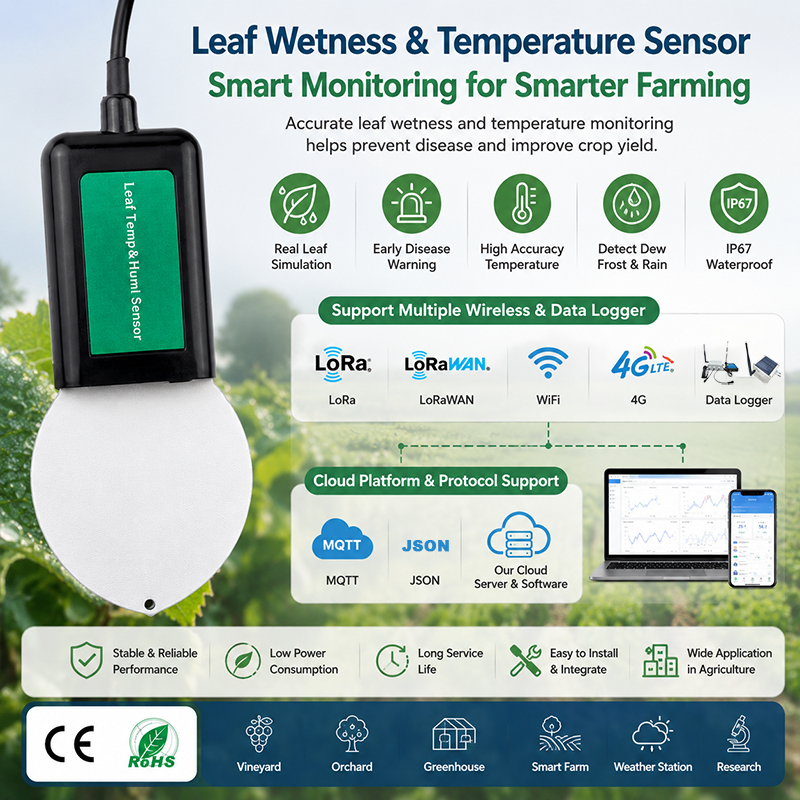
What Is a Leaf Wetness Sensor?
A Leaf Wetness Sensor is designed to simulate the surface characteristics of a natural leaf.
Instead of measuring rainfall directly, it detects the presence and duration of water on the leaf surface caused by:
- Rain
- Dew
- Irrigation
- Fog
- Frost
- Condensation
When combined with leaf temperature, air temperature, relative humidity, and solar radiation, growers can accurately predict disease infection periods.
Why Is Leaf Wetness So Important?
Many crop diseases only develop when leaves remain wet for a certain amount of time.
Examples include:
| Crop | Common Disease | Wetness Duration |
|---|---|---|
| Grapes | Downy Mildew | 6–24 hours |
| Apples | Apple Scab | 9–18 hours |
| Tomatoes | Early Blight | High humidity + wet leaves |
| Potatoes | Late Blight | Long leaf wetness period |
| Strawberries | Gray Mold | Persistent moisture |
Without monitoring leaf wetness, farmers often spray fungicides on fixed schedules, increasing costs and chemical usage.
With accurate monitoring, spraying can be performed only when disease risk is high.
How Does a Leaf Wetness Sensor Work?
Unlike ordinary humidity sensors, a leaf wetness sensor uses a specially designed sensing plate that mimics a real leaf.
It detects:
- Surface moisture
- Water film thickness
- Leaf drying process
- Leaf surface temperature
The sensor continuously sends data to a controller through RS485 Modbus RTU.
After connecting to a data logger or IoT gateway, users can remotely monitor field conditions from anywhere.
Typical communication options include:
- RS485 Modbus RTU
- LoRa
- LoRaWAN
- WiFi
- 4G LTE
- NB-IoT
- Ethernet
Key Features of Our Leaf Wetness & Temperature Sensor
High Accuracy Monitoring
The sensing surface closely simulates real plant leaves for reliable moisture detection.
Benefits
- Detect dew formation
- Monitor rainfall residue
- Measure leaf drying time
- Improve disease prediction accuracy
Built-in Temperature Measurement
Besides leaf wetness, the sensor simultaneously measures leaf temperature.
This improves disease prediction models because many fungi require both moisture and specific temperatures to infect crops.
Industrial RS485 Modbus Output
Standard RS485 Modbus RTU communication allows easy integration with:
- Agricultural weather stations
- PLC systems
- SCADA
- IoT gateways
- Environmental monitoring systems
IP67 Waterproof Housing
Designed for continuous outdoor operation.
Features include:
- UV-resistant materials
- Waterproof enclosure
- Corrosion resistance
- Long service life
Suitable for year-round deployment.
Supports Smart Agriculture IoT
The sensor can work with:
- LoRa Gateway
- LoRaWAN Network
- WiFi Data Logger
- 4G Data Logger
- MQTT
- JSON API
- Cloud Dashboard
- Mobile App
- PC Monitoring Software
Users can remotely access historical records, alarms, and real-time measurements.
Typical Applications
Leaf wetness sensors are widely used in:
- Smart Agriculture
- Precision Farming
- Agricultural Weather Stations
- Greenhouses
- Vineyards
- Orchards
- Tea Plantations
- Vegetable Farms
- Plant Disease Monitoring
- Crop Research
- Irrigation Management
Technical Advantages Compared with Traditional Monitoring
| Feature | Traditional Observation | Leaf Wetness Sensor |
|---|---|---|
| Manual inspection | Yes | No |
| Real-time monitoring | No | Yes |
| Disease prediction | Difficult | Accurate |
| Remote monitoring | No | Yes |
| Cloud integration | No | Yes |
| Historical data | Limited | Unlimited |
| Automation | No | Yes |
Why Choose an RS485 Leaf Wetness Sensor?
Industrial users prefer RS485 because it offers:
- Long communication distance
- Excellent anti-interference capability
- Stable industrial communication
- Easy PLC integration
- Low maintenance
It is the standard interface used in agricultural weather stations worldwide.
Our Experience in Smart Agriculture
At Honde Technology Co., Ltd., we have more than 15 years of experience designing environmental monitoring equipment for agriculture, meteorology, and industrial IoT.
Our engineering team has supplied thousands of monitoring systems to customers worldwide, including projects involving:
- Smart agriculture
- Greenhouse automation
- Vineyard disease monitoring
- Orchard management
- Agricultural weather stations
- Environmental monitoring
- Precision irrigation
Based on field experience, one of the most common mistakes growers make is relying only on air humidity instead of monitoring actual leaf surface conditions. Air humidity alone cannot accurately determine disease risk because pathogens depend on the presence and duration of moisture on the leaf itself.
Frequently Asked Questions
Does a leaf wetness sensor measure humidity?
No.
It measures the presence and duration of moisture on the leaf surface rather than the humidity of the surrounding air.
Can it detect dew?
Yes.
The sensor is specifically designed to detect dew formation, rainfall residue, irrigation water, and condensation.
Is it suitable for weather stations?
Absolutely.
It is widely integrated into agricultural weather stations and smart farming systems.
Does it support cloud platforms?
Yes.
Our solution supports:
- MQTT
- JSON API
- LoRa
- LoRaWAN
- WiFi
- 4G
- Data Logger
- Cloud Server
- Mobile APP
- PC Software
Industry Standards and References
When selecting environmental monitoring equipment, it is good practice to consider internationally recognized standards and guidance from organizations such as:
- International Organization for Standardization (ISO) — Environmental management and quality standards.
- International Electrotechnical Commission (IEC) — Electrical and electronic equipment standards.
- World Meteorological Organization (WMO) — Best practices for meteorological observations and environmental monitoring.
Referencing these organizations helps ensure compatibility with globally accepted monitoring practices.
Why Customers Choose Honde Technology
- Professional manufacturer with over 15 years of experience
- High-accuracy environmental monitoring sensors
- OEM & ODM services
- Global export experience
- CE & RoHS compliant products
- Complete IoT monitoring solutions
- Supports LoRa, LoRaWAN, WiFi, 4G, MQTT and JSON
- One-stop weather station solutions
Get a Custom Smart Agriculture Solution
Whether you are building a vineyard monitoring system, greenhouse automation project, orchard weather station, or precision agriculture platform, Honde Technology Co., Ltd. can provide complete hardware and cloud monitoring solutions tailored to your requirements.
Contact our technical team today to:
- Request the latest product catalog
- Download detailed specifications
- Get a customized quotation
- Discuss OEM/ODM requirements
- Build your smart agriculture solution
Post time: Jul-03-2026