

What Is a LoRa LoRaWAN RS485 Soil Sensor?
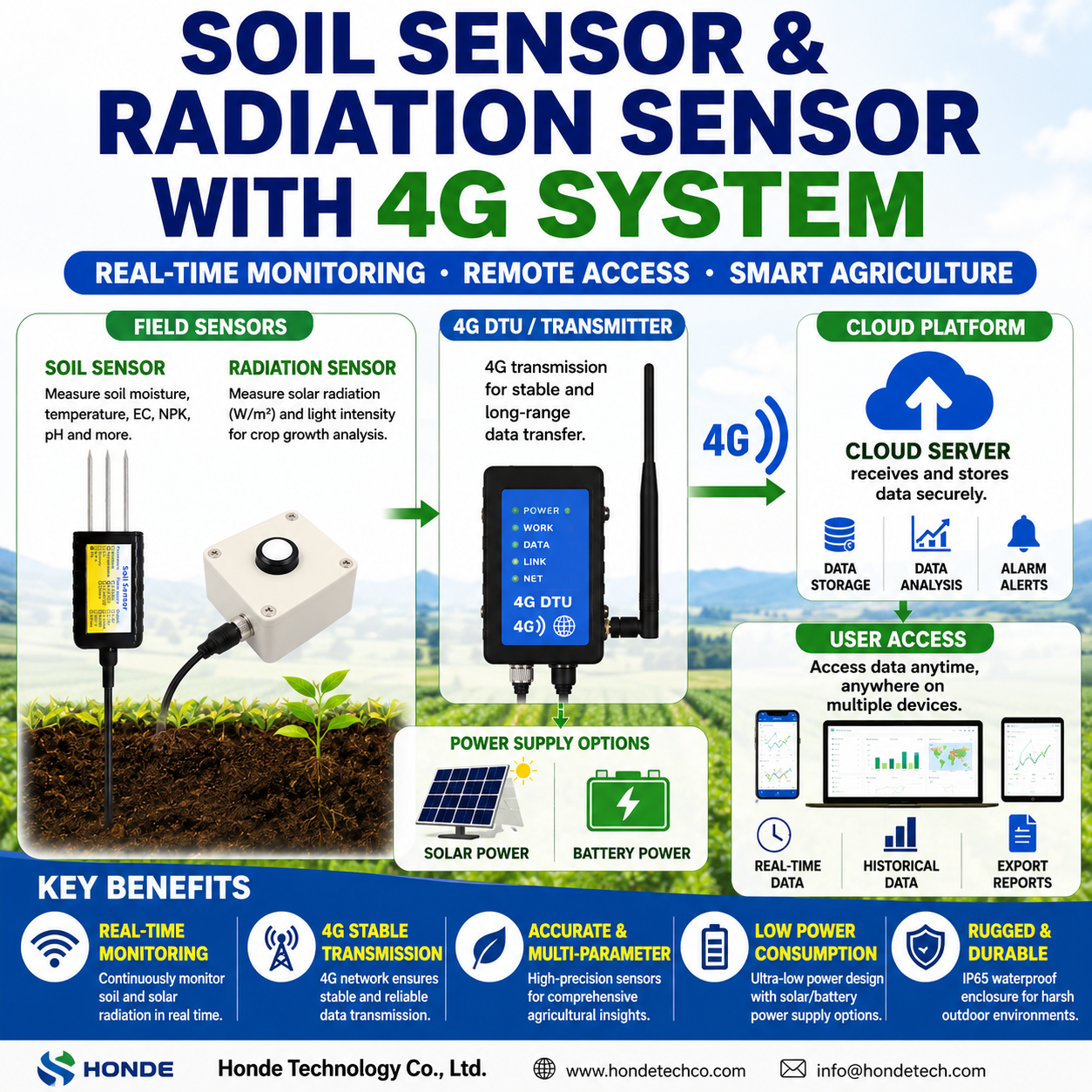
A LoRa LoRaWAN RS485 soil sensor combines multi-parameter soil measurement, industrial RS485 communication and long-range wireless connectivity into one agricultural monitoring solution. It can measure key soil conditions such as moisture, temperature, electrical conductivity (EC), salinity and, depending on configuration, NPK or pH, then transmit the collected data through LoRa or LoRaWAN networks for remote monitoring.
For precision agriculture, this architecture is valuable because it separates the system into three practical layers:
Honde Technology’s soil-monitoring products support RS485 communication and configurable wireless transmission options including LoRa, LoRaWAN, GPRS, 4G and WiFi. The company also provides matching data loggers and cloud/software solutions for remote data access.
The important point for buyers is that a professional soil monitoring project should not be evaluated only by sensor accuracy. The complete system must also provide stable communication, appropriate installation, reliable data collection and practical remote access.
Why Use LoRa LoRaWAN for Remote Soil Monitoring?
Traditional wired soil monitoring can become complicated when sensors are distributed across large agricultural areas.
Long cable runs create several challenges:
- More wiring and installation labor
- Greater exposure to physical damage
- Higher maintenance requirements
- Limited flexibility when monitoring points change
- Difficult expansion across large fields
LoRa and LoRaWAN solve part of this problem by providing long-range, low-power wireless communication.
A typical agricultural deployment can use multiple soil sensor nodes in different field locations. Each node collects soil data and transmits measurements to a central gateway or network infrastructure.
This makes LoRa/LoRaWAN particularly attractive for:
- Large farms
- Orchards
- Vineyards
- Greenhouses
- Irrigation zones
- Agricultural research stations
- Environmental monitoring sites
Honde’s product range includes LoRa/LoRaWAN RS485 soil sensors designed for remote soil monitoring, with emphasis on long-range transmission, low power consumption and compatibility with agricultural IoT systems.
What Soil Parameters Can Be Measured?
The required parameters depend on the crop, soil type and agricultural management strategy.
Soil Moisture
Soil moisture is one of the most important variables for irrigation management. Continuous measurement can help determine:
- Whether the root zone contains sufficient water
- When irrigation should begin
- Whether irrigation has penetrated deeply enough
- How quickly soil dries after irrigation
- Differences between irrigation zones
Honde’s soil sensors include models capable of measuring volumetric soil moisture, with one 4-in-1 model specifying a measurement range of 0–100% V/V and an accuracy of ±2% V/V.
Soil Temperature
Soil temperature affects root development, microbial activity and crop growth. Combining soil temperature with moisture measurements gives growers more context than either measurement alone.
Electrical Conductivity (EC)
EC is widely used as an indicator related to dissolved salts and soil fertility conditions. For example, Honde’s 4-in-1 soil sensor specifies an EC range of 0–20,000 μS/cm, with model-dependent accuracy.
Salinity
Salinity monitoring becomes particularly important in:
- Irrigated agriculture
- Greenhouses
- Arid regions
- Coastal agricultural areas
- High-value crop production
Tracking salinity over time can help identify changes that may otherwise remain invisible during manual inspection.
NPK and pH
For more advanced agricultural applications, multi-parameter sensors can also be configured to measure nitrogen, phosphorus, potassium and pH. Honde’s 7-in-1 soil sensor, for example, combines soil moisture, temperature, EC, salinity and NPK measurements.
LoRa Soil Sensor vs. RS485 Soil Sensor: What Is the Difference?
One of the most common questions from system integrators is whether they should purchase a standard RS485 sensor or a wireless LoRa/LoRaWAN sensor. The answer depends on the system architecture.
| Feature | RS485 Soil Sensor | LoRa/LoRaWAN RS485 Soil Sensor |
|---|---|---|
| Soil measurement | ✓ | ✓ |
| Modbus-RTU | ✓ | ✓ |
| Long-range wireless | No | ✓ |
| Cable requirement | Higher | Lower |
| Large field deployment | Possible | More suitable |
| Multi-point networking | ✓ | ✓ |
| Gateway required | Usually not | Usually |
| Low-power remote operation | Good | Excellent |
| Cloud connectivity | Through external equipment | Through gateway/network |
| Best application | Local wired system | Distributed IoT monitoring |
The key distinction is that RS485 describes the sensor’s communication interface, while LoRa/LoRaWAN describes the wireless communication layer. This means RS485 and LoRa are not necessarily competing technologies. They can work together.
For example:
This modular architecture gives system integrators considerably more flexibility.
How Does a Wireless Soil Monitoring System Work?
A complete agricultural IoT monitoring system normally contains four layers.
1 Soil Sensor Layer
Sensors are installed at selected monitoring points to measure soil parameters. Depending on the project, the system can include:
- Soil moisture sensors
- Soil temperature sensors
- EC sensors
- Salinity sensors
- NPK sensors
- pH sensors
2 Data Collection Layer
RS485/Modbus provides a stable industrial communication interface between the sensor and data acquisition equipment. For larger projects, multiple sensors can be connected to a centralized RS485 data collector. Honde offers an RS485 data collector with multiple sensor ports and supports applications including soil sensors, water-quality sensors, weather stations, gas sensors and water-level sensors.
3 Wireless Transmission Layer
The collected data can then be transmitted through:
- LoRa
- LoRaWAN
- 4G
- GPRS
- WiFi
The best technology depends on the project. For example:
LoRa/LoRaWAN: large-area, low-power sensor networks
4G: remote locations with reliable cellular coverage
WiFi: farms, greenhouses or facilities with existing WiFi
RS485: short-to-medium-distance wired sensor networks
Honde’s soil sensor products support these communication options through configurable modules.
4 Cloud and Software Layer
The final objective is not simply collecting data. It is making the data useful. A complete monitoring platform can provide:
- Real-time data
- Historical records
- Data curves
- Remote access
- Alarm notifications
- Data export
- Multi-site management
Honde’s soil sensor systems can be matched with software for online monitoring, while selected configurations support data logging to storage devices for later download.
How Many Soil Sensors Do You Need for a Farm?
There is no universal number. Sensor quantity should be determined by soil variability, crop type, irrigation zones and monitoring objectives. A practical approach is to divide the farm into management zones.
| Farm Condition | Suggested Monitoring Strategy |
|---|---|
| Small greenhouse | 1–3 representative points |
| Uniform field | Several representative zones |
| Large field | Multiple distributed monitoring nodes |
| Different soil types | At least one node per major soil zone |
| Different irrigation areas | One or more nodes per irrigation zone |
| Research project | Higher sensor density for spatial analysis |
The objective is not to install the maximum number of sensors. The objective is to obtain representative data from the areas that matter.
Why Multi-Parameter Soil Monitoring Is Better Than Moisture-Only Monitoring
A moisture-only sensor answers one question:
How much water is in the soil?
A multi-parameter sensor provides a broader answer:
What is happening to the soil environment?
Consider this example:
| Parameter | What It Can Tell You |
|---|---|
| Moisture | Water availability |
| Temperature | Root-zone thermal condition |
| EC | Electrical conductivity / salt-related condition |
| Salinity | Salt accumulation trend |
| NPK | Nutrient-related information |
| pH | Soil acidity/alkalinity |
When these parameters are collected continuously, farmers and researchers can identify relationships that are difficult to observe through manual sampling. This is one reason Honde’s multi-parameter soil sensors combine several measurements into a single device.
What Should Buyers Check Before Purchasing a LoRaWAN Soil Sensor?
For B2B buyers, the following checklist is more important than simply asking for the lowest unit price.
1 Measurement Parameters
First determine exactly what you need:
- Moisture
- Temperature
- EC
- Salinity
- NPK
- pH
Do not pay for unnecessary parameters if the project only requires moisture and temperature.
2 Measurement Accuracy
Ask the supplier for:
- Measurement range
- Accuracy
- Resolution
- Calibration method
- Applicable soil conditions
For example, Honde’s 4-in-1 model publishes specific moisture, EC and salinity ranges and accuracy specifications rather than only describing the sensor as “high precision.”
3 Communication Protocol
For system integration, verify whether the sensor supports:
RS485 + Modbus-RTU
This is particularly important when connecting third-party gateways, PLCs, data loggers or agricultural control systems. Honde’s 4-in-1 soil sensor specifies RS485 with the standard Modbus-RTU protocol.
4 Wireless Network
Choose the communication technology based on the deployment.
| Project Requirement | Recommended Technology |
|---|---|
| Long-range low-power network | LoRa / LoRaWAN |
| Cellular remote monitoring | 4G |
| Existing local network | WiFi |
| Existing legacy cellular network | GPRS |
| Wired industrial integration | RS485 |
5 Waterproof Protection
Outdoor soil sensors must withstand continuous exposure to soil moisture and rain. For example, Honde’s 7-in-1 soil sensor is specified with IP68 waterproof protection and is designed for continuous buried monitoring.
6 Data Logger and Cloud Platform
A sensor is only one component. Ask whether the supplier can provide:
- Data logger
- Gateway
- Wireless module
- Cloud server
- PC software
- Mobile access
- Data export
- MQTT/API integration
This becomes especially important for system integrators managing hundreds of monitoring nodes.
Common Mistakes When Selecting a Wireless Soil Sensor
Mistake 1: Choosing Only by Sensor Accuracy
A sensor with excellent laboratory accuracy is not necessarily the best choice for a remote farm. The complete system must also consider:
- Installation
- Communication
- Power
- Data storage
- Maintenance
- Environmental protection
Mistake 2: Ignoring Communication Distance
A wired RS485 sensor may work perfectly inside a greenhouse but become inconvenient across a large outdoor farm. For distributed monitoring points, wireless architecture can substantially simplify deployment.
Mistake 3: Forgetting Modbus Compatibility
If the sensor must communicate with an existing PLC, gateway or agricultural controller, protocol compatibility should be confirmed before purchasing.
Mistake 4: Buying a Sensor Without a Data Strategy
Ask where the data will go. A professional project should have a clear data path:
Sensor → Collector → Wireless Network → Server → Dashboard
Mistake 5: Selecting Too Many Parameters
More parameters do not automatically mean a better system. If the application only requires irrigation control, moisture and temperature may be sufficient. If the project involves soil fertility research, EC, salinity, NPK and pH may become more important.
Honde Technology’s Wireless Soil Monitoring Ecosystem
Honde Technology Co., Ltd. was founded in 2011 and focuses on IoT products and solutions for smart water equipment, smart agriculture and smart environmental protection. Its applications include soil monitoring, agricultural environmental monitoring, water-level monitoring, greenhouse monitoring and other IoT projects.
For agricultural monitoring, Honde can combine:
- Multi-parameter soil sensors
- RS485/Modbus communication
- LoRa/LoRaWAN modules
- 4G/GPRS/WiFi connectivity
- Data collectors
- Data loggers
- Cloud servers
- PC/mobile monitoring
This modular approach allows the sensor configuration to be adjusted according to the actual project rather than forcing every customer into one fixed hardware configuration. Honde’s product pages specifically describe customizable wireless modules and matched server/software solutions.
Example: Building a Remote LoRaWAN Soil Monitoring Network
Imagine a farm divided into five irrigation zones. Each zone contains several soil monitoring points. A possible architecture would be:
The advantage is scalability. Instead of installing a dedicated long cable from every monitoring point back to a central control room, distributed sensor nodes can communicate wirelessly. For large-scale agricultural projects, this can simplify installation and make future expansion easier.
LoRa vs. LoRaWAN: Which One Should You Choose?
The terms are often confused. LoRa generally refers to the long-range radio communication technology. LoRaWAN refers to a networking protocol and architecture built around LoRa radio technology.
| Feature | LoRa | LoRaWAN |
|---|---|---|
| Radio technology | ✓ | ✓ |
| Long range | ✓ | ✓ |
| Low power | ✓ | ✓ |
| Network protocol | Basic | Standardized network architecture |
| Multi-node management | Possible | Strong |
| Cloud IoT integration | Depends on system | More structured |
| Best for | Private point-to-point/custom networks | Scalable IoT deployments |
For a small private agricultural monitoring project, a customized LoRa architecture may be sufficient. For a large multi-node deployment, LoRaWAN can provide a more structured IoT network architecture.
Applications of LoRa Wireless Soil Sensors
Precision Agriculture
Monitor soil moisture and environmental conditions to improve irrigation decisions.
Greenhouse Management
Track soil moisture, temperature and fertility-related parameters continuously.
Orchard and Vineyard Monitoring
Distributed wireless nodes can monitor different planting zones without extensive field wiring.
Agricultural Research
Collect long-term datasets for soil-water-plant relationship analysis.
Environmental Monitoring
Soil sensors can be combined with water-level, weather and radiation sensors for broader environmental observation. Honde’s environmental engineering and hydrology portfolio includes soil moisture, water level, rainfall, flow and data-logging equipment for integrated monitoring applications.
FAQ: LoRa LoRaWAN RS485 Soil Sensor
Q: What does RS485 do in a soil sensor?
RS485 provides a robust wired communication interface between the sensor and a data collector, gateway or controller. Honde’s RS485 soil sensors can use Modbus-RTU for system integration.
Q: Can an RS485 soil sensor work with LoRa?
Yes. RS485 can be used as the local sensor interface while a LoRa or LoRaWAN module provides wireless transmission.
Q: Can one sensor measure multiple soil parameters?
Yes. Depending on the model, multi-parameter sensors can measure moisture, temperature, EC, salinity and additional parameters such as NPK or pH.
Q: Can the data be viewed remotely?
Yes. Honde offers configurations with wireless transmission and matched server/software systems for real-time monitoring on PC or mobile devices.
Q: Is the sensor suitable for outdoor installation?
Yes. Selected Honde soil sensor models are designed for long-term outdoor or buried deployment, with models such as the 7-in-1 sensor specified at IP68 protection.
Q: Can Honde customize the wireless communication?
Yes. Honde product documentation describes configurable LoRa, LoRaWAN, GPRS, 4G and WiFi wireless modules.
Conclusion: Choose the Complete IoT Soil Monitoring System
A modern agricultural soil sensor should not be viewed as an isolated measuring device. The real value comes from connecting:
Accurate Soil Measurement + RS485/Modbus + LoRa/LoRaWAN + Data Logging + Cloud Monitoring
For buyers, the most important selection criteria are:
- Required soil parameters
- Measurement accuracy and range
- RS485/Modbus compatibility
- LoRa or LoRaWAN network architecture
- Wireless transmission distance
- Power consumption
- Waterproof protection
- Data logger capability
- Cloud/software integration
- OEM/ODM customization
Honde Technology combines sensor hardware, data acquisition, wireless communication and software capabilities to help international agricultural customers build customized soil monitoring systems rather than simply purchasing a standalone sensor.
Ready to Build Your Wireless Soil Monitoring Project?
If you are sourcing a LoRa LoRaWAN RS485 soil sensor, wireless soil monitoring system or customized agricultural IoT solution, contact Honde Technology with your project requirements.
Tell our engineering team:
- Required soil parameters
- Number of monitoring points
- Communication method
- Required sensor cable length
- Power supply
- Installation depth
- Cloud/server requirements
- Target quantity
- Destination country
We can help you select the appropriate soil sensor, wireless module, data collector, datalogger and software architecture for your application.
Post time: Aug-24-2026