

What Is a LoRa Weather Station With a Rainfall Sensor?
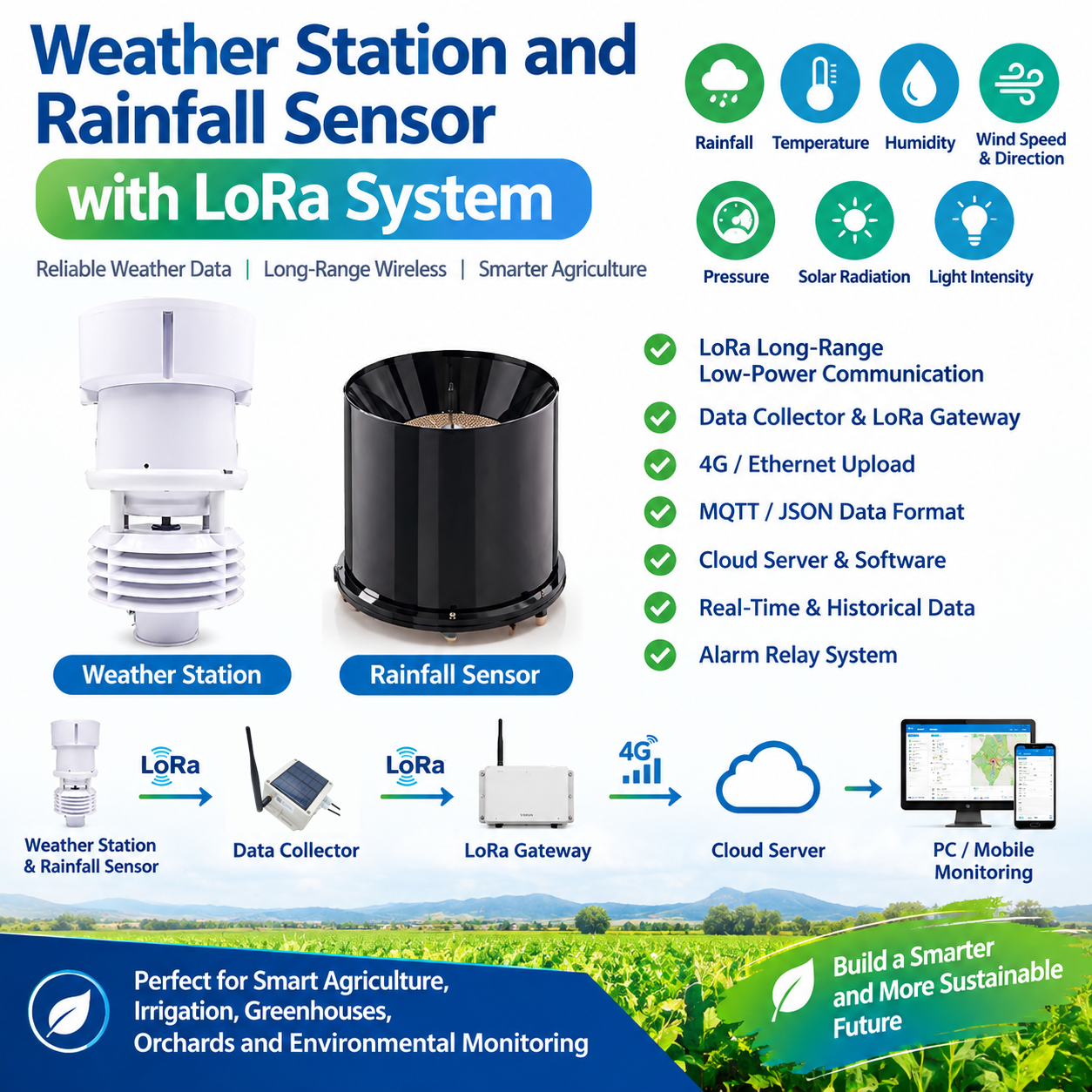
A LoRa weather station with a rainfall sensor is a wireless environmental monitoring system designed to collect weather data from remote locations and transmit it over a low-power LoRa network.
For agricultural and environmental projects, the system can monitor key parameters such as rainfall, air temperature, air humidity, wind speed, wind direction, atmospheric pressure, solar radiation, and light intensity, depending on the selected weather station configuration.
The major advantage is that field sensors do not need to be connected individually to the Internet. Instead, the weather station can send data wirelessly through LoRa to a data collector or gateway, which can then forward the information to a remote server or cloud platform.
This architecture is particularly useful for smart agriculture, precision irrigation, orchards, greenhouses, environmental monitoring, water management, and remote weather stations.
Honde Technology’s existing LoRa agricultural monitoring architecture combines weather stations, soil sensors, LoRa collectors and gateways to create a complete field-to-cloud monitoring system.
Why Combine a Weather Station With a Rainfall Sensor?
Weather conditions directly influence agricultural operations. Rainfall is especially important because irrigation decisions should not be based only on soil moisture.
- High temperature + low soil moisture → irrigation may be required
- Heavy rainfall + high soil moisture → irrigation can potentially be postponed
- Strong wind + rainfall → agricultural operations may need to be adjusted
- High solar radiation + low rainfall → crop water demand may increase
- Continuous rainfall → potential drainage or disease-management concerns
How Does a LoRa Weather Station System Work?
Weather Station + Rainfall Sensor → LoRa → Data Collector → LoRa Gateway → 4G/Ethernet → Cloud Server → PC/Mobile Monitoring
1. Weather Monitoring Layer
| Weather Parameter | Monitoring Purpose |
|---|---|
| Rainfall | Irrigation and precipitation monitoring |
| Air Temperature | Crop and environmental analysis |
| Air Humidity | Microclimate monitoring |
| Wind Speed | Weather and agricultural operation decisions |
2. LoRa Wireless Communication Layer
Instead of installing cables, LoRa allows field devices to communicate wirelessly with a nearby collector or gateway.
3. Cloud and Remote Monitoring Layer
After the gateway receives the LoRa data, the information can be transmitted to a remote server through 4G or Ethernet, providing real-time dashboards and alarm notifications.
LoRa vs WiFi vs 4G: Which Method to Choose?
| Communication | Typical Advantage | Best Application |
|---|---|---|
| WiFi | High local speed | Greenhouses |
| 4G | Direct Internet | Remote points |
| LoRa | Long-range/Low-power | Large farms |
Honde Technology: Weather Monitoring From Sensor to Cloud
Honde Technology Co., Ltd. was founded in 2011 and focuses on IoT equipment, smart agriculture, environmental monitoring and related solutions.
Website: www.hondetechco.com
Email: info@hondetech.com
Post time: Sep-14-2026