

Summary Answer
A LoRaWAN soil monitoring system combines soil sensors, a LoRaWAN collector, a gateway, and cloud software to collect and transmit agricultural soil data over a low-power wireless network. This architecture reduces field wiring, supports distributed monitoring, and allows farmers, agricultural companies, greenhouse operators, and researchers to remotely monitor parameters such as soil moisture, temperature, EC, salinity, pH, and NPK, depending on the selected sensor configuration.
For large farms and distributed agricultural projects, the key advantage is not simply the soil sensor itself. The complete system creates a data path from the soil → sensor → LoRaWAN collector → gateway → cloud server → PC/mobile monitoring, making soil information available for irrigation management, fertilization decisions, crop monitoring, and precision agriculture.
In this article, we explain how a LoRaWAN soil sensor with collector works, what parameters can be monitored, how to design the system, and what buyers should check before selecting a wireless soil monitoring solution.
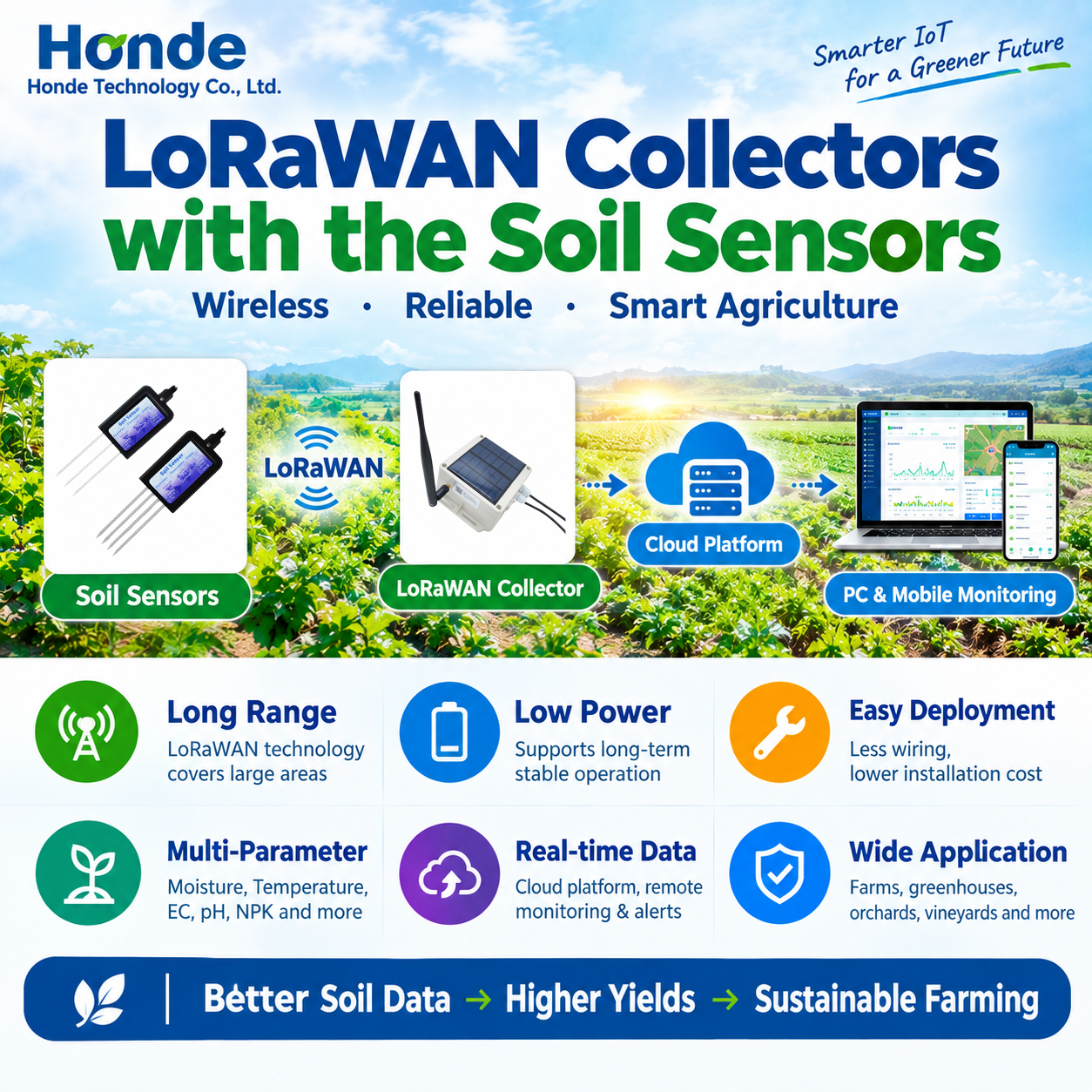
1. What Is a LoRaWAN Soil Sensor With Collector?
A LoRaWAN soil sensor with collector is a wireless agricultural monitoring architecture designed to connect distributed soil sensors with a remote monitoring platform.
Instead of installing long communication cables from every soil monitoring point back to a control room, sensors can communicate with a local collector through wired interfaces such as RS485, while the collector transmits the collected information wirelessly through LoRa or LoRaWAN.
A typical architecture is:
Soil Sensors → RS485 → LoRaWAN Collector → LoRaWAN Gateway → 4G/WiFi/Ethernet → Cloud Server → PC / Mobile
Honde’s existing wireless soil-monitoring architecture similarly separates sensing, data collection, wireless transmission, and cloud monitoring into different layers, allowing the system to be customized according to project requirements.
2. Why Use LoRaWAN for Agricultural Soil Monitoring?
A LoRaWAN-based architecture offers several practical advantages:
- ☑ Long-range wireless communication
- ☑ Low power consumption
- ☑ Reduced field wiring
- ☑ Distributed sensor deployment
- ☑ Remote data access
- ☑ Scalable monitoring architecture
- ☑ Easy integration with cloud platforms
- ☑ Support for real-time and historical data
3. How Does a LoRaWAN Soil Monitoring System Work?
Layer 1: Soil Sensor
| Soil Parameter | Typical Application |
|---|---|
| Soil Moisture | Irrigation management |
| Soil Temperature | Root-zone monitoring |
| EC | Fertilizer and salinity management |
Layer 2-5: Data Collection & Transmission
The system follows a modular flow: Sensor → Collector → Gateway → Cloud → Analysis. This design makes it easier to build a monitoring network with multiple sensor types across large fields, orchards, or greenhouses.
4. What Soil Parameters Can Be Monitored?
One of the biggest advantages of a modular LoRaWAN soil monitoring system is that the sensor configuration can be selected according to the agricultural objective, including Moisture, Temperature, EC, pH, and NPK.
5. Why Combine Multi-Parameter Soil Sensors With LoRaWAN?
| Monitoring Requirement | Recommended Parameters |
|---|---|
| Basic Irrigation | Moisture + Temperature |
| Soil Health | Moisture + Temp + pH + EC |
6. Multi-Depth Soil Monitoring
For many agricultural applications, monitoring only the surface soil is not enough. Water movement through the soil profile varies significantly. We recommend monitoring at 10cm, 30cm, and 50cm depths to understand water infiltration and root-zone health.
7. LoRaWAN Collector vs. Traditional Wired
While wired RS485 is sufficient for small greenhouses, LoRaWAN is significantly better for large-scale deployments due to reduced cabling costs and easier scalability.
8. What Should Buyers Check Before Purchasing?
Key Checklist:
- Measurement Parameters (Moisture, pH, NPK, etc.)
- Sensor Interface (RS485, Modbus, SDI-12)
- Power Supply (Solar vs. Grid)
- Cloud Integration (MQTT, API, Mobile App)
- Environmental Protection (IP Rating)
9. Why Choose Honde Technology?
Honde Technology Co., Ltd. (founded 2011) provides end-to-end IoT solutions for smart agriculture. Our systems are deployed in over 70 countries, offering modular, customizable hardware from sensors to cloud dashboards.
Get a Customized LoRaWAN Soil Monitoring Solution
Website: www.hondetechco.com
Email: info@hondetech.com
WhatsApp: +86-15210548582
Technology making our life better.
Post time: Sep-15-2026