

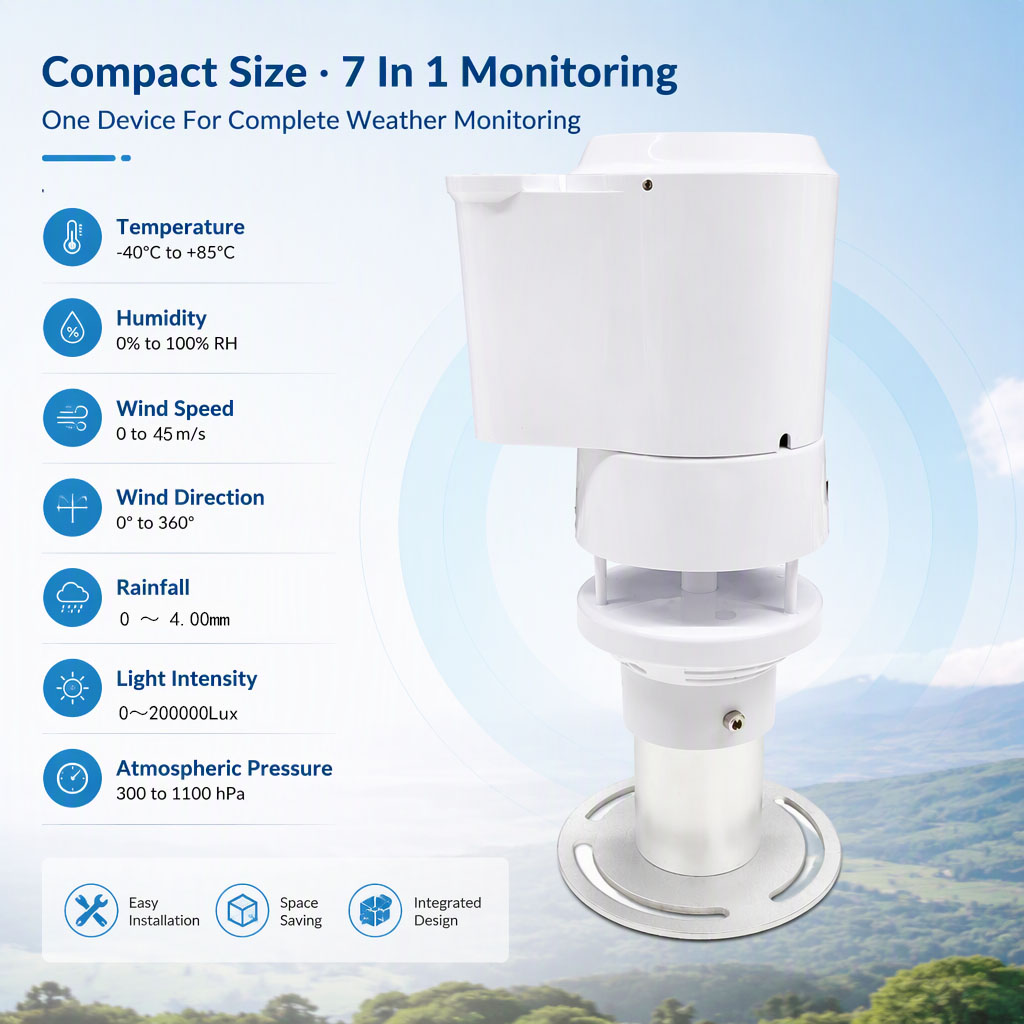
1. What Is a Mini Ultrasonic Environmental Monitor?
A Mini Ultrasonic Environmental Monitor is a compact, low-power weather monitoring device designed for continuous outdoor environmental data collection. It integrates six monitoring parameters into a single compact unit, combining wind speed, wind direction, air temperature, relative humidity, atmospheric pressure and one selectable parameter: rainfall, illuminance or solar radiation.
With an RS485 digital communication interface, the device can transmit all six configured measurement parameters to a compatible data acquisition system. Its low-power circuit design makes it suitable for remote monitoring projects and large-scale environmental sensor deployments.
Unlike conventional weather stations that may require multiple independent sensors, an integrated environmental monitor combines several measurement functions in one device. This can simplify system integration, reduce installation complexity and support cost-effective monitoring networks.
For agricultural meteorology, environmental monitoring, smart agriculture and outdoor weather observation, the Mini Ultrasonic Environmental Monitor offers a compact approach to continuous data collection.
2. Key Features of the Mini Ultrasonic Environmental Monitor
2.1 Environmental Monitoring Parameters in One Device
The Mini Ultrasonic Environmental Monitor integrates six environmental monitoring elements into a compact structure.
| Measurement Parameter | Description | Typical Application |
|---|---|---|
| Wind Speed | Measures outdoor wind speed | Agricultural meteorology and wind monitoring |
| Wind Direction | Measures wind direction | Weather observation and environmental monitoring |
| Air Temperature | Monitors ambient air temperature | Agricultural and environmental research |
| Relative Humidity | Measures ambient relative humidity | Greenhouse and field monitoring |
| Atmospheric Pressure | Measures atmospheric pressure | Weather observation |
| Selectable Parameter | Rainfall, illuminance or solar radiation | Project-specific monitoring |
The multiple parameter can be selected according to project requirements. Buyers should specify their preferred option when configuring the system.
Integrating multiple measurement functions into one device helps simplify the overall monitoring architecture, particularly for projects that require several environmental parameters at each monitoring point.
2.2 Low-Power Design for Continuous Outdoor Monitoring
Power consumption is an important consideration for environmental monitoring equipment installed in remote areas or large-scale monitoring networks.
The Mini Ultrasonic Environmental Monitor uses low-power chips and an optimized low-power circuit design. This makes it suitable for applications where energy consumption needs to be carefully managed.
Low-power operation is particularly useful for:
- Remote agricultural weather stations
- Solar-powered monitoring systems, subject to power-budget verification
- Distributed environmental monitoring networks
- Long-term outdoor monitoring installations
- Monitoring projects with limited power availability
For solar-powered deployments, the power supply should be sized according to the complete system’s energy consumption, including the data logger, communication module and other connected devices.
2.3 RS485 Digital Communication Interface
The device uses an RS485 digital communication interface to output all six measurement parameters.
RS485 is commonly used in industrial instrumentation and environmental monitoring systems because it supports communication over relatively long cable distances and is suitable for multi-device communication architectures when correctly configured.
The interface can facilitate integration with compatible:
- Industrial data loggers
- Weather monitoring controllers
- Environmental data acquisition systems
- Agricultural monitoring platforms
- Industrial automation equipment
Before integration, buyers should confirm the supported communication protocol, register map, baud rate and wiring requirements with the manufacturer.
2.4 Reliable Data in Rainy and Foggy Conditions
Outdoor environmental sensors must operate under changing weather conditions. Rain, fog and moisture can affect measurement stability and data quality.
The Mini Ultrasonic Environmental Monitor incorporates an efficient filtering algorithm and specialized compensation technology for rainy and foggy conditions. These technologies are designed to improve measurement stability and data consistency under challenging weather conditions.
For outdoor agricultural and environmental monitoring, stable data collection helps support long-term observation and analysis.
Actual measurement accuracy and operating limits should be evaluated against the product’s detailed technical specifications and installation conditions.
2.5 Compact Structure for Distributed Monitoring Networks
A compact integrated design is particularly useful when environmental monitoring equipment needs to be installed at numerous locations.
Combining multiple sensing functions in a single device can reduce the number of separate sensors and associated installation points.
For projects involving multiple monitoring locations, this design can help simplify equipment deployment, system integration and routine maintenance.
2.6 Cost-Effective Deployment for Large Monitoring Networks
Large-scale agricultural and environmental monitoring projects often require numerous monitoring points. The equipment cost, installation workload and maintenance requirements can significantly affect the total project budget.
The Mini Ultrasonic Environmental Monitor is designed as a low-cost, integrated monitoring solution suitable for grid-based deployment.
By integrating six environmental measurement functions into one device, it can help reduce the need for separate sensor installations at each monitoring point.
For large monitoring projects, buyers should evaluate the total cost of ownership, including sensor quantity, data acquisition equipment, cabling, power supplies, installation and maintenance.
3. How Does a Mini Ultrasonic Environmental Monitor Work?
The Mini Ultrasonic Environmental Monitor collects environmental measurements through its integrated sensing components and outputs the configured parameters through its RS485 digital interface.
A typical monitoring architecture includes the following steps:
- Environmental Data Collection: The integrated sensors measure wind speed, wind direction, air temperature, relative humidity, atmospheric pressure and the selected sixth parameter.
- Signal Processing: The internal processing system applies the available filtering and compensation algorithms to help maintain data stability.
- Digital Data Output: The device outputs the six measurement parameters through the RS485 interface.
- Data Acquisition: A compatible data logger or monitoring controller receives and records the measurements.
- Remote Monitoring: When connected to a suitable communication gateway and monitoring platform, the collected data can be transmitted for remote viewing and historical analysis.
This architecture allows the environmental monitor to serve as a measurement component in larger IoT weather monitoring and smart agriculture systems. Remote data access depends on the connected data acquisition and communication equipment.
4. Mini Ultrasonic Environmental Monitor vs. Traditional Weather Stations
Selecting suitable weather monitoring equipment depends on the required measurement parameters, installation environment, communication interface and project budget.
| Comparison | Mini Ultrasonic Environmental Monitor | Multiple Separate Sensors |
|---|---|---|
| Sensor Configuration | integrated parameters | Individual sensors |
| Installation | Compact integrated installation | Multiple mounting points may be required |
| Communication | RS485 digital output | Depends on each sensor |
| Power Design | Low-power circuit design | Varies by sensor |
| System Integration | Centralized parameter output | May require multiple interfaces |
| Deployment Cost | Designed for cost-effective deployment | Depends on sensor quantity and installation |
| Customization | Selectable sixth parameter | Individual sensor selection |
An integrated environmental monitor can simplify installation when the required parameters match its configuration. Separate sensors may offer more flexibility when a project requires specialized measurement ranges, different mounting positions or measurement functions that are not available in an integrated unit.
The choice should be based on the specific monitoring requirements rather than the number of integrated parameters alone.
5. Applications of the Mini Ultrasonic Environmental Monitor
5.1 Smart Agriculture and Precision Farming
Agricultural production is influenced by wind speed, wind direction, temperature, humidity and atmospheric pressure. Continuous monitoring of these parameters can provide useful environmental information for agricultural management.
The Mini Ultrasonic Environmental Monitor can be deployed in agricultural fields to collect meteorological data. When integrated with suitable data loggers and monitoring platforms, it can support:
- Field weather monitoring
- Agricultural environmental data collection
- Crop growth research
- Microclimate observation
- Distributed agricultural weather networks
For precision agriculture projects, the selectable rainfall, illuminance or solar radiation parameter can be chosen according to the monitoring objectives.
5.2 Greenhouse and Horticultural Monitoring
Environmental conditions are important for greenhouse management and horticultural research.
Although the Mini Ultrasonic Environmental Monitor is designed for outdoor environmental monitoring, it can also be considered for suitable greenhouse-related applications where its measurement parameters and installation conditions meet project requirements.
For comprehensive greenhouse monitoring, it can be combined with dedicated temperature, humidity, soil moisture and other sensors.
5.3 Agricultural Weather Monitoring Networks
Large agricultural areas may require multiple monitoring stations to observe environmental differences across different locations.
The compact design and low-power characteristics of this monitor make it suitable for projects that require distributed environmental measurement points.
When connected to compatible RS485 data acquisition equipment, multiple monitoring devices can be incorporated into a larger monitoring architecture, subject to the controller’s communication capacity and configuration.
5.4 Environmental Monitoring and Meteorological Research
Environmental monitoring projects often require long-term records of weather conditions.
The integrated monitor can collect several important meteorological parameters at the same monitoring point. Its digital output supports integration with compatible data acquisition equipment for subsequent analysis.
Potential applications include:
- Local microclimate observation
- Outdoor environmental research
- Agricultural meteorological studies
- Weather data collection networks
- Long-term environmental monitoring
5.5 Smart City and Distributed Outdoor Monitoring
Smart city and infrastructure projects may require multiple environmental monitoring points distributed across large geographical areas.
The Mini Ultrasonic Environmental Monitor can serve as an integrated environmental sensing component in suitable systems. With compatible controllers and communication gateways, it can contribute to centralized data collection and analysis.
Its compact configuration is particularly relevant to projects seeking to reduce the number of individual sensors at each monitoring location.
6. How to Choose the Right Mini Environmental Monitoring System
Selecting a suitable environmental monitor involves evaluating the required measurements, installation conditions and data acquisition architecture.
| Selection Factor | Key Consideration |
|---|---|
| Measurement Parameters | Confirm the six required parameters |
| Sixth Parameter | Select rainfall, illuminance or solar radiation |
| Communication Interface | Verify RS485 compatibility |
| Power Consumption | Evaluate the complete system’s energy requirements |
| Measurement Accuracy | Check the official product specifications |
| Installation Environment | Consider temperature, humidity, rain and wind exposure |
| Data Acquisition | Confirm controller and data logger compatibility |
| Deployment Scale | Evaluate the number of monitoring points |
Step 1: Define the Required Measurement Parameters
Identify the environmental parameters that your project needs to measure.
For example, an agricultural weather monitoring project may require wind speed, wind direction, air temperature, humidity, atmospheric pressure and rainfall.
A solar radiation research project may instead require solar radiation as the sixth parameter.
Defining these requirements before purchasing helps avoid unnecessary equipment and ensures that the selected configuration matches the intended application.
Step 2: Confirm the RS485 Interface Requirements
Check the compatibility between the environmental monitor and the intended data acquisition system.
Important communication details include the supported protocol, baud rate, register addresses, cable arrangement and power supply requirements.
These details are particularly important when integrating the sensor into an existing monitoring network.
Step 3: Evaluate Power Consumption
For remote monitoring projects, consider the power requirements of the complete installation rather than the sensor alone.
When using solar power, calculate the daily energy consumption and consider local sunlight conditions, battery capacity and the required operating autonomy.
Step 4: Consider the Installation Environment
Choose a suitable installation location based on the required measurements and sensor operating specifications.
Ensure that the installation structure is stable and that nearby buildings, trees or other obstructions do not unnecessarily interfere with environmental measurements.
For rainfall and solar radiation applications, follow the relevant sensor installation recommendations.
Step 5: Plan for Data Collection and Expansion
For projects involving multiple monitoring locations, select a compatible data logger or controller with sufficient communication capacity.
If remote monitoring is required, plan the communication gateway and cloud platform as part of the complete system.
7. Frequently Asked Questions (FAQ)
Q1: What parameters does the Mini Ultrasonic Environmental Monitor measure?
It integrates six monitoring parameters: wind speed, wind direction, air temperature, relative humidity, atmospheric pressure and one selectable parameter from rainfall, illuminance or solar radiation.
Q2: What is the communication interface of the Mini Ultrasonic Environmental Monitor?
The device uses an RS485 digital communication interface to output the six configured measurement parameters. Buyers should confirm the specific communication protocol and register information for their application.
Q3: Is the Mini Ultrasonic Environmental Monitor suitable for continuous outdoor monitoring?
Yes. It is designed for 24-hour continuous online outdoor monitoring. Its low-power circuit design and filtering and compensation technologies support continuous environmental data collection. The actual operating conditions should follow the product specifications.
Q4: Can this environmental monitor be used in solar-powered weather stations?
Its low-power design makes it a candidate for solar-powered monitoring systems. However, the solar panel and battery must be sized according to the complete system’s power consumption and local solar conditions.
Q5: Can the sixth measurement parameter be customized?
The sixth parameter is selectable from rainfall, illuminance or solar radiation. Buyers should specify their required option when ordering and confirm availability with the manufacturer.
Q6: Can the device be integrated into an IoT monitoring platform?
The RS485 output allows integration with compatible data acquisition equipment. Remote IoT monitoring can be implemented using a suitable controller or gateway and a compatible software platform.
Q7: Is the Mini Ultrasonic Environmental Monitor suitable for large-scale monitoring projects?
It is designed as a cost-effective solution for grid-based deployment. Its integrated structure and low-power design are relevant to projects requiring multiple monitoring points. The final system configuration should consider communication capacity, power supply and installation requirements.
8. Why Choose Honde Technology Co., Ltd.?
Honde Technology Co., Ltd. was founded in 2011 and specializes in the research, development, production and sales of smart water equipment, smart agriculture equipment, smart environmental monitoring equipment and related IoT solutions.
With products supplied to customers in more than 70 countries, Honde provides environmental and agricultural monitoring equipment for a wide range of applications.
Our product portfolio includes:
- Integrated weather stations
- Ultrasonic wind speed and direction sensors
- Soil temperature and moisture sensors
- Environmental monitoring equipment
- Wireless data acquisition systems
- Smart agriculture monitoring solutions
For the Mini Ultrasonic Environmental Monitor, buyers can discuss the required sixth measurement parameter, RS485 integration and intended monitoring application with our team.
Our team can assist buyers with product selection and project configuration according to their monitoring requirements.
9. Conclusion
The Mini Ultrasonic Environmental Monitor is a compact, low-power, six-parameter weather monitoring device designed for continuous outdoor environmental data collection. Its integrated sensing structure, RS485 digital communication interface, rain and fog compensation technology and cost-effective design make it suitable for agricultural meteorology, environmental monitoring and distributed weather networks.
For projects that require multiple environmental parameters at a single monitoring point, an integrated monitor can simplify sensor deployment and data acquisition.
Before selecting a configuration, buyers should confirm the required measurement parameters, the sixth parameter option, communication compatibility and installation conditions.
Looking for a compact, low-power environmental monitoring solution?
Contact Honde Technology Co., Ltd. to discuss your project requirements and request product specifications or a quotation.
Website: www.hondetechco.com
Email: info@hondetech.com
Post time: Sep-30-2026