

Introduction: Why Choose a Mini Weather Station with Solar Radiation Sensor?
A mini weather station with a solar radiation sensor helps users monitor solar radiation and, depending on the selected configuration, other environmental parameters for agricultural management, solar energy projects, and outdoor environmental monitoring. When integrated with an IoT communication system, the collected data can be transmitted to a remote platform for visualization, analysis, and long-term record keeping.
For smart agriculture, solar radiation data provides valuable information about the light energy available to crops. For photovoltaic (PV) power plants, it helps operators understand the solar resource reaching the installation and compare environmental conditions with power-generation performance. When combined with temperature, humidity, wind, or rainfall measurements, it provides a broader picture of local weather conditions.
Honde Technology Co., Ltd. supplies weather monitoring equipment and IoT sensing solutions that can be configured for different project requirements. Depending on the selected model and communication architecture, users can build a monitoring system connecting field sensors, wireless data collectors, gateways, and cloud platforms.
1. What Is a Mini Weather Station with Solar Radiation Sensor?
A mini weather station with solar radiation monitoring is a compact environmental measurement system designed to collect meteorological data from outdoor locations.
Its main advantage is integration: instead of installing separate instruments for every measurement, users can select a suitable combination of sensors according to their application.
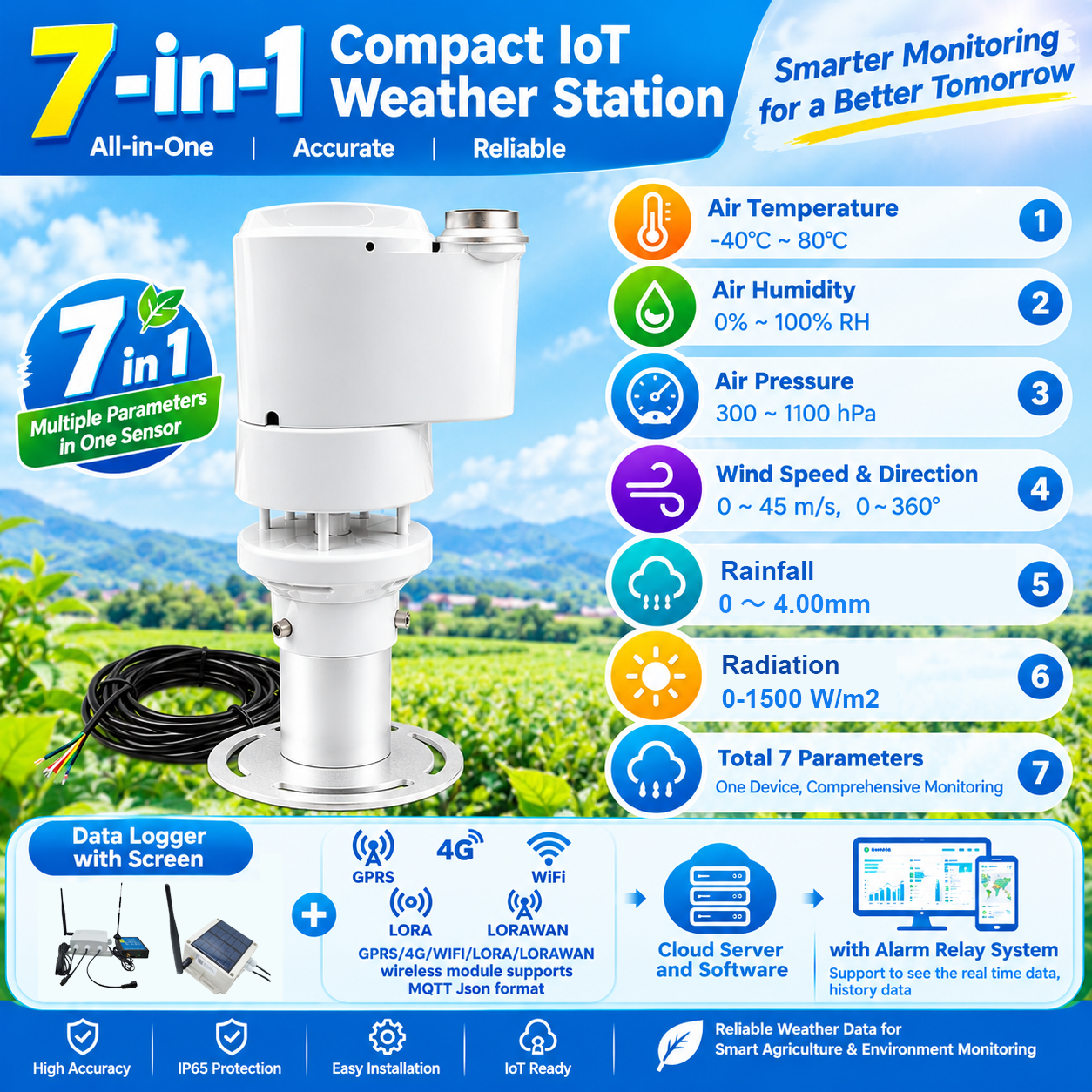
Typical Monitoring Parameters
| Monitoring Parameter | What It Measures | Typical Application |
|---|---|---|
| Solar Radiation | Solar irradiance received at the sensor | PV performance analysis and environmental research |
| Air Temperature | Ambient temperature | Crop management and weather analysis |
| Air Humidity | Moisture content in the air | Greenhouse and field environment monitoring |
| Wind Speed | Wind velocity | Agricultural operations and solar farm monitoring |
| Wind Direction | Wind direction | Weather analysis and infrastructure assessment |
| Rainfall | Precipitation | Irrigation planning and rainfall records |
| Light Intensity | Ambient visible light, when configured | Plant lighting and environmental studies |
Important: The available parameters depend on the selected weather station model. Solar radiation, light intensity, and PAR are different measurements and should not be treated as interchangeable.
2. Solar Radiation Monitoring for Smart Agriculture
Solar radiation influences photosynthesis, crop development, evapotranspiration, and irrigation demand. Monitoring it alongside other environmental parameters helps agricultural operators understand changing growing conditions.
How Does Solar Radiation Data Help Farmers?
1. Evaluate the crop light environment
Solar radiation measurements help growers track changes in incoming solar energy throughout the day and across different seasons.
2. Support irrigation planning
Solar radiation, temperature, humidity, wind, and rainfall can be used together to understand environmental conditions affecting crop water demand.
For more advanced irrigation planning, weather data may also be used as an input for estimating reference evapotranspiration (ET₀). However, ET₀ is a calculated or derived value, not a direct solar radiation measurement, and its calculation requires an appropriate method and sufficient input data.
3. Compare growing conditions between locations
Installing monitoring stations at representative points can help growers compare environmental conditions across greenhouses, orchards, and open fields.
4. Support agricultural research
Continuous environmental records can help researchers evaluate relationships between radiation, crop growth, weather changes, and irrigation practices.
For precision agriculture projects, a compact weather station can also be integrated with soil moisture and soil temperature sensors to combine above-ground environmental measurements with root-zone conditions.
3. Solar Radiation Monitoring for Photovoltaic Power Plants
Solar radiation is a key environmental variable for solar energy projects because available sunlight affects the energy that photovoltaic modules can potentially produce.
A solar farm monitoring system can combine solar radiation measurements with local weather data to support operational analysis.
Key Applications
- Solar resource assessment: Record solar radiation conditions at the installation site.
- Performance analysis: Compare irradiance data with PV system output, taking system configuration and operating conditions into account.
- Environmental monitoring: Track temperature, wind, and rainfall where supported by the selected station.
- Long-term data collection: Maintain environmental records for performance comparisons and project analysis.
- Remote site supervision: Transmit measurements to a monitoring platform when suitable communication infrastructure is available.
Which Parameters Should a Solar Farm Monitor?
| Parameter | Why It Matters |
|---|---|
| Solar Irradiance | Helps characterize the solar resource |
| Air Temperature | Provides ambient thermal conditions |
| Wind Speed | Supports environmental and operational assessment |
| Wind Direction | Helps characterize local wind conditions |
| Rainfall | Records precipitation and changing weather |
| Module Temperature | Useful for PV performance analysis, if measured separately |
For solar energy projects, buyers should confirm whether they need global horizontal irradiance (GHI), plane-of-array (POA) irradiance, or another radiation measurement. Sensor orientation, mounting location, calibration, and measurement specifications should match the intended analysis.
A general-purpose solar radiation sensor does not automatically replace a dedicated, calibrated PV performance monitoring instrument.
4. How to Build an IoT Weather Monitoring System
A mini weather station becomes more useful when its measurements can be accessed remotely rather than collected only during on-site inspections.
A typical IoT monitoring architecture is:
Weather Station → Data Collector or Communication Module → Gateway or Network → Cloud Server → PC or Mobile Dashboard
The actual architecture depends on the selected product and communication requirements.
Communication Options for Different Projects
| Communication Method | Typical Use Case | Key Consideration |
|---|---|---|
| RS485 / Modbus | Industrial monitoring and local data acquisition | Requires compatible interfaces and wiring |
| LoRa | Wireless communication between field devices and a receiver | Range depends on terrain, antennas, and configuration |
| LoRaWAN | Low-power, distributed IoT monitoring networks | Requires compatible network infrastructure |
| 4G | Remote monitoring through cellular networks | Requires suitable coverage and a compatible data plan |
| Wi-Fi | Monitoring within an available wireless network | Depends on coverage and network access |
| MQTT | Transferring data between compatible devices and server applications | Requires compatible message formats and broker configuration |
These technologies serve different purposes. RS485 is a wired interface, LoRa and LoRaWAN provide wireless communication options, 4G and Wi-Fi provide network connectivity, and MQTT is a messaging protocol that can be used for data integration.
For remote agricultural sites, a LoRa collector and gateway can reduce the need for individual internet connections at each sensor. In other projects, a direct 4G communication module may be more appropriate.
Honde Technology also describes an integrated weather and soil monitoring architecture using a LoRa data collector, a 4G LoRa gateway, and MQTT-based server communication.
5. How to Select the Right Mini Weather Station
Before purchasing a mini weather station with a solar radiation sensor, buyers should evaluate the following factors.
1. Confirm the Required Parameters
List the measurements needed for your project. A solar farm may prioritize irradiance and wind, while a smart agriculture project may require solar radiation, air temperature, humidity, rainfall, and soil moisture.
Do not assume that all parameters are included in every model.
2. Check Measurement Range and Accuracy
Ask the supplier for the technical datasheet, including:
- Solar radiation measurement range and accuracy
- Resolution and response characteristics
- Temperature and humidity measurement specifications
- Wind measurement range and accuracy, where applicable
- Operating temperature and environmental protection rating
Select specifications based on the required application and data quality.
3. Verify Communication Compatibility
Confirm whether the station supports RS485, Modbus-RTU, a wireless module, or another output. If the project requires MQTT or cloud integration, verify the complete data path rather than checking only the sensor interface.
4. Evaluate Installation Conditions
Consider outdoor exposure, mounting height, sensor orientation, power supply, cable routing, and maintenance access.
For solar radiation measurements, avoid obstructions that create unwanted shading and follow the installation guidance for the selected sensor.
5. Plan for Future Expansion
A modular monitoring system may allow additional soil sensors, rainfall sensors, wind sensors, or other environmental instruments to be integrated later.
For multi-location deployments, confirm the supported sensor count, addressing method, communication range, and gateway capacity before finalizing the design.
6. Common Purchasing Mistakes to Avoid
Mistake 1: Confusing solar radiation with PAR
Solar radiation generally describes radiant energy over a specified spectral range, while photosynthetically active radiation (PAR) refers to light in the spectral range used to characterize photosynthesis. Choose the appropriate sensor for the intended measurement.
Mistake 2: Selecting a station based only on the number of parameters
A higher parameter count does not automatically mean better measurement performance. Accuracy, calibration, sensor type, environmental protection, and output compatibility also matter.
Mistake 3: Ignoring the communication system
A sensor that produces data locally may still require a separate collector, gateway, or communication module for remote monitoring. Confirm which components are included in the quotation.
Mistake 4: Assuming that every weather station calculates ET₀
ET₀ calculation requires an appropriate calculation method and the necessary meteorological inputs. Ask whether the software or monitoring platform supports ET₀ calculation and which input parameters it uses.
Mistake 5: Overlooking installation and maintenance
Radiation sensors need suitable placement and periodic inspection. Dust, shading, mounting errors, and poor maintenance can affect data quality.
7. Why Choose Honde Technology for Environmental Monitoring?
Honde Technology Co., Ltd. develops and supplies sensing equipment and IoT monitoring solutions for smart agriculture, environmental monitoring, and smart water applications.
Our product and solution portfolio includes weather stations, soil sensors, wireless data collectors, and related monitoring equipment. Depending on project requirements, these components can be combined to build an integrated environmental monitoring network.
Potential project configurations can be discussed according to:
- Required environmental parameters
- Sensor output and communication interface
- Wireless transmission method
- Cloud platform and data integration requirements
- Installation environment and power supply
- Customization and deployment scale
For buyers developing agricultural monitoring networks, solar farm environmental monitoring systems, or remote IoT projects, selecting compatible sensors and communication equipment at the planning stage can help simplify integration and future expansion.
8. Frequently Asked Questions
Q1: What is a mini weather station with a solar radiation sensor used for?
It is used to monitor solar radiation and, depending on the configuration, other weather parameters. Typical applications include smart agriculture, photovoltaic site monitoring, environmental research, and outdoor weather data collection.
Q2: Can a mini weather station be used for solar farm monitoring?
Yes, if the selected model provides the required radiation measurement and environmental parameters. For formal PV performance assessment, confirm the irradiance type, sensor specifications, mounting orientation, and calibration requirements.
Q3: Can solar radiation data help with irrigation management?
Yes. Solar radiation can help characterize the energy available to drive evapotranspiration. When combined with suitable weather data and an appropriate calculation method, it can support irrigation scheduling and crop water-demand analysis.
Q4: Can the weather station send data to a cloud platform?
This depends on the model and system configuration. Compatible communication modules, collectors, gateways, and server software can be used to enable remote monitoring. Confirm interface and protocol compatibility before ordering.
Q5: Can soil sensors be added to the weather monitoring system?
Potentially, yes. Compatible soil moisture, soil temperature, or other soil sensors can be integrated into a broader agricultural monitoring network. The connection method and supported sensor count depend on the selected hardware.
Q6: What information should I provide when requesting a quotation?
Provide your application, required parameters, measurement specifications, communication method, power supply, installation environment, and estimated quantity. If you already have a cloud platform, include its interface or protocol requirements.
Conclusion: Build a Monitoring Solution Around Your Project
A mini weather station with a solar radiation sensor can provide useful environmental data for smart agriculture, solar energy monitoring, and IoT-based outdoor measurement. The best configuration depends on the parameters you need, the required data quality, the installation environment, and how the data will be transmitted and used.
By planning the sensing, communication, and software components together, project developers can build a monitoring system that meets current requirements and can be expanded when needed.
Contact Honde Technology Co., Ltd. to discuss a mini weather station and solar radiation monitoring solution for your project.
Company Name: Honde Technology Co., Ltd.
Website: https://www.hondetechco.com
Email: info@hondetech.com
Request a Quote: Tell us your required parameters, communication method, and application scenario to discuss a suitable configuration for your project.
Post time: Oct-09-2026