

Modern farms need more than a single sensor. To manage irrigation, crop growth, water resources, and changing weather conditions, agricultural operators need connected data from the soil, atmosphere, and water system.
A practical solution is to combine a weather station, soil sensor, water level sensor, and LoRaWAN collector into one wireless monitoring network. The sensors collect field data, the LoRaWAN collector gathers and transmits the measurements, and the data can then be connected to a gateway, cloud server, or agricultural management platform for remote monitoring.
For farms, greenhouses, orchards, irrigation projects, reservoirs, and agricultural research, this architecture provides a scalable way to move from isolated sensor measurements to a connected smart agriculture monitoring system.
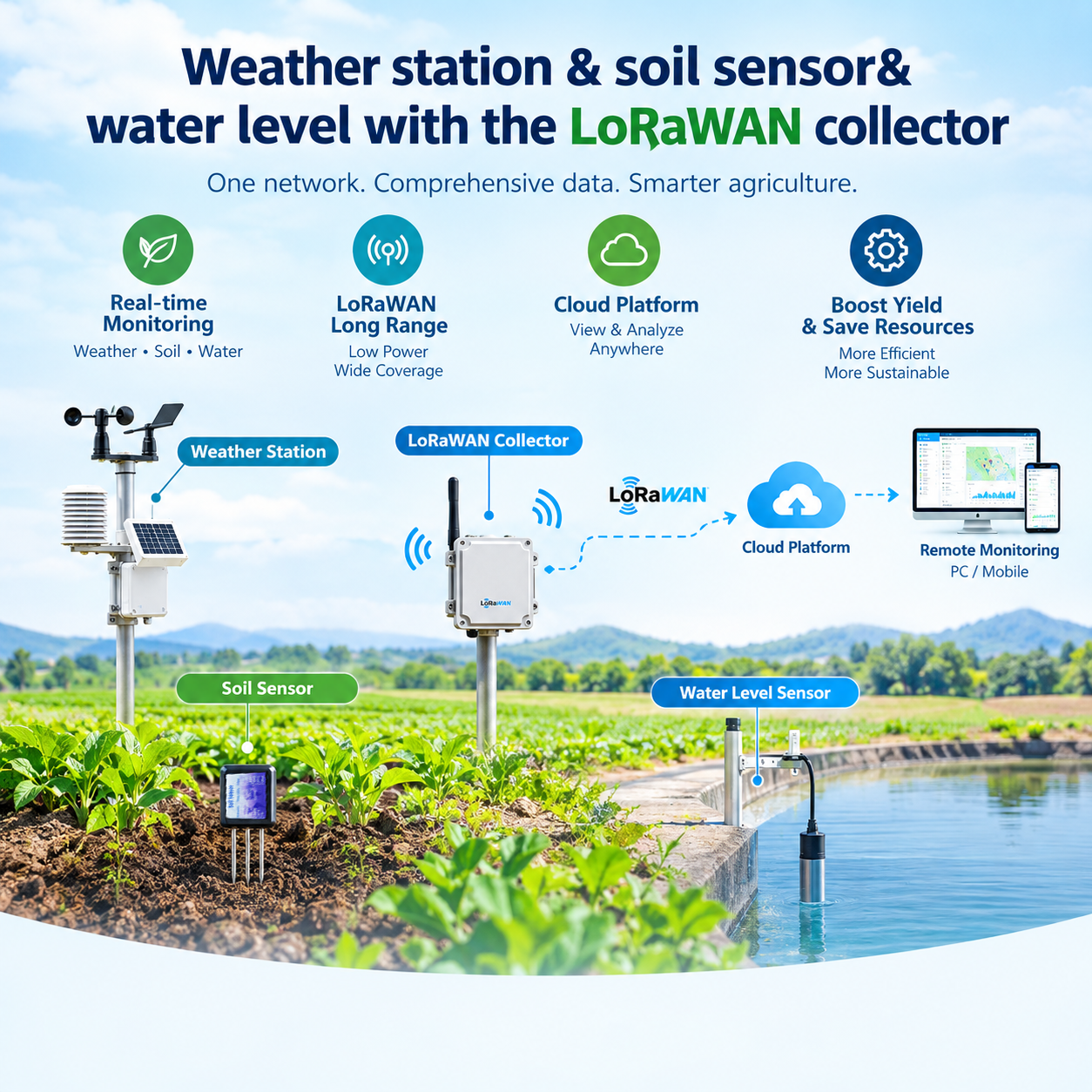
1. What Is a Weather Station Soil Sensor and Water Level Monitoring System?
A weather station soil sensor and water level monitoring system integrates several types of environmental sensors into one wireless IoT architecture.
The basic structure is:
The weather station monitors atmospheric conditions, the soil sensor measures the crop root-zone environment, and the water level sensor provides information about irrigation water, reservoirs, canals, tanks, or other water resources.
The LoRaWAN collector acts as the field communication hub.
LoRaWAN is designed as a low-power wide-area networking protocol for connecting battery-operated IoT devices. Its architecture uses gateways to relay messages between end devices and the network server, making it suitable for distributed sensor networks.
For agriculture, this is important because sensors may be distributed across large fields where installing communication cables to every monitoring point is difficult or expensive.
2. Why Combine Weather, Soil and Water Level Monitoring?
A single measurement can provide useful information, but agricultural decisions often depend on several environmental factors at the same time.
For example:
- Soil moisture indicates the current water condition around the crop roots.
- Soil temperature helps describe the root-zone environment.
- Air temperature and humidity describe atmospheric conditions.
- Rainfall data shows natural water input.
- Wind speed and direction provide information about field weather conditions.
- Water level data shows the availability or variation of irrigation water.
When these measurements are collected together, farm managers can compare soil conditions, weather conditions, and water availability instead of relying on one data source.
Typical Monitoring Parameters
| Monitoring Area | Typical Parameters | Application |
|---|---|---|
| Weather | Air Temperature | Crop and climate monitoring |
| Weather | Air Humidity | Crop environment monitoring |
| Weather | Wind Speed & Direction | Weather and spraying management |
| Weather | Rainfall | Irrigation and rainfall analysis |
| Soil | Soil Moisture | Irrigation management |
| Soil | Soil Temperature | Root-zone monitoring |
| Soil | EC / Salinity | Soil condition monitoring |
| Water | Water Level | Irrigation and water-resource monitoring |
| Communication | LoRa / LoRaWAN | Wireless field communication |
| Data | Cloud / MQTT / JSON | Remote monitoring and integration |
The exact parameters can be configured according to the agricultural project and sensor model.
3. How Does the LoRaWAN Collector Work?
The LoRaWAN collector is an important part of the system because it connects field sensors with the wireless network.
A typical architecture is:
↓
LoRaWAN Collector
↓
LoRaWAN Gateway
↓
4G / Ethernet / Internet
↓
Cloud Server & Software
↓
PC / Mobile Phone
The sensor layer can contain different devices.
For example:
- Weather station
- Soil moisture sensor
- Soil temperature sensor
- Soil EC or salinity sensor
- Water level sensor
- Other agricultural or environmental sensors
The collector receives the field measurements and transmits the data wirelessly.
This approach means that several monitoring points can share the same wireless infrastructure rather than requiring an independent internet connection for every sensor.
Honde\’s existing smart agriculture architecture similarly combines distributed soil and weather sensors with LoRa/LoRaWAN data collectors and gateways before sending data to a cloud platform.
4. Weather Station Monitoring for Smart Agriculture
Weather conditions directly affect crop growth, irrigation demand, field operations, and agricultural risk management.
A compact agricultural weather station can be configured to monitor parameters such as:
- Air temperature
- Air humidity
- Wind speed
- Wind direction
- Rainfall
- Atmospheric pressure
- Light intensity
- PAR
- Solar radiation
The actual configuration depends on the selected weather station.
Why Is Weather Data Important?
Consider an irrigation decision.
If the soil moisture is low but rainfall is forecast or rainfall has recently occurred, the irrigation strategy may be different from a situation where the soil is dry, air temperature is high, humidity is low, and there has been no recent rainfall.
Therefore, combining weather data with soil data gives farm operators more environmental context.
Honde\’s existing agricultural monitoring solutions use weather stations together with soil sensors to create a broader field monitoring network rather than treating weather and soil monitoring as independent systems.
5. Soil Sensor Monitoring for Root-Zone Management
For a deeper look at wireless soil monitoring architecture, see our guide to LoRaWAN Soil Sensor With Collector, which explains the sensor → collector → gateway → cloud data path.
Soil monitoring provides direct information about the environment surrounding crop roots.
Depending on the selected model, Honde soil sensors can measure parameters such as:
- Soil moisture
- Soil temperature
- EC
- Salinity
- pH
- NPK
For irrigation projects, soil moisture is particularly important because it provides direct information about the water condition of the monitored soil layer.
For example:
while:
Adding EC, salinity, pH, or NPK measurements can provide additional information for soil and fertilizer management.
Honde\’s existing soil-monitoring products support different combinations of these parameters and can be integrated with LoRa, LoRaWAN, GPRS, 4G, or Wi-Fi communication according to the project architecture.
6. Water Level Monitoring Completes the Agricultural Picture
Soil moisture tells you about the water condition in the soil, but it does not necessarily tell you how much water is available in an irrigation reservoir, canal, tank, river, or other water source.
This is where water level monitoring becomes useful.
For irrigation reservoirs, canals, tanks, and other water-resource applications, our Water Level Monitoring with LoRaWAN solution provides wireless data transmission for remote monitoring.
A connected water level sensor can provide information about:
- Reservoir water level
- Irrigation canal level
- Water tank level
- River level
- Groundwater level
- Other agricultural water resources
For example:
combined with:
Soil Moisture → Root-Zone Water Condition
and:
Rainfall + Weather Data → Environmental Conditions
creates a much more complete dataset for agricultural water management.
Honde also provides water-level monitoring solutions with wireless communication and cloud software, including configurations using LoRaWAN, 4G, Wi-Fi and other communication methods.
7. The Key Advantage: One Wireless Network for Multiple Sensors
One of the biggest advantages of this architecture is the ability to connect different types of sensors through a common wireless monitoring network.
Instead of building separate systems:
Soil Sensor → System B
Water Level Sensor → System C
a connected architecture can use:
Soil Sensor
Water Level Sensor
↓
LoRaWAN Collector
↓
LoRaWAN Gateway
↓
Cloud Platform
This simplifies the overall system architecture and makes future expansion easier.
Additional sensors can potentially be added according to project requirements.
For large farms, this modular architecture is particularly useful because monitoring requirements may increase as the project expands from a few test points to multiple agricultural zones.
This architecture can be further expanded into a Weather-Soil LoRaWAN Smart Agriculture System, where distributed weather stations and soil sensors communicate through LoRa/LoRaWAN collectors and gateways.
8. LoRaWAN vs. Wired Sensor Networks
For agricultural environments, communication method is an important engineering consideration.
| Feature | Traditional Wired Network | LoRaWAN Wireless Network |
|---|---|---|
| Field cabling | Required | Greatly reduced |
| Installation | More infrastructure | Flexible deployment |
| Large-area deployment | More difficult | Suitable for distributed nodes |
| Sensor mobility | Limited | More flexible |
| Maintenance | Cable inspection required | Wireless architecture reduces field cabling |
| Expansion | May require additional wiring | Additional nodes can be added |
| Remote monitoring | Requires communication infrastructure | Designed for connected IoT devices |
| Best fit | Fixed infrastructure | Distributed agricultural monitoring |
The actual communication distance, power consumption, gateway capacity, and reliability depend on terrain, antenna configuration, sensor settings, environmental conditions, and network design.
Therefore, a professional system should be designed according to the actual farm rather than assuming that one communication configuration is suitable for every project.
9. Applications of the Integrated Monitoring Solution
9.1 Precision Irrigation
Soil moisture sensors can monitor root-zone water conditions while water level sensors monitor the available irrigation resource.
Weather stations add rainfall and atmospheric information.
The combined data can support irrigation scheduling and help operators make decisions based on measured field conditions.
9.2 Greenhouse Monitoring
Inside or around greenhouses, the system can monitor:
- Soil moisture
- Soil temperature
- Air temperature
- Air humidity
- Light
- Rainfall
- Other environmental parameters
The data can be transmitted wirelessly to a central platform for remote monitoring.
9.3 Orchard Monitoring
Orchards often contain multiple planting zones.
Wireless sensor nodes can be distributed among different areas to monitor soil and local environmental conditions without installing extensive communication cables.
9.4 Irrigation Canal and Reservoir Monitoring
Water level sensors can be installed at important irrigation infrastructure points.
When combined with weather and soil information, operators can obtain a more complete picture of the relationship between:
9.5 Agricultural Research
For agricultural research stations, long-term environmental datasets are valuable.
A LoRaWAN monitoring network can continuously collect measurements from multiple locations, making it easier to compare different soil layers, planting zones, weather conditions, and irrigation conditions.
10. What Should You Check Before Choosing a LoRaWAN Agriculture Monitoring System?
Before purchasing a system, B2B buyers should check more than the sensor measurement range.
1. Sensor Parameters
Confirm exactly which parameters are required.
For example:
- Soil moisture
- Soil temperature
- EC
- Salinity
- pH
- NPK
- Air temperature
- Air humidity
- Rainfall
- Wind
- Water level
2. Communication Interface
Confirm whether the system uses:
- RS485
- Modbus-RTU
- LoRa
- LoRaWAN
- 4G
- Wi-Fi
- MQTT
- JSON
The interface should match the existing gateway, PLC, SCADA, or cloud platform.
3. Power Supply
Remote agricultural installations may require:
- Battery power
- Solar power
- DC power
- Low-power operation
Power requirements should be evaluated together with transmission frequency and installation environment.
4. Installation Environment
Check:
- IP protection
- Temperature range
- Sensor installation depth
- Soil conditions
- Water environment
- Sensor mounting position
- Solar exposure
- Communication coverage
5. Cloud Platform Compatibility
A sensor network becomes more valuable when users can remotely view:
- Real-time data
- Historical data
- Data trends
- Sensor status
- Alarm status
Honde can provide wireless communication and server/software configurations for different IoT monitoring requirements.
11. From Sensor Data to a Complete Smart Agriculture IoT System
The real value of the system is not simply collecting more sensor data.
The goal is to create a complete data chain:
For example:
↓
LoRaWAN Collector
↓
LoRaWAN Gateway
↓
Cloud Server
↓
Real-Time Soil Moisture Dashboard
At the same time:
↓
LoRaWAN Collector
↓
Cloud Platform
and:
↓
LoRaWAN Collector
↓
Cloud Platform
The three datasets can then be viewed together.
This creates a foundation for future functions such as irrigation automation, alarm notifications, environmental analysis, and agricultural decision support.
12. Honde Technology\’s IoT Monitoring Solution
Honde Technology Co., Ltd. develops and supplies IoT sensing and monitoring equipment for smart agriculture, smart water, and environmental monitoring applications.
The company\’s solutions can combine:
- Weather stations
- Soil sensors
- Water level sensors
- LoRa / LoRaWAN collectors
- LoRaWAN gateways
- GPRS / 4G / Wi-Fi communication
- Data loggers with screens
- MQTT / JSON communication
- Cloud servers and software
- Alarm relay systems
This modular approach allows the monitoring architecture to be customized according to the project.
For example:
Soil Sensor → LoRaWAN Collector → Gateway → Cloud
Integrated Farm
Weather Station + Soil Sensors + Water Level Sensor → LoRaWAN Collector → Gateway → Cloud
Large Agricultural Project
Multiple Sensor Nodes → Multiple LoRaWAN Collectors → Gateway Network → 4G / Ethernet → Cloud Platform
This makes the architecture suitable for projects that need to start small and expand later.
13. Recommended Honde Resources for Further Reading
For buyers researching a complete LoRaWAN agricultural monitoring system, the following Honde articles can be used as supporting resources:
- LoRa LoRaWAN RS485 Soil Sensor: explains soil moisture, temperature, EC, salinity and other soil monitoring options.
- Weather-Soil-Network Integrated Smart Agriculture System: explains the architecture of weather stations, soil sensors, LoRa collectors, gateways and cloud platforms.
- Soil and Air Temperature Humidity Sensor with LoRaWAN Collector: explains how soil and atmospheric monitoring can be integrated through a LoRaWAN collector.
- Submersible Water Level Sensor and IoT Monitoring: provides additional information about remote water-level monitoring, wireless communication and cloud platforms.
These articles can form an internal content cluster around the broader topic of LoRaWAN Smart Agriculture Monitoring.
14. FAQ: Weather Station, Soil Sensor and Water Level with LoRaWAN Collector
Can a LoRaWAN collector connect different agricultural sensors?
Yes. The exact compatibility depends on the collector interface, sensor communication protocol, and system configuration. RS485/Modbus sensors can be integrated into suitable data-collection architectures, while LoRaWAN provides the wireless network layer.
What can be monitored in a smart agriculture system?
Depending on the selected sensors, the system can monitor soil moisture, soil temperature, EC, salinity, pH, NPK, air temperature, humidity, rainfall, wind, light, and water level.
Is LoRaWAN suitable for large farms?
LoRaWAN is designed for low-power wide-area IoT connectivity and can connect distributed field devices through gateways. Actual coverage depends on terrain, antenna installation, network configuration, and environmental conditions.
Can the data be viewed remotely?
Yes. A complete configuration can connect the field monitoring equipment to a gateway, cellular or Ethernet backhaul, cloud server, and software platform for remote access.
Can the system be customized?
Yes. A B2B agricultural monitoring project can be configured according to the required sensors, measurement parameters, communication method, power supply, installation environment, data protocol, and cloud platform.
Conclusion: Build a Connected Agriculture Monitoring Network
A modern agricultural monitoring system should not be limited to one sensor or one measurement point.
By integrating a:
farm operators can build a connected monitoring network that combines atmospheric, soil, and water-resource information.
The architecture can then be expanded with:
to create a complete IoT monitoring solution.
For agricultural projects requiring precision irrigation, greenhouse monitoring, orchard monitoring, water-resource management, environmental monitoring, or agricultural research, this modular architecture provides a practical foundation for building a scalable smart agriculture system.
Need a Customized LoRaWAN Agriculture Monitoring Solution?
Honde Technology Co., Ltd. can customize sensor combinations, communication methods, data collection systems, and cloud monitoring solutions according to your project requirements.
Contact Honde Technology to discuss your weather station + soil sensor + water level + LoRaWAN collector project and request a customized solution.
Post time: Sep-17-2026