

SUBTITLE
RS485, 4G, WiFi, LoRaWAN and Cloud Connectivity Help Utilities, Aquaculture Operators and Environmental Teams Build Continuous Water Quality Monitoring Networks
DATE
September 28, 2026
KEYWORDS
multi parameter water quality sensor; multiparameter water quality sensor; online water quality monitoring; water quality monitoring sensor; RS485 water quality sensor; Modbus water quality sensor; IoT water quality monitoring; LoRaWAN water quality sensor; 4G water quality sensor; remote water quality monitoring; pH DO EC turbidity sensor; dissolved oxygen sensor; wastewater monitoring sensor; river water quality monitoring; aquaculture water quality monitoring; IP68 water quality sensor; self-cleaning water quality sensor; real-time water quality monitoring; cloud water monitoring system
1. MARKET OVERVIEW: WATER QUALITY MONITORING IS BECOMING A CONTINUOUS DATA TASK
Water quality monitoring is moving beyond periodic manual sampling. Utilities, environmental agencies, industrial sites and aquaculture operators increasingly need measurements that show what is happening between two sampling visits.
A September 2026 market study by Fortune Business Insights estimates that the global water quality monitoring systems market was worth USD 6.09 billion in 2025 and is projected to reach USD 6.51 billion in 2026 and USD 11.68 billion by 2034, representing a 7.59% CAGR. The same study puts Asia Pacific at 30.71% of the global market in 2025.
The important commercial signal is not only market size. Monitoring systems are increasingly expected to combine sensors, data acquisition, communications and software. The U.S. EPA’s Water Sensors Toolbox describes applications ranging from drinking-water and environmental monitoring to pollution investigation, industrial leak detection and emergency response. EPA’s online water-quality-monitoring guidance also specifically addresses source-water monitoring, distribution systems, remote communications and real-time event detection.
This changes the purchasing question.
A project no longer asks only:
“Can the probe measure pH or dissolved oxygen?”
It increasingly asks:
“Can one field device collect several parameters, transmit the data reliably, store local records, provide remote access and trigger an alarm when conditions change?”
That is where multi-parameter water quality sensors become useful.
2. HIGH-HEAT KEYWORDS FOR INTERNATIONAL B2B MARKETING
The following keyword groups are recommended for Alibaba International, Google SEO, product pages, brochures and technical articles. They are prioritized according to product relevance, buyer intent and the current direction of water-monitoring projects. They are not presented as audited Google search-volume figures.
TABLE 1 — KEYWORD PRIORITY MAP
Keyword Cluster | Recommended Keywords | Buyer Intent | Main Use
Core product | multi parameter water quality sensor; multiparameter water quality sensor; online multi parameter water quality sensor | Very High | Product title / landing page
Communication | RS485 water quality sensor; Modbus water quality sensor; 4G water quality sensor; LoRaWAN water quality sensor | Very High | Product listing / technical page
Remote monitoring | remote water quality monitoring; real-time water quality monitoring; IoT water quality monitoring | Very High | Solution page / article
Parameter combinations | pH DO EC turbidity sensor; pH ORP DO EC turbidity sensor; dissolved oxygen pH conductivity sensor | High | Product specification / application
Environmental | river water quality monitoring; lake water quality monitoring; groundwater quality monitoring | High | Environmental projects
Wastewater | wastewater monitoring sensor; sewage treatment water quality sensor; industrial wastewater monitoring | Very High | Industrial / municipal projects
Aquaculture | aquaculture water quality sensor; fish farm water quality monitoring; shrimp pond water quality sensor | Very High | Aquaculture
Infrastructure | online water quality monitoring system; water quality monitoring station; remote water quality monitoring system | High | System integrators
Hardware features | IP68 water quality sensor; self-cleaning water quality sensor; digital RS485 water quality probe | High | Technical buyers
IoT | MQTT water quality monitoring; LoRaWAN water monitoring; cloud water quality monitoring | High | IoT / smart-city projects
SEO NOTE:
For B2B conversion, long-tail combinations such as “RS485 Modbus IP68 multi parameter water quality sensor” and “LoRaWAN remote water quality monitoring sensor” can be more commercially useful than relying only on the broad term “water quality sensor.”
3. WHICH DEVELOPED MARKETS SHOW STRONG APPLICATION DEMAND?
No single public database provides a reliable, country-by-country sales ranking for this exact sensor model. Instead, the following market assessment combines documented monitoring programs, regulatory requirements and established application demand.
TABLE 2 — DEVELOPED-MARKET APPLICATION SIGNALS
Country / Market | Documented Monitoring Direction | Typical Demand Scenario | Relevant Sensor Value
United States | EPA supports online and sensor-based water-quality monitoring for source water, distribution systems, environmental applications and event detection | Rivers, reservoirs, drinking-water source monitoring, wastewater, industrial sites | Multi-parameter measurement + remote data transmission + alarms
Germany / EU | EU wastewater rules require monitoring at urban wastewater treatment plants and broader pollutant/nutrient monitoring | Municipal wastewater, industrial discharge, receiving waters | Continuous measurements + data records + remote supervision
Netherlands | European bathing-water reporting shows continuing pressure from short-term pollution events, especially after heavy rainfall | Surface water, urban drainage, bathing water, wastewater impacts | Real-time trend observation + event alerts
United Kingdom | Strong regulatory and environmental monitoring requirements create demand for continuous field data | Rivers, wastewater, catchments, industrial discharge | Long-term unattended monitoring + communications
Australia | Government environmental programs use water-quality monitoring to assess mining impacts and protect ecosystems | Mining water, rivers, wetlands, environmental compliance | Robust field deployment + early detection
Canada | Federal and provincial networks maintain long-term river and ambient water-quality monitoring | Rivers, lakes, transboundary waters, ecosystems | Continuous multiparameter logging + remote sites
The United States is particularly relevant for multi-parameter monitoring because EPA documentation explicitly covers sensors measuring dissolved oxygen, conductivity, pH, turbidity, temperature, salinity, pressure and other parameters. EPA also notes that demand for more frequent and lower-cost water monitoring is increasing.
Canada provides another clear example of continuous monitoring. Federal open-government data include continuous freshwater measurements at more than 23 locations, with many sites recording temperature, dissolved oxygen, specific conductance, pH and turbidity hourly.
Australia’s monitoring programs demonstrate a different but important use case: early detection of environmental impacts around mining operations. This makes multi-parameter probes relevant where field teams need both immediate warning and long-term trend records.
4. WHY A MULTI-PARAMETER SENSOR IS PRACTICAL FOR FIELD PROJECTS
A water body can change rapidly after rainfall, discharge, temperature changes, biological activity or operational events. A single parameter rarely explains the whole situation.
For example:
pH can indicate acid/base changes.
Dissolved oxygen can reveal oxygen depletion or biological stress.
Conductivity can show changes in dissolved ionic content.
Turbidity can reveal suspended particles and runoff.
Temperature provides essential context for interpreting several other measurements.
The U.S. EPA’s technical materials describe multiparameter sondes for in-situ monitoring, real-time measurement, profiling and unattended data logging, including combinations of dissolved oxygen, temperature, pH, conductivity and turbidity.
A multi-parameter architecture therefore reduces the need to install and manage several independent instruments at the same monitoring point.
5. HONDE MULTI-PARAMETER WATER QUALITY SENSOR: FROM PROBE TO MONITORING NETWORK
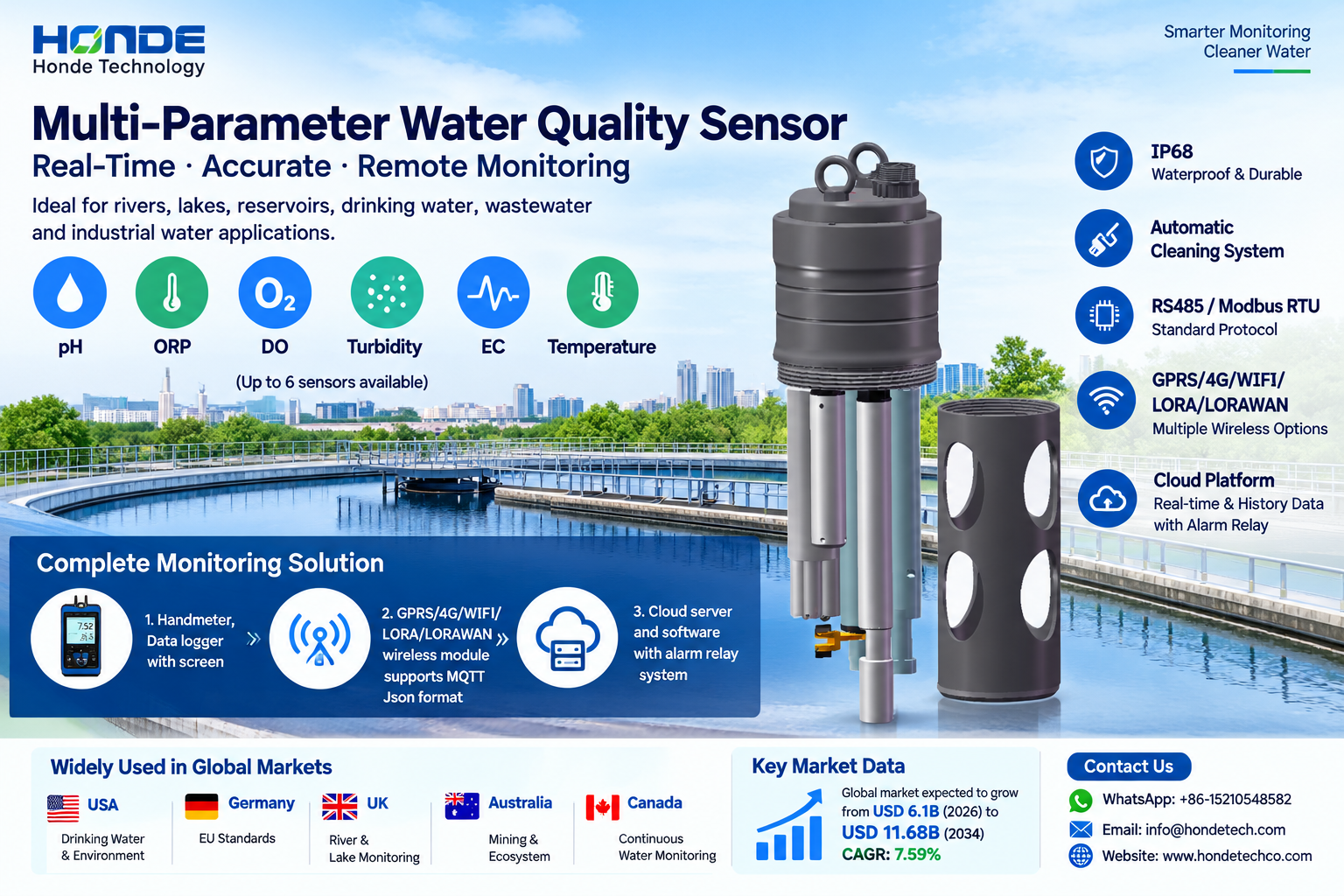
Honde’s online multi-parameter water quality sensor uses an integrated architecture in which multiple digital sensors can be configured in one platform. The official product information states that the platform can accommodate up to six sensors plus one wiper, with automatic sensor recognition.
The system supports RS485 and Modbus RTU communication. It is designed with IP68 protection, low-power mode and water-leak alarm functionality. A matched automatic cleaning brush can be used where long-term submerged monitoring creates fouling or biofilm challenges.
Possible measurement modules include:
TABLE 3 — CONFIGURABLE MONITORING PARAMETERS
Parameter | Typical Project Purpose
Temperature | Compensation, seasonal trend and process monitoring
pH | Acid/base condition and treatment-process control
ORP | Oxidation-reduction condition
Dissolved Oxygen (DO) | Aquaculture, rivers, wastewater and biological process monitoring
Conductivity / EC | Ionic concentration and water-condition trend
TDS / Salinity | Water chemistry and salinity trend
Turbidity / SS | Suspended solids, runoff and water clarity
COD | Organic pollution / wastewater process monitoring
Ammonia Nitrogen | Aquaculture and wastewater nutrient monitoring
Nitrate Nitrogen | Nutrient pollution and water-resource studies
Total Nitrogen | Nutrient-load monitoring
Chlorophyll-a | Algae and eutrophication monitoring
Blue-Green Algae | Cyanobacteria-related monitoring
Oil in Water | Industrial and environmental monitoring
Water Level | Combined environmental monitoring stations
Not every project needs every parameter. The commercial advantage is configurability: the sensor package can be matched to the actual monitoring objective rather than forcing the buyer to purchase a fixed combination.
6. THE THREE-LAYER SOLUTION: LOCAL, WIRELESS AND CLOUD
For a remote monitoring project, the sensor itself is only the first layer.
HONDE REMOTE WATER QUALITY MONITORING SOLUTION
Layer 1 — Field Measurement
Handmeter + data logger with screen
↓
Local display and field verification
↓
Layer 2 — Wireless Communication
GPRS / 4G / WiFi / LoRa / LoRaWAN
MQTT / JSON data transmission
↓
Layer 3 — Cloud Platform
Cloud server + software + alarm relay
↓
Real-time data + historical data + alarm management
The complete solution supplied by Honde can be described as:
1. Handmeter, Data logger with screen;
2. GPRS/4G/WIFI/LORA/LORAWAN wireless module supports MQTT Json format;
3. Cloud server and software with alarm relay system support to see the real time data, history data.
This structure is particularly useful when the monitoring point is far from a control room. Instead of sending technicians to collect every reading manually, the monitoring network can transmit data remotely and preserve historical records for later analysis.
7. APPLICATION SCENARIO 1 — U.S. RESERVOIR AND RIVER MONITORING
A practical U.S. deployment can be designed around a reservoir, tributary or source-water intake.
Field requirement:
- Continuous measurement rather than occasional sampling
- Several parameters at the same point
- Local backup data
- Remote data transmission
- Alarm when abnormal changes occur
- Historical records for trend analysis
Recommended configuration:
Temperature + pH + DO + conductivity + turbidity
Deployment concept:
The submerged probe is installed at a representative monitoring point. The local data logger provides on-site verification and storage. A 4G or LoRaWAN communication module transfers data to the cloud platform. The operator can review current values and historical trends from the software.
A useful alarm strategy is not simply “one number is high.” The project can define threshold rules for individual parameters and use trend changes as a trigger for field inspection.
This type of architecture is consistent with EPA’s documented interest in online water-quality monitoring for source waters, distribution systems and contamination-event detection.
8. APPLICATION SCENARIO 2 — EUROPEAN WASTEWATER AND RECEIVING-WATER MONITORING
European wastewater regulation is strengthening the need for systematic monitoring. Directive (EU) 2024/3019 requires monitoring of urban wastewater treatment plant discharges and, for relevant agglomerations, monitoring at treatment-plant inlets and outlets for specified pollutants and other parameters.
This creates a practical role for online multi-parameter systems as part of a broader monitoring network.
Example engineering arrangement:
Influent monitoring point
→ pH / EC / temperature / turbidity / selected nutrient parameters
Biological treatment zone
→ DO / pH / temperature / ORP
Final effluent
→ pH / EC / turbidity / temperature / selected nutrient parameters
Receiving water
→ pH / DO / EC / turbidity / temperature
The multi-parameter probe does not replace laboratory compliance testing where regulations require certified analytical methods. Its value is continuous operational visibility: it can help identify changes between scheduled laboratory measurements and support faster field response.
9. APPLICATION SCENARIO 3 — AUSTRALIAN MINING-IMPACT MONITORING
Australia provides a strong example of environmental monitoring in remote locations.
The Australian Government’s Office of the Supervising Scientist operates formal water-quality monitoring around the Ranger mine area in the Alligator Rivers Region, using early detection monitoring and long-term ecosystem assessment.
A comparable field architecture can use:
Multi-parameter probe
→ local data logger
→ solar-powered field station
→ 4G / LoRaWAN communications
→ cloud server
→ alarm relay
→ environmental team
For remote sites, low-power operation and automatic cleaning are important because maintenance visits can be expensive. The purpose is not to eliminate laboratory analysis. It is to increase observation frequency and provide an early indication that conditions may have changed.
10. APPLICATION SCENARIO 4 — CANADIAN RIVER AND FRESHWATER MONITORING
Canada’s long-term monitoring network illustrates why continuous multiparameter data are valuable.
Federal continuous freshwater datasets include hourly measurements of temperature, dissolved oxygen, specific conductance, pH and turbidity at many monitoring locations.
For a remote river station, a practical configuration can therefore combine:
Temperature
+
DO
+
pH
+
EC / conductivity
+
Turbidity
+
Local data logging
+
4G / LoRaWAN
+
Cloud history
The resulting time series can help distinguish short-term events from longer seasonal changes. For example, a sudden turbidity increase after heavy rainfall can be viewed together with conductivity and dissolved oxygen changes rather than treated as an isolated number.
11. APPLICATION SCENARIO 5 — AQUACULTURE AND RECIRCULATING WATER SYSTEMS
Aquaculture is one of the most direct commercial applications for multi-parameter monitoring.
Fish and shrimp production systems are sensitive to dissolved oxygen, temperature, pH, conductivity/salinity and other water conditions. Operators need measurements frequently enough to respond before a water-quality problem becomes a production problem.
A typical configuration can be:
DO + temperature + pH + EC/salinity + turbidity
↓
Local display
↓
4G / WiFi / LoRaWAN
↓
Cloud dashboard
↓
Alarm relay
For a farm with multiple ponds, each pond can become an independent monitoring node. Historical records can then be compared across ponds, feeding periods, weather conditions and operating cycles.
12. PRODUCT ADVANTAGES FOR SYSTEM INTEGRATORS
TABLE 4 — ENGINEERING VALUE
Feature | Practical Advantage
Multiple digital sensors | Several water-quality variables can be measured from one monitoring point
RS485 / Modbus RTU | Easy integration with PLC, RTU, SCADA and data-acquisition systems
IP68 protection | Suitable for submerged and outdoor monitoring installations
Automatic sensor recognition | Simplifies configuration when compatible modules are installed
Automatic cleaning option | Helps reduce fouling-related maintenance in long-term deployments
Low-power mode | Useful for remote monitoring stations and solar-powered systems
Leakage alarm | Adds an equipment-protection layer
Wireless options | Supports different project communication environments
MQTT / JSON | Suitable for IoT and cloud-based data transmission
Cloud platform | Enables real-time and historical data viewing
Alarm relay | Allows abnormal conditions to be linked to remote warning or control workflows
Configurable parameters | Lets project designers select the measurement combination required by the site
13. WHY COMMUNICATION OPTIONS MATTER IN REAL PROJECTS
Different monitoring sites have different network conditions.
TABLE 5 — COMMUNICATION SELECTION
Communication | Suitable Environment | Typical Role
GPRS | Legacy cellular coverage / low-data installations | Basic remote transmission
4G | Widely available cellular areas | Real-time remote monitoring
WiFi | Farms, plants, campuses and facilities with local network access | Short-range internet connection
LoRa | Private low-power sensor networks | Multi-node field deployments
LoRaWAN | Large-area low-power IoT networks | Remote monitoring with gateway architecture
RS485 | Local industrial wiring | PLC / RTU / SCADA integration
A flexible communication architecture prevents the sensor from being locked to one network technology. This matters when a product is sold internationally because the connectivity conditions in a wastewater plant in Germany are very different from those at a remote mining site in Australia or a reservoir station in the United States.
14. MARKET SIGNALS IN NUMBERS
TABLE 6 — PUBLICLY DOCUMENTED MARKET / MONITORING DATA
Indicator | Published Figure / Finding | Why It Matters
Global water quality monitoring systems market, 2025 | USD 6.09 billion | Demonstrates the scale of the monitoring-system market
Projected market, 2026 | USD 6.51 billion | Shows continued near-term expansion
Projected market, 2034 | USD 11.68 billion | Indicates long-term system demand
Forecast CAGR, 2026–2034 | 7.59% | Indicates sustained growth
Asia Pacific share, 2025 | 30.71% | Confirms strong regional market activity
Canada continuous freshwater dataset | More than 23 locations | Demonstrates established continuous-monitoring practice
Canadian continuous measurements | Many sites record hourly temperature, DO, specific conductance, pH and turbidity | Shows the practical value of multiparameter time-series monitoring
EU wastewater plants | Requirements apply to urban wastewater treatment monitoring, with additional monitoring requirements for relevant agglomerations | Supports demand for systematic monitoring infrastructure
15. A SIMPLE DATA-VOLUME EXAMPLE FOR REMOTE MONITORING
Consider one monitoring station measuring five parameters every 10 minutes.
5 parameters × 6 measurements/hour × 24 hours × 30 days
= 21,600 parameter readings per month
For 10 stations:
21,600 × 10
= 216,000 parameter readings per month
This is why a cloud-based monitoring platform becomes important as the number of stations increases. Manual collection becomes increasingly inefficient when the project generates tens or hundreds of thousands of readings each month.
The purpose of the wireless and cloud architecture is therefore not simply “remote viewing.” It is to turn a field sensor into a manageable data source.
16. WHAT BUYERS SHOULD CHECK BEFORE ORDERING
A multi-parameter sensor should be selected according to the project rather than by parameter count alone.
Buyer checklist:
1. Which parameters are actually required?
2. Is the installation temporary or long-term?
3. Will the probe be submerged continuously?
4. Is biofouling expected?
5. Is automatic cleaning required?
6. Is RS485 Modbus integration required?
7. Is cellular coverage available?
8. Is 4G, WiFi, LoRa or LoRaWAN more practical?
9. Is local data storage required when communication fails?
10. Does the project require cloud access?
11. Are alarm relays required?
12. What calibration and maintenance interval is acceptable?
13. Is laboratory verification required by local regulation?
14. Does the project need solar power or low-power operation?
17. CONCLUSION
The next phase of water-quality monitoring is not simply about adding more sensing elements. It is about connecting field measurements to a complete monitoring workflow.
For a river station, that can mean a submerged multi-parameter probe connected to a local logger and 4G gateway.
For a wastewater plant, it can mean RS485/Modbus integration with the plant control system and cloud-based historical records.
For a remote mining project, it can mean a low-power station with automatic cleaning, LoRaWAN or 4G communication and alarm notifications.
For aquaculture, it can mean continuous DO, temperature, pH and salinity monitoring with automatic alerts.
Across these applications, the underlying requirement is similar: reliable measurements, practical communications, accessible historical data and a faster way to identify abnormal conditions.
Honde’s multi-parameter water quality monitoring architecture combines the sensor platform with field data logging, wireless communication and cloud software, allowing international project integrators to build monitoring systems around the actual requirements of each site.
CONTACT HONDE TECHNOLOGY
WhatsApp: +86-15210548582
Email: info@hondetech.com
Company: Honde Technology Co., Ltd.
Website: www.hondetechco.com
Post time: Sep-28-2026