

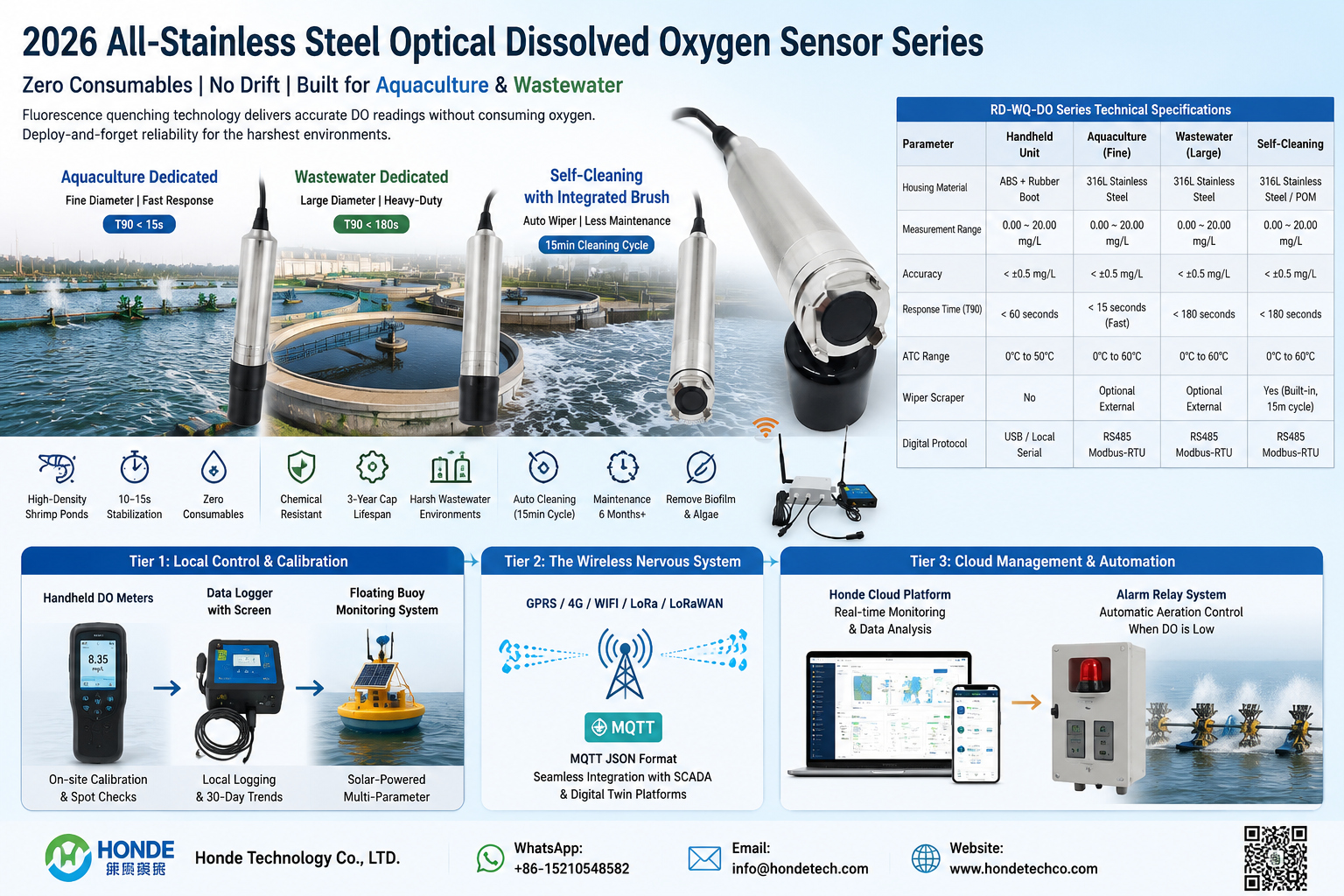
The Reality of Field Operations: Why Membranes and Electrolyte are Operational Liabilities
For years, facilities managing wastewater treatment or commercial aquaculture had to accept a frustrating maintenance loop: deploying polarographic dissolved oxygen (DO) sensors meant dedicating labor to replacing torn membranes, refilling depleted electrolytes, and recalibrating drifted sensors every few weeks. In harsh environments like aeration basins or organic-rich shrimp ponds, bio-fouling (algae and biofilm buildup) would “blind” standard sensors within days, leading to false readings and catastrophic oxygen drops.
With the release of Honde Technology’s 2026 All-Stainless Steel Optical Dissolved Oxygen Sensor Series, the industry has a ruggedized, “deploy-and-forget” alternative that completely eliminates consumables.
The Optical Core: Fluorescence Quenching Explained
Instead of an electrochemical reaction that consumes oxygen, our sensors utilize the Fluorescence Quenching Principle (ISO 101.32 kPa calibration standards). A blue LED excites a robust, wear-resistant luminophore cap. Oxygen molecules in the water quench the returning red light. By measuring the phase shift, the internal microprocessor calculates dissolved oxygen down to 0.01 mg/L resolution without consuming a single molecule of oxygen.
Three Specialized Designs for 2026 Industrial Demands
To match different budget and deployment constraints, Honde has engineered three distinct physical configurations of the 316L stainless steel DO series:
1 Aquaculture Dedicated (Fine Diameter)
- The Design: A slim-profile, highly responsive probe designed specifically for high-density aquaculture (e.g., Whiteleg shrimp, eel, and mandarin fish).
- The Benefit: Features an ultra-fast stabilization time of 10 to 15 seconds after power-on, making it perfect for rapid onsite checks and solar-powered stations that operate on duty cycles to save power.
2 Wastewater Dedicated (Large Diameter)
- The Design: A heavy-duty, thick-walled 316L stainless steel probe engineered to withstand high shear forces, abrasive suspended solids, and chemical shock.
- The Benefit: Fully immune to interference from common industrial chemicals like H2S, heavy metals, and hydrocarbons, offering a 3-year membrane cap lifespan in raw industrial sewage.
3 Self-Cleaning with Integrated Brush
- The Design: Incorporates a mechanical wiper scraper directly on the sensor face (default cleaning cycle of 15 minutes).
- The Benefit: Physically removes biofilm, algae, and calcium scale automatically, extending manual maintenance intervals from “weekly” to “once every six months.”
Technical Specifications: RD-WQ-DO Series
| Parameter | Handheld Unit | Aquaculture (Fine) | Wastewater (Large) | Self-Cleaning |
|---|---|---|---|---|
| Housing Material | ABS + Rubber Boot | 316L Stainless Steel | 316L Stainless Steel | 316L Stainless Steel / POM |
| Measurement Range | 0.00 ~ 20.00 mg/L | 0.00 ~ 20.00 mg/L | 0.00 ~ 20.00 mg/L | 0.00 ~ 20.00 mg/L |
| Accuracy | < ±0.5 mg/L | < ±0.5 mg/L | < ±0.5 mg/L | < ±0.5 mg/L |
| Response Time (T90) | < 60 seconds | < 15 seconds (Fast) | < 180 seconds | < 180 seconds |
| ATC Range | 0°C to 50°C | 0°C to 50°C | 0°C to 60°C | 0°C to 60°C |
| Wiper Scraper | No | Optional External | Optional External | Yes (Built-in, 15m cycle) |
| Digital Protocol | USB / Local Serial | RS485 Modbus-RTU | RS485 Modbus-RTU | RS485 Modbus-RTU |
The Honde Full-Stack Monitoring Architecture
Hardware solves the physical detection, but a business owner needs an actionable data loop. Honde provides a complete 3-tier integration:
Tier 1: Local Control & Calibration
- Handheld DO Meters: Equipped with our Handmeter, technicians can perform rapid spot-checks and on-site air calibration (relying on built-in compensation table data).
- Local Terminals: Pumping stations utilize our Data Logger with screen for local data logging and 30-day graphical trends on-site.
- Open-Water Deployments: For reservoirs and large estuaries, our Floating Buoy System offers solar-powered autonomy, keeping the Automatic cleaning brush enabled multi-parameter probe suspended at the exact water depth needed.
Tier 2: The Wireless Nervous System
- Our sensors transmit data seamlessly using GPRS, 4G, WIFI, LoRa, or LoRaWAN wireless modules.
- The MQTT Logic: For smart city and industrial integrators, our modules natively support MQTT Json format, allowing the data to feed directly into SCADA and Digital Twin platforms without proprietary drivers.
Tier 3: Cloud Management & Automation (The Safety Loop)
- All data feeds into the Honde Cloud Server and Software, providing a real-time management dashboard from any web browser or mobile app.
- The Alarm Relay System: When dissolved oxygen levels drop below a critical threshold (e.g., 4.0 mg/L in shrimp ponds or 2.0 mg/L in municipal aeration tanks), the platform triggers a physical Alarm Relay on-site, automatically starting the paddlewheel aerators or opening pure oxygen injection valves.
Contact Honde Technology for Project Inquiries
For more sensor information and customized IoT solutions, please contact Honde Technology Co., LTD.
- WhatsApp: +86-15210548582
- Email: info@hondetech.com
- Company Website: www.hondetechco.com
Post time: Jun-09-2026