

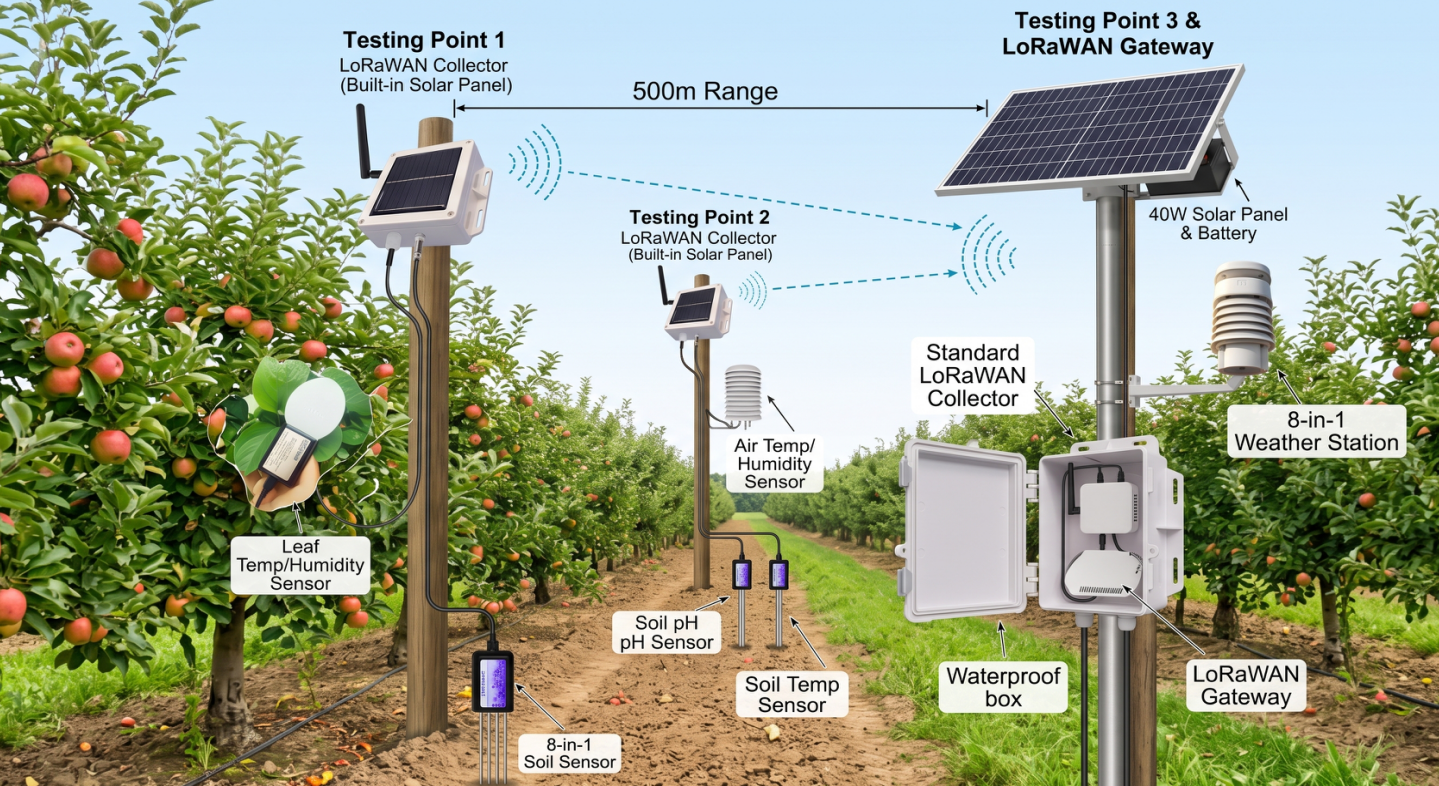
An orchard monitoring system combines leaf sensors, soil sensors, an agricultural weather station, and a solar powered LoRaWAN data collection network to help growers monitor environmental conditions across fruit-growing areas. By connecting field sensors to wireless collectors and a gateway, orchard operators can access selected environmental measurements remotely and analyze changes in crop conditions, soil moisture, and local weather.
For orchards with distributed monitoring points, this integrated architecture offers a practical approach to precision agriculture, remote environmental monitoring, and data-driven irrigation management.
Honde Technology Co., Ltd. provides agricultural sensing and IoT monitoring solutions that can be configured according to project requirements. Explore our Orchard Monitoring System With Leaf and Soil Sensors for a solution tailored to your application.
1. Why Do Orchards Need Integrated Environmental Monitoring?
Fruit production depends on more than rainfall or soil moisture alone. Atmospheric conditions, leaf-level environmental changes, and root-zone conditions interact throughout the growing season.
Traditional manual inspections provide useful observations, but measurements collected at different times and locations can make it difficult to understand environmental variations across a large orchard.
An integrated orchard monitoring system helps address this challenge by connecting several types of sensors within one data collection architecture.
Key monitoring objectives include:
- Tracking leaf temperature and humidity where supported by the selected sensor.
- Measuring soil moisture and temperature to understand root-zone conditions.
- Monitoring local weather conditions such as air temperature, humidity, wind, and rainfall.
- Collecting data from multiple locations across the orchard.
- Transmitting measurements wirelessly to a gateway or remote monitoring platform.
- Supporting irrigation planning and environmental analysis using historical and current data.
The actual parameters available depend on the selected sensors and system configuration.
2. How Does a Solar Powered LoRaWAN Orchard Monitoring System Work?
A typical system can be organized into four functional layers.
Leaf and Soil Sensors + Weather Station → Solar Powered LoRaWAN Collector → LoRaWAN Gateway → Cloud Platform or Remote Monitoring System
Each component has a specific role in the overall monitoring network.
Layer 1: Leaf Sensors for Plant Environment Monitoring
Leaf-level measurements provide information about environmental conditions around selected trees and their foliage.
Depending on the sensor model, leaf temperature and humidity measurements can help growers investigate local microclimate changes and compare environmental conditions between different orchard zones.
When selecting a leaf sensor, buyers should confirm whether the required parameter is leaf temperature, leaf humidity, leaf wetness, or a combination of these measurements. These terms are not interchangeable.
Layer 2: Soil Sensors for Root Zone Monitoring
Soil sensors measure conditions below the surface, where water availability and temperature influence the root environment.
Commonly selected parameters include:
- Soil moisture
- Soil temperature
- Soil electrical conductivity (EC)
- Soil pH, when supported by the selected model
Not every soil sensor measures all these parameters. The final configuration should match the crop, soil characteristics, installation depth, and monitoring objectives.
For additional information about integrated sensing architectures, see Honde’s Weather Station and Soil Sensor System With 4G MQTT.
Layer 3: Agricultural Weather Station
An agricultural weather station measures atmospheric conditions that can influence orchard management.
Depending on the selected model, monitoring parameters may include:
- Air temperature and relative humidity
- Wind speed and direction
- Rainfall
- Atmospheric pressure
- Solar radiation or light intensity
Combining weather measurements with soil data gives growers a broader view of the orchard environment. For example, rainfall and soil moisture can be reviewed together to understand how precipitation affects soil water conditions.
Learn more about Honde’s Agricultural Weather Station Solutions.
Layer 4: Solar Powered LoRaWAN Collector and Gateway
The wireless communication layer connects distributed field sensors with a remote monitoring system.
A LoRaWAN collector gathers data from compatible sensors and transmits it wirelessly. A gateway receives the transmitted data and forwards it to a cloud server or another supported platform using an available backhaul connection, such as 4G or Ethernet.
Solar power can help support installations where grid electricity is unavailable or difficult to access.
Before deployment, confirm the collector’s sensor interfaces, radio frequency, LoRaWAN compatibility, gateway configuration, power requirements, and server protocol. LoRa and LoRaWAN are related but distinct technologies, so end-to-end compatibility should be verified for the selected equipment.
3. System Components and Their Functions
| Component | Main Function | Potential Application |
|---|---|---|
| Leaf Sensor | Measures selected leaf-level parameters | Plant environment monitoring |
| Soil Sensor | Measures selected soil parameters | Root-zone condition monitoring |
| Agricultural Weather Station | Measures local atmospheric conditions | Orchard weather analysis |
| Solar Powered Collector | Acquires and transmits compatible sensor data | Distributed field deployment |
| LoRaWAN Gateway | Receives wireless data and forwards it upstream | Network connectivity |
| Cloud Platform | Stores and displays data when included | Remote access and historical analysis |
The complete configuration can be customized according to the number of monitoring points, sensor parameters, communication requirements, and the software platform used by the customer.
4. Key Benefits for Smart Orchard Management
Distributed Monitoring Across the Orchard
Different orchard zones may experience different soil and microclimate conditions due to terrain, tree density, sunlight exposure, and irrigation practices.
Placing sensors at representative locations helps growers compare these variations instead of relying on a single measurement point.
Reduced Dependence on Manual Data Collection
Wireless data acquisition can reduce the need for staff to visit every sensor location simply to collect readings. The extent of remote access depends on the installed communication network and monitoring platform.
More Informed Irrigation Decisions
Soil moisture data provides information about soil water conditions, while weather measurements add context about recent rainfall and local environmental changes.
Reviewing these data together can support irrigation planning. Actual irrigation recommendations should also account for crop stage, soil type, root depth, and local agronomic practices.
Flexible Expansion
A modular architecture allows the monitoring network to be designed around the initial project requirements, with potential expansion where the collector, gateway, and software support additional devices.
Buyers should evaluate network capacity and compatibility before adding more sensors.
5. What Should Buyers Check Before Ordering?
Choosing an orchard monitoring system involves more than comparing individual sensor prices.
Consider the following questions before requesting a quotation:
- Which parameters are required? Identify the exact leaf, soil, and weather measurements needed for the project.
- How many monitoring points are planned? Determine the number of sensors, collectors, and gateways required.
- Which wireless protocol is needed? Confirm LoRa or LoRaWAN requirements, regional frequency settings, and device compatibility.
- How will the system be powered? Evaluate solar panel capacity, battery storage, local sunlight conditions, and the energy consumption of each device.
- Where will the data be sent? Confirm whether the project requires a cloud platform, customer server, 4G connectivity, MQTT, or another supported interface.
- What environmental protection is required? Check the specified ingress protection rating, temperature range, mounting arrangement, and outdoor installation requirements.
- Can the system be customized? Confirm sensor combinations, cable lengths, communication interfaces, and software integration options with the supplier.
These checks help align the final equipment configuration with the actual orchard deployment.
6. Typical Applications
An integrated orchard monitoring network can be adapted for:
- Apple orchards and other fruit plantations
- Citrus and tropical fruit farms
- Precision irrigation projects
- Agricultural research and field trials
- Remote environmental monitoring
- Digital farming and agricultural IoT platforms
The exact configuration will vary according to the crop, local environment, monitoring objectives, and communication infrastructure.
Frequently Asked Questions
What is an orchard monitoring system?
An orchard monitoring system combines sensors and communication equipment to collect selected environmental data from fruit-growing areas. It can integrate leaf sensors, soil sensors, weather stations, wireless collectors, gateways, and remote monitoring software.
Why combine leaf sensors, soil sensors, and a weather station?
Each component measures a different part of the growing environment. Leaf sensors provide leaf-level measurements, soil sensors monitor root-zone conditions, and weather stations measure atmospheric variables. Reviewing these measurements together provides a more comprehensive environmental dataset.
Can the system operate without grid electricity?
Solar powered collectors and gateways can be used in suitable off-grid deployments. The required solar panel and battery capacity depend on the equipment’s energy consumption, sampling frequency, communications activity, and local sunlight conditions.
Does LoRaWAN support long-distance agricultural monitoring?
LoRaWAN is designed for low-power wide-area IoT communication. Actual coverage depends on the radio configuration, antennas, terrain, obstructions, interference, and local regulations. A site survey or field test is recommended for project planning.
Can sensor data be sent to an existing cloud platform?
This depends on the collector, gateway, and software configuration. Confirm the supported protocols, data format, server interface, and integration requirements before ordering.
Can Honde customize an orchard monitoring solution?
Honde Technology can discuss project-specific combinations of agricultural sensors, wireless data collection, gateway connectivity, and monitoring requirements. The final configuration should be confirmed against the selected product specifications.
Conclusion: Build a Connected Orchard Monitoring Network
A smart orchard monitoring system connects leaf-level measurements, soil conditions, local weather, wireless data collection, and remote monitoring into one coordinated architecture.
By selecting suitable sensors and a compatible solar powered LoRaWAN network, orchard operators can build a monitoring solution tailored to their field layout and data requirements.
Honde Technology Co., Ltd. supports agricultural and environmental IoT projects with configurable sensing and monitoring solutions.
Planning an orchard monitoring project?
Contact Honde Technology to discuss your required sensor parameters, number of monitoring points, wireless communication method, power supply, and data integration needs.
Company: Honde Technology Co., Ltd.
Website: https://www.hondetechco.com/
Email: info@hondetech.com
Request a customized configuration and quotation for your orchard monitoring project.
Post time: Oct-27-2026