

1.From Passive Monitoring to Real-Time Early Warning
Traditional water level monitoring methods often rely on manual inspection or outdated sensing technologies. These approaches are not only labor-intensive but also prone to delays and inaccuracies during critical flood events.
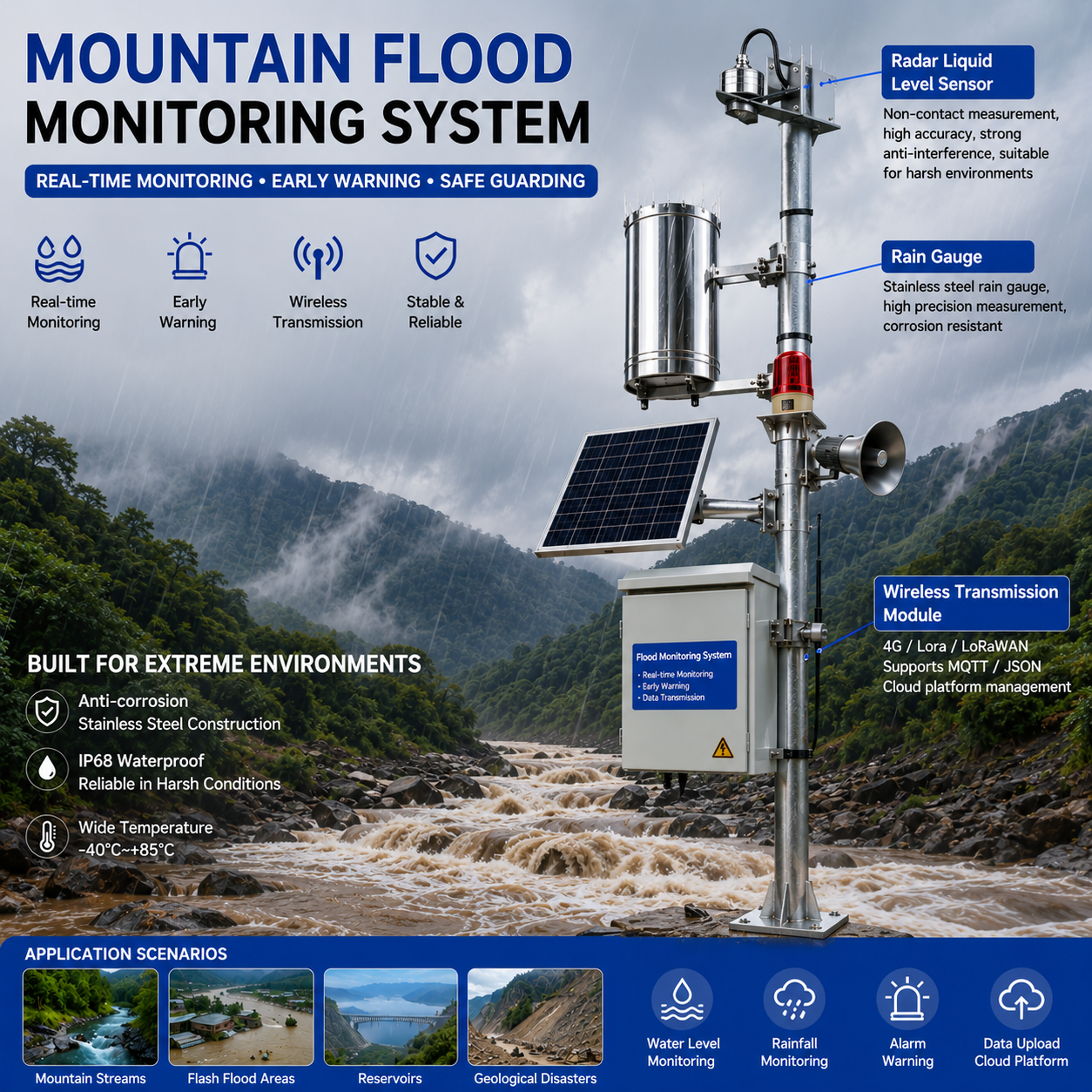
Today’s advanced flood monitoring systems integrate:
- High-precision radar level sensors
- Rain gauges and multi-parameter sensors
- Wireless communication modules (4G / LoRa / NB-IoT)
- Cloud-based data platforms and alarm systems
These systems enable continuous real-time monitoring, automatic alerts, and remote data visualization, significantly improving emergency response efficiency.
2.Why Radar Level Sensors Are Driving Market Demand
Among all sensing technologies, radar water level sensors are emerging as the preferred choice for flood monitoring applications.
1. Unaffected by Harsh Weather Conditions
Unlike ultrasonic sensors, radar technology is immune to fog, rain, temperature fluctuations, and vapor interference — ensuring stable performance in extreme environments.
2. High Accuracy for Critical Decision-Making
Modern radar sensors can achieve millimeter-level accuracy and support long-distance measurement (up to 30m or more), making them ideal for rivers, reservoirs, and urban drainage systems.
3. Non-Contact & Maintenance-Free
Radar sensors operate without direct contact with water, reducing corrosion risks and significantly lowering maintenance costs.
4. Seamless IoT Integration
With support for RS485, Modbus, 4-20mA, and wireless transmission, radar sensors can easily integrate into smart city and environmental monitoring networks.
3.A Complete Flood Monitoring Solution for Modern Infrastructure
The latest integrated flood monitoring systems go beyond single-point sensing. They provide a comprehensive solution, including:
These systems are widely used in:
- Urban flood control and smart drainage networks
- Hydrological monitoring stations
- Hydropower and reservoir management
- Agriculture irrigation systems
- Disaster early warning systems
4.Market Trend: From Equipment to Intelligent Systems
The global market is shifting from standalone sensors to integrated, intelligent monitoring ecosystems.
Key trends include:
- Adoption of 80GHz high-frequency radar for higher precision
- Growing demand for solar-powered, low-power systems in remote areas
- Integration with AI analytics and predictive flood modeling
- Expansion of smart city infrastructure projects
According to industry data, radar-based monitoring solutions are increasingly favored for their long lifespan (8–12 years) and reliability in harsh environments.
5.Why This Matters for Buyers and Distributors
For B2B buyers, choosing the right flood monitoring solution is no longer just about price — it’s about system reliability, scalability, and data intelligence.
A high-quality radar-based system can deliver:
Faster Disaster Response
Reduced Operational Costs
Improved Data Accuracy
Stronger Project Competitiveness
6.Conclusion
As extreme weather becomes the new normal, real-time flood monitoring systems powered by radar technology are no longer optional — they are essential infrastructure.
Companies that adopt these advanced solutions today will not only enhance safety and resilience but also gain a competitive edge in the rapidly evolving environmental monitoring market.
WhatsApp: +86-15210548582
Email: info@hondetech.com Company
website: www.hondetechco.com
Post time: May-30-2026