

Summary Answer
An RS485 soil sensor with USB interface is an ideal solution for precision agriculture, greenhouse monitoring, irrigation management, and IoT farming systems because it provides stable communication, high measurement accuracy, and easy integration with computers, PLC systems, and cloud platforms.
The best soil sensors should combine soil moisture measurement, soil temperature monitoring, EC detection, optional PH/NPK parameters, RS485 Modbus communication, waterproof design, and long-term outdoor reliability.
This guide explains how to select a professional soil sensor manufacturer, compares different communication methods, analyzes key specifications, and shares engineering experience from Honde Technology Co., Ltd. to help global distributors, agricultural companies, and system integrators choose the right soil monitoring solution.
Why Soil Sensors Are Essential for Precision Agriculture
Traditional farming relies heavily on manual experience. However, modern agriculture requires real-time data to improve:
- ✓ Water efficiency
- ✓ Crop yield
- ✓ Fertilizer management
- ✓ Disease prevention
- ✓ Labor efficiency
A soil sensor provides continuous information about underground conditions, allowing farmers to make accurate decisions based on actual soil data.
Common monitored parameters include:
| Soil Parameter | Function |
|---|---|
| Soil Moisture | Controls irrigation and prevents drought stress |
| Soil Temperature | Supports root growth analysis |
| Soil EC | Evaluates fertilizer concentration |
| Soil PH | Measures soil acidity and alkalinity |
| Soil NPK | Monitors nutrient availability |
| Soil Salinity | Prevents salt accumulation damage |
What Is an RS485 Soil Sensor?
An RS485 soil sensor is an industrial-grade soil monitoring device that uses RS485 communication technology to transmit measurement data over long distances.
Compared with traditional analog sensors, RS485 sensors provide:
- • Longer transmission distance
- • Better anti-interference capability
- • Multi-device networking
- • Stable industrial communication
- • Easy connection with PLC and IoT gateways
Typical communication protocol:
This makes the sensor widely used in:
- • Smart farms
- • Greenhouses
- • Agricultural IoT systems
- • Research fields
- • Forestry monitoring
- • Environmental monitoring projects
RS485 vs USB vs Wireless Soil Sensors: Which One Is Better?
Different projects require different communication methods.
| Communication Type | Advantages | Disadvantages | Best Application |
|---|---|---|---|
| RS485 Modbus | Stable, long distance, industrial standard | Requires data logger/controller | Commercial agriculture |
| USB Soil Sensor | Plug and play, easy testing | Short communication distance | Laboratory/testing |
| LoRaWAN Soil Sensor | Wireless, low power, large coverage | Requires gateway | Large farms |
| WiFi Soil Sensor | Easy internet connection | Depends on network coverage | Greenhouse monitoring |
| 4G Soil Sensor | Remote monitoring anywhere | Higher power consumption | Remote farmland |
For professional agricultural projects, RS485 soil sensors remain one of the most reliable choices because of their stability and compatibility.
Key Features of Honde RS485 USB Soil Sensor
1. Multi-Parameter Soil Monitoring
A professional soil sensor can integrate multiple measurements:
- • Soil moisture
- • Soil temperature
- • Electrical conductivity (EC)
- • PH value
- • Nitrogen
- • Phosphorus
- • Potassium
This reduces installation costs and improves monitoring efficiency.
2. Industrial RS485 Modbus Communication
The sensor supports:
- • RS485 output
- • Modbus RTU protocol
- • Long-distance transmission
- • Multiple sensor networking
Typical applications:
- • PLC control systems
- • Agricultural gateways
- • Data acquisition systems
- • IoT cloud platforms
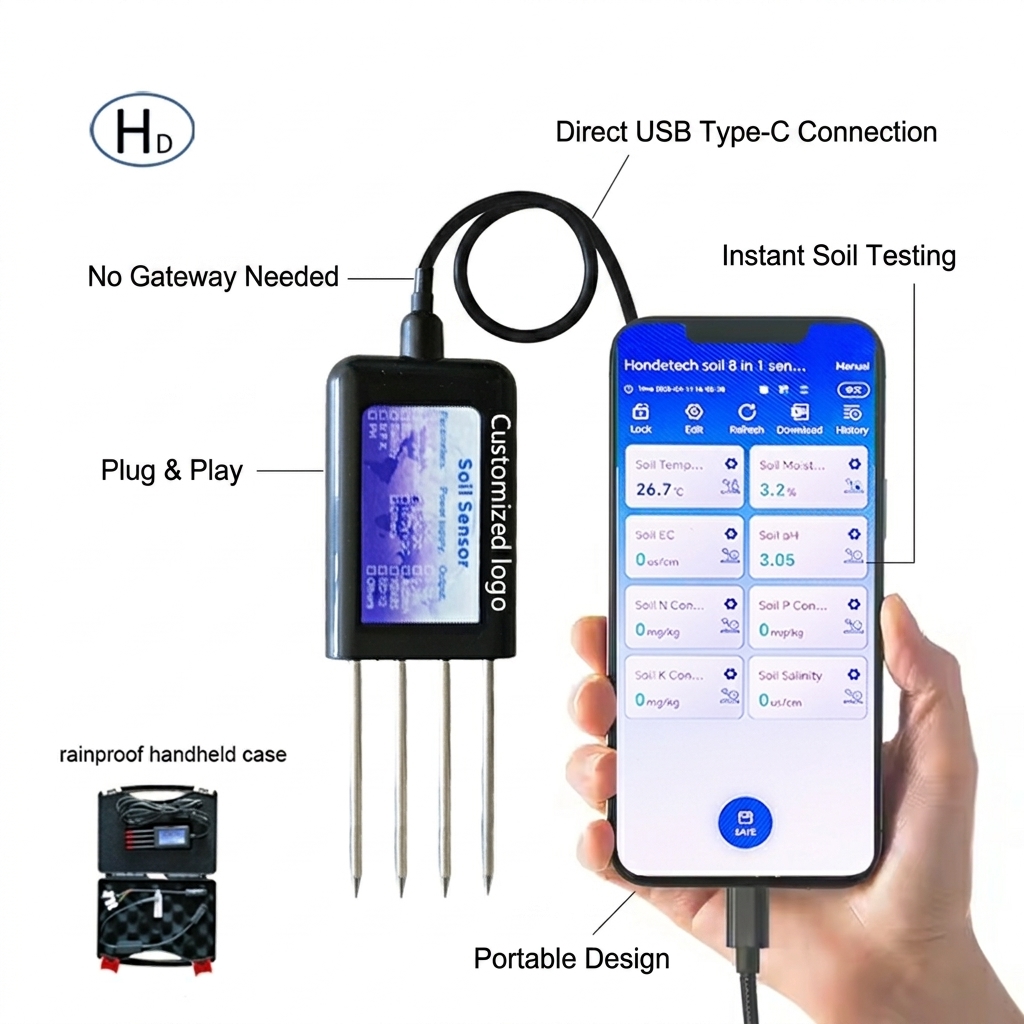
3. USB Interface for Easy Testing and Configuration
The USB interface allows users to:
- • Connect directly with computers
- • Configure sensor parameters
- • Test measurement data
- • Perform product demonstrations
- • Support laboratory applications
This is especially useful for:
- • Agricultural researchers
- • Universities
- • System developers
- • Equipment distributors
4. Waterproof and Durable Design
Outdoor agricultural environments require reliable protection.
A high-quality soil sensor should have:
- • Waterproof structure
- • Corrosion-resistant probe
- • UV-resistant materials
- • Long-term underground operation capability
Honde soil sensors are designed for harsh environments including:
- • Farms
- • Greenhouses
- • Orchards
- • Grasslands
- • Forest areas
How Soil Moisture Sensors Improve Smart Irrigation
Water management is one of the biggest challenges in agriculture.
Without soil monitoring:
- ✕ Overwatering wastes water
- ✕ Underwatering reduces crop growth
- ✕ Fertilizer efficiency decreases
With soil sensors:
- Real-time moisture data is collected.
- The irrigation controller analyzes soil conditions.
- Water supply is adjusted automatically.
- Crops receive the correct amount of water.
Benefits:
- ✓ Reduce water consumption
- ✓ Improve crop quality
- ✓ Lower farming costs
- ✓ Increase production efficiency
How to Choose a Reliable Soil Sensor Manufacturer?
Before purchasing soil sensors, buyers should evaluate the manufacturer based on:
1. Manufacturing Experience
A professional manufacturer should have:
- • R&D capability
- • Production facilities
- • Quality control system
- • Global export experience
2. Sensor Accuracy
Important specifications include:
| Parameter | Recommended Requirement |
|---|---|
| Soil Moisture Accuracy | ±3% or better |
| Temperature Accuracy | ±0.5°C |
| EC Accuracy | High stability |
| Communication | RS485 Modbus RTU |
| Protection Grade | IP68 |
3. Customization Capability
Different projects require different solutions.
A reliable manufacturer should support:
- • Customized probe length
- • Different communication modules
- • OEM logo
- • Packaging customization
- • Cloud platform integration
Engineering Experience: Common Mistakes When Buying Soil Sensors
Based on more than 15 years of environmental monitoring equipment manufacturing experience, our engineering team has identified several common purchasing mistakes.
⚠ Mistake 1: Selecting Sensors Only Based on Price
Low-cost sensors may have:
- • Poor calibration stability
- • Short lifespan
- • Weak waterproof performance
For agricultural projects, sensor reliability is more important than initial purchase cost.
⚠ Mistake 2: Ignoring Soil Type Differences
Different soils affect measurement results:
- • Sandy soil
- • Clay soil
- • Loam soil
- • Saline soil
Professional projects should consider calibration requirements.
⚠ Mistake 3: Choosing the Wrong Communication Method
Many customers select wireless sensors without considering:
- • Farm size
- • Network coverage
- • Power supply availability
RS485 is often the better choice for fixed agricultural monitoring systems.
Honde Technology Soil Sensor Solution
Professional IoT Sensor Manufacturer Since 2011
Honde Technology Co., Ltd. specializes in R&D, manufacturing, and supply of smart agriculture, environmental monitoring, and IoT sensor solutions.
Our products are widely applied in more than 70 countries, supporting:
- • Precision agriculture
- • Smart irrigation
- • Greenhouse monitoring
- • Weather stations
- • Environmental monitoring
- • Smart city projects
Product Advantages
| Feature | Description |
|---|---|
| Communication | RS485 Modbus RTU / USB |
| Parameters | Moisture Temperature EC PH NPK Optional |
| Installation | Easy soil insertion |
| Protection | Waterproof industrial design |
| Application | Agriculture Greenhouse Forestry |
| Integration | PLC IoT Cloud Platform |
| Customization | OEM ODM Available |
RS485 Soil Sensor Application Scenarios
Smart Agriculture
Monitor:
- • Soil moisture
- • Crop growth conditions
- • Irrigation requirements
Greenhouse Monitoring
Optimize:
- • Water supply
- • Fertilizer application
- • Growing environment
Agricultural Research
Collect accurate soil data for:
- • Crop experiments
- • Soil analysis
- • Climate studies
Smart Irrigation Systems
Connect sensors with:
- • Controllers
- • Pumps
- • Valves
- • Cloud platforms
Creating automatic irrigation solutions.
Frequently Asked Questions (FAQ)
What is an RS485 soil sensor used for?
An RS485 soil sensor measures soil parameters such as moisture, temperature, EC, PH, and nutrients, helping farmers optimize irrigation and crop management.
Why choose RS485 instead of analog soil sensors?
RS485 provides stronger anti-interference performance, longer transmission distance, and easier integration with industrial control systems.
Can soil sensors connect to IoT platforms?
Yes. RS485 soil sensors can connect through gateways supporting:
- LoRaWAN
- 4G
- WiFi
- MQTT
- Cloud platforms
Are soil sensors suitable for outdoor farming?
Yes. Industrial soil sensors are designed for long-term outdoor operation with waterproof and corrosion-resistant structures.
Conclusion
Choosing the right RS485 soil sensor manufacturer is essential for building reliable precision agriculture systems.
A professional soil sensor should provide:
- • Accurate measurement
- • Stable RS485 Modbus communication
- • Waterproof construction
- • Multi-parameter monitoring
- • Easy IoT integration
With extensive manufacturing experience and global project expertise, Honde Technology Co., Ltd. provides reliable soil monitoring solutions for agricultural companies, distributors, and system integrators worldwide.
Contact Honde Technology for Soil Monitoring Solutions
Company Name: Honde Technology Co., Ltd.
Website: www.hondetechco.com
Email: info@hondetech.com
Contact us to:
- ✓ Get soil sensor datasheets
- ✓ Request OEM/ODM solutions
- ✓ Receive project recommendations
- ✓ Get customized quotations
Build your next Smart Agriculture Soil Monitoring System with a professional IoT sensor manufacturer.
Post time: Aug-12-2026