

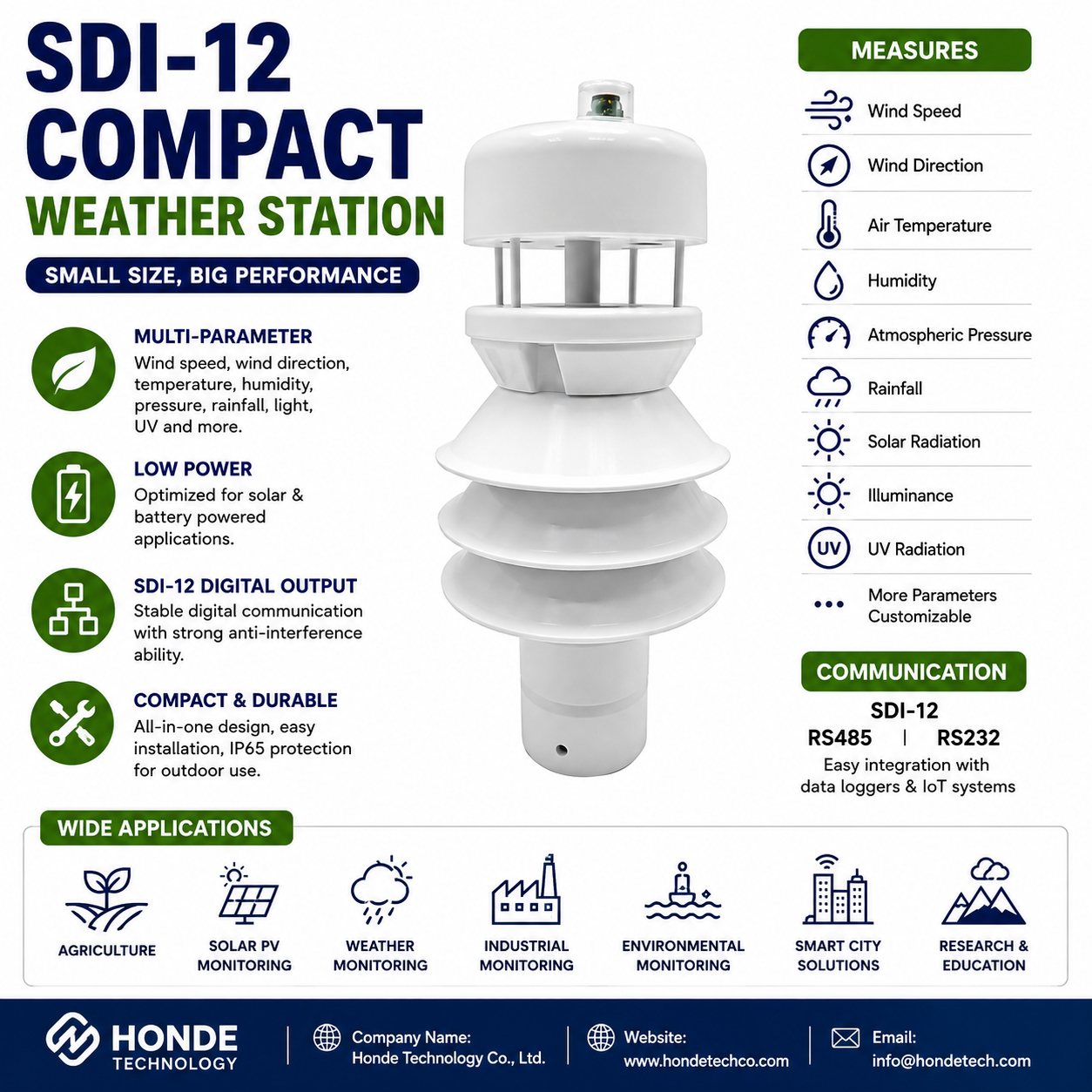
An SDI-12 compact weather station is a practical choice for long-term environmental monitoring when low power consumption, digital communication, compact installation, and reliable multi-parameter measurement are important. By combining sensors such as wind speed, wind direction, air temperature, humidity, pressure, rainfall, solar radiation and other environmental parameters in a compact platform, the system can be integrated with data loggers, remote monitoring equipment and IoT networks. Honde Technology also provides SDI-12, RS485 and RS232 communication options, as well as wireless solutions such as 4G, WiFi, LoRa and LoRaWAN for different deployment requirements.
What Is an SDI-12 Compact Weather Station?
SDI-12 stands for Serial Data Interface at 1200 baud and is a digital communication protocol widely used for low-power environmental sensors and data acquisition systems.
For remote weather monitoring, the main advantage is that the sensor can communicate digitally with a compatible data logger instead of relying only on traditional analog outputs.
According to Honde’s technical information, SDI-12 is particularly suitable for low-power environmental monitoring and can support multiple sensors on the same bus, making it useful for battery- and solar-powered monitoring systems.
A compact weather station can therefore combine:
- Wind Speed
- Wind Direction
- Air Temperature
- Relative Humidity
- Atmospheric Pressure
- Rainfall
- Solar Radiation
- Illumination
- UV Radiation
- PM2.5 / PM10
- Other customized environmental parameters
For example, one Honde 10-in-1 weather station configuration supports RS232, RS485 and SDI-12, with Modbus, NMEA-0183 and SDI-12 protocols.
Why Choose SDI-12 for Remote Weather Monitoring?
The communication interface is one of the most important considerations when designing a weather monitoring system.
1. Low-Power Communication
Remote weather stations are often installed in locations without stable grid power.
SDI-12 is designed for low-power environmental sensors, making it suitable for:
- Solar-powered weather stations
- Agricultural monitoring
- Remote environmental stations
- Hydrological monitoring
- Coastal monitoring
- Research stations
This is particularly valuable when the equipment needs to operate continuously with a battery and solar panel.
2. Digital Data Transmission
Unlike traditional analog signals, SDI-12 transmits sensor data digitally.
This can simplify integration with compatible data loggers and reduce some of the problems associated with analog signal acquisition.
3. Multi-Sensor Integration
A single monitoring system can integrate multiple environmental measurements, allowing users to build a more complete environmental data profile.
This is especially useful for smart agriculture, environmental research and meteorological observation.
What Parameters Can a Compact Weather Station Measure?
The exact configuration depends on the selected sensor combination.
| Measurement | Typical Application |
|---|---|
| Wind Speed | Weather monitoring, wind energy, construction |
| Wind Direction | Meteorology, agriculture, aviation |
| Air Temperature | Climate and environmental monitoring |
| Humidity | Agriculture, greenhouse monitoring |
| Air Pressure | Meteorological analysis |
| Rainfall | Agriculture, hydrology, weather observation |
| Solar Radiation | Solar PV performance and environmental research |
| Illumination | Agriculture and smart-city monitoring |
| UV Radiation | Environmental and solar studies |
| PM2.5 / PM10 | Air-quality monitoring |
Honde’s compact weather station platform is modular, allowing additional parameters to be customized depending on the project requirements.
SDI-12 vs RS485: Which Interface Should You Choose?
For system integrators, choosing the communication interface before purchasing the weather station can save significant integration time.
| Feature | SDI-12 | RS485 |
|---|---|---|
| Communication | Digital | Digital |
| Power consumption | Very low | Low |
| Multi-sensor bus | Excellent | Excellent |
| Typical application | Remote environmental sensors | Industrial monitoring |
| Data logger integration | Excellent | Excellent |
| Long-distance transmission | Suitable with system design | Up to long cable distances depending on installation |
| IoT integration | Usually through logger/gateway | Easy through gateway |
| Solar-powered deployment | Excellent | Excellent |
Honde provides both SDI-12 and RS485 configurations, allowing the same basic monitoring concept to be adapted to different data acquisition architectures.
Compact Design Makes Installation Easier
A major advantage of an integrated weather station is that several sensors can be combined into a single compact structure.
This reduces:
- Installation space
- Cable complexity
- Number of separate sensor housings
- Maintenance points
- Mechanical installation work
For example, Honde’s mini ultrasonic wind sensor weighs only 53 g and measures approximately 66 × 64 mm, making it suitable for compact or weight-sensitive applications. It supports SDI-12, Modbus-RTU and other communication protocols.
This type of compact architecture is particularly attractive for:
- Drones and UAV platforms
- Smart poles
- Portable monitoring equipment
- Small weather stations
- Remote IoT terminals
- Solar-powered monitoring systems
Ultrasonic Wind Measurement for Compact Weather Stations
For applications requiring a compact wind sensor, ultrasonic technology can eliminate the mechanical moving parts found in traditional cup anemometers.
Honde’s mini ultrasonic anemometer uses ultrasonic time-of-flight technology to measure wind speed and direction. The available specification includes a wind-speed range of 0–60 m/s, wind-direction measurement of 0–360°, and support for SDI-12, RS485, RS232 and other interfaces.
The absence of mechanical rotating components can also reduce mechanical wear and maintenance requirements.
Honde also offers larger integrated weather monitoring solutions where wind measurement can be combined with temperature, humidity, pressure, precipitation and radiation sensors.
From SDI-12 Sensor to Cloud Monitoring
An SDI-12 weather station does not have to remain an isolated data logger.
A typical architecture can be:
For projects requiring remote monitoring, Honde can provide wireless communication options including:
- 4G
- GPRS
- WiFi
- LoRa
- LoRaWAN
Honde also provides matched cloud software for selected wireless configurations, allowing users to view real-time data and download historical data.
This transforms a conventional weather station into an IoT environmental monitoring system.
What Should You Check Before Buying an SDI-12 Weather Station?
From our experience supplying environmental monitoring equipment, buyers should not evaluate a weather station only by the number of parameters.
We recommend checking these seven points first:
Required Measurement Parameters
Determine whether the project requires only wind measurement or a complete weather station.
Communication Protocol
Confirm whether your existing data logger supports:
- SDI-12
- RS485
- RS232
- Modbus
- NMEA
Power Supply
For remote locations, check the total power consumption and whether the system can work with solar power.
Environmental Protection
Outdoor sensors should be evaluated for:
- Waterproof protection
- UV resistance
- Operating temperature
- Corrosion resistance
- Long-term outdoor stability
Wireless Transmission
If the station is far from the control center, determine whether you need:
- 4G
- WiFi
- LoRa
- LoRaWAN
Data Management
Ask whether the supplier can provide:
- Real-time monitoring
- Historical data
- Excel data export
- Alarm functions
- Cloud software
- API integration
Customization
For engineering projects, the ability to customize sensors, communication interfaces, cable length, mounting structures and power systems can be more important than a standard off-the-shelf configuration.
SDI-12 Compact Weather Station Applications
A compact SDI-12 weather station can be deployed in many environmental monitoring scenarios.
Precision Agriculture
Monitor weather conditions together with soil parameters to support irrigation and crop management.
Solar PV Monitoring
Measure wind, temperature, humidity, radiation and other environmental variables around photovoltaic installations.
Environmental Monitoring
Collect long-term meteorological data from remote monitoring stations.
Smart Cities
Integrate compact weather sensors into smart poles and urban environmental monitoring networks.
Ports and Coastal Areas
Monitor wind and environmental conditions in marine and coastal environments.
Research Stations
SDI-12′s low-power architecture makes it suitable for long-term unattended scientific monitoring.
Honde’s weather monitoring products are designed for applications including agriculture, ports, environmental monitoring, wind power, photovoltaic plants and other outdoor monitoring scenarios.
Why Work With Honde Technology Co., Ltd.?
Honde Technology Co., Ltd. specializes in environmental monitoring sensors and complete weather monitoring solutions.
Our product range covers:
- Compact Weather Stations
- SDI-12 Sensors
- Ultrasonic Wind Sensors
- Wind Speed and Direction Sensors
- Rainfall Sensors
- Soil Sensors
- Solar Radiation Sensors
- Wireless Monitoring Systems
For different projects, we can configure sensor combinations, communication interfaces, wireless modules and mounting accessories according to the customer’s requirements.
Our compact weather station solutions can also be integrated with wireless transmission and cloud software for remote real-time monitoring.
Frequently Asked Questions
Is SDI-12 suitable for solar-powered weather stations?
Yes. SDI-12 is designed for low-power environmental sensors and is well suited to remote battery- and solar-powered monitoring applications.
Can an SDI-12 weather station be customized?
Yes. Honde provides ODM/OEM customization, including additional environmental parameters and different communication configurations.
Can SDI-12 weather data be uploaded to the cloud?
Yes. An SDI-12 sensor can be connected to a suitable data logger or gateway, and wireless communication such as 4G, WiFi, LoRa or LoRaWAN can then be used for remote data transmission.
Can I use RS485 instead of SDI-12?
Yes. Honde offers configurations with RS485, RS232 and SDI-12 depending on the sensor and application.
Conclusion: Build a Weather Monitoring System Around Your Actual Project
The best SDI-12 compact weather station is not necessarily the station with the largest number of sensors. The right solution should match the project’s measurement requirements, power conditions, communication architecture, installation environment and data-management needs.
For remote monitoring projects, a compact sensor platform combined with SDI-12 + low-power operation + solar power + wireless communication + cloud monitoring can provide a scalable foundation for long-term environmental data collection.
Need a customized SDI-12 compact weather station for your project?
Contact Honde Technology Co., Ltd.
Get a customized sensor configuration, communication solution and quotation for your project.
Recommended internal links:
- Mini Ultrasonic Wind Speed Direction Sensor — supports SDI-12 and is useful for the wind-measurement section.
- 10-in-1 Weather Station — useful for the multi-parameter weather-station section.
- Wind Speed Sensor — useful for strengthening the wind-sensor topic cluster.
- Wind Speed And Direction Sensor RS485 — useful for the RS485-vs-SDI-12 comparison.
- SDI-12 Weather Station Application Guide — useful as a supporting educational article.
Post time: Aug-27-2026