

Introduction: The Summer Water Challenge in India
As temperatures soar above 45°C across Delhi, Maharashtra, and Karnataka this April, India’s municipal water supply faces a dual crisis: Water Scarcity and Waterborne Pathogens. With reservoir levels dropping, pollutants concentrate, making real-time monitoring of “Residual Chlorine” and “Turbidity” a matter of public health urgency.
The Shift: Indian municipal corporations (ULBs) are moving away from manual testing to Autonomous Smart Water Grids to ensure that every drop of water reaching the “Last Mile” is safe and compliant with BIS (Bureau of Indian Standards) IS 10500.
Technical Spotlight: Non-Reagent Sensors for Indian Infrastructure
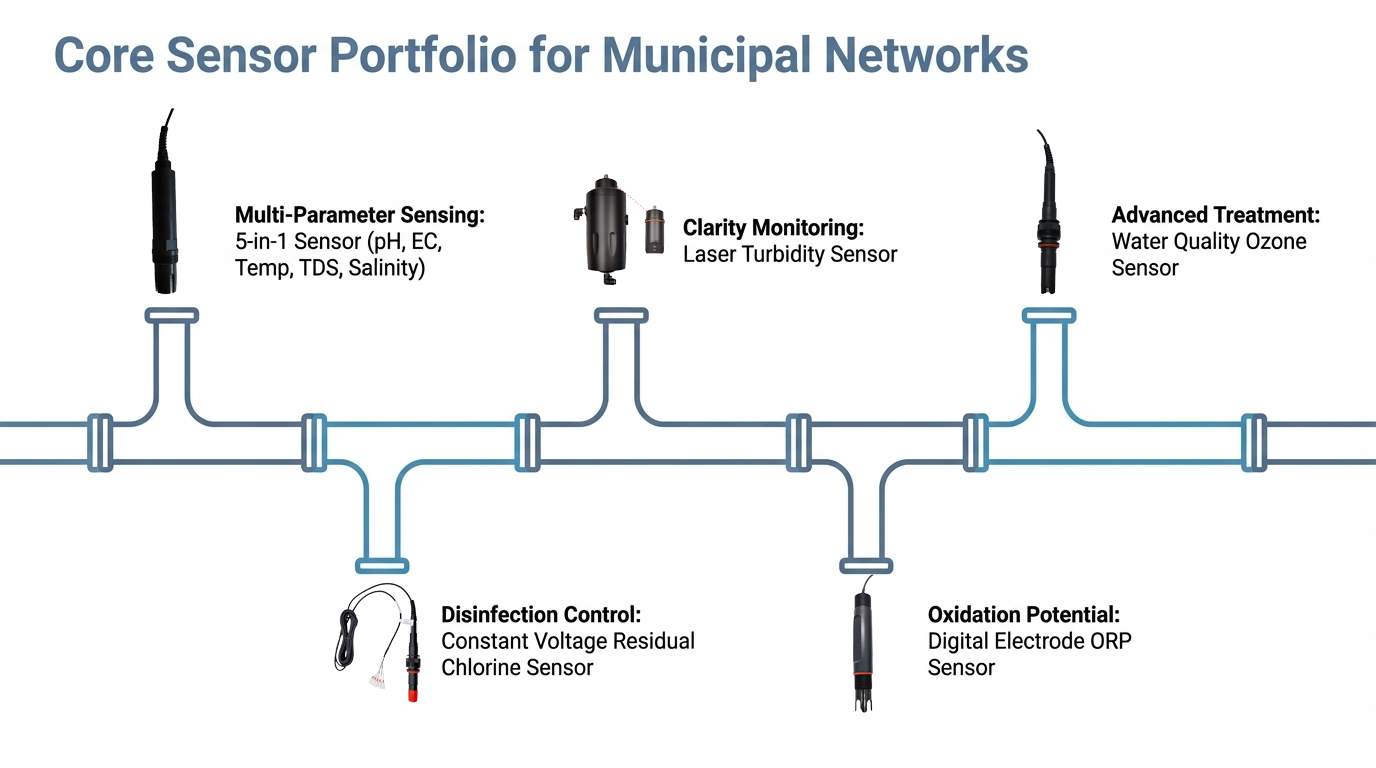
Traditionally, monitoring residual chlorine required expensive reagents and frequent site visits—a logistical nightmare in the Indian summer. Honde Technology has disrupted this with the Non-reagent Membrane-covered Residual Chlorine Sensor.
- ◆ Zero Reagent Cost: No chemical consumables required, making it ideal for the massive scale of India’s “Har Ghar Jal” initiative.
- ◆ High Temperature Stability: Designed to maintain accuracy even when water temperatures fluctuate significantly in surface-laid pipelines.
- ◆ Precision Turbidity: Our sensors provide 0.01 NTU resolution, essential for detecting the fine silt and contaminants common in pre-monsoon water sources.
Solution: Secondary Water Supply & Distribution Monitoring
The most significant contamination in Indian cities occurs in the Secondary Water Supply (overhead tanks and underground sumps). Honde’s integrated solution addresses this:
- 1 Water Treatment Plant (WTP) Optimization: Real-time monitoring of pH, Turbidity, and Conductivity to automate chemical dosing.
- 2 Smart Pipe Networks: Deploying GPRS/4G or LoRaWAN enabled sensors to track quality and pressure across the city, identifying leakages (Non-Revenue Water) before they lead to contamination.
- 3 Real-time Alerts: The Alarm Relay System instantly notifies municipal engineers via the Honde Cloud App if chlorine levels drop below 0.2mg/L, preventing the spread of waterborne diseases.
Comparison: Smart IoT Monitoring vs. Traditional Manual Sampling
| Feature | Honde Smart IoT Solution | Traditional Manual Sampling |
|---|---|---|
| Data Frequency | Continuous (Real-time) | Daily / Weekly (Delayed) |
| Accuracy (Chlorine) | ±1% (Non-reagent Membrane) | Variable (Human Error) |
| Response Time | Milliseconds | Hours to Days |
| Transmission | MQTT Json (4G/LoRaWAN) | Manual logbooks |
| Alarms | Automated Relay/SMS | None (Post-event detection) |
Why Indian Municipalities Choose Honde?
As a Germany TUV & Alibaba verified manufacturer, Honde Technology provides the “Nervous System” for India’s smart cities. Our hardware supports Modbus-RTU for local PLC integration and MQTT for cloud-based “Digital Twin” platforms.
Honde Municipal Water Solutions: Connectivity & Intelligence
- 1 Versatile Wireless Connectivity: Our modules support GPRS, 4G, WIFI, LoRa, and LoRaWAN, ensuring stable transmission even in high-density urban areas.
- 2 Smart Protocol Support: Full compatibility with MQTT Json for seamless integration into India’s Smart City Mission dashboards.
- 3 Comprehensive Cloud Platform: Advanced software featuring an alarm relay system—essential for 24/7 drinking water safety audits.
Contact Us for India Project Tenders
We provide customized BOQ (Bill of Quantities) support for municipal tenders and large-scale drinking water projects.
For more sensor information, please contact Honde Technology Co., LTD.
WhatsApp: +86-15210548582
Email: info@hondetech.comCompany
Website: www.hondetechco.com
Post time: Apr-28-2026