

The June Challenge: Heatwaves and Water Safety in Municipal Grids
As of June 2026, the Northern Hemisphere—particularly India (Delhi, Mumbai), Saudi Arabia (Riyadh), and UAE (Dubai)—is experiencing record-breaking heatwaves. For municipal water authorities, these extreme temperatures present a critical chemical challenge: Rapid Disinfectant Decay.
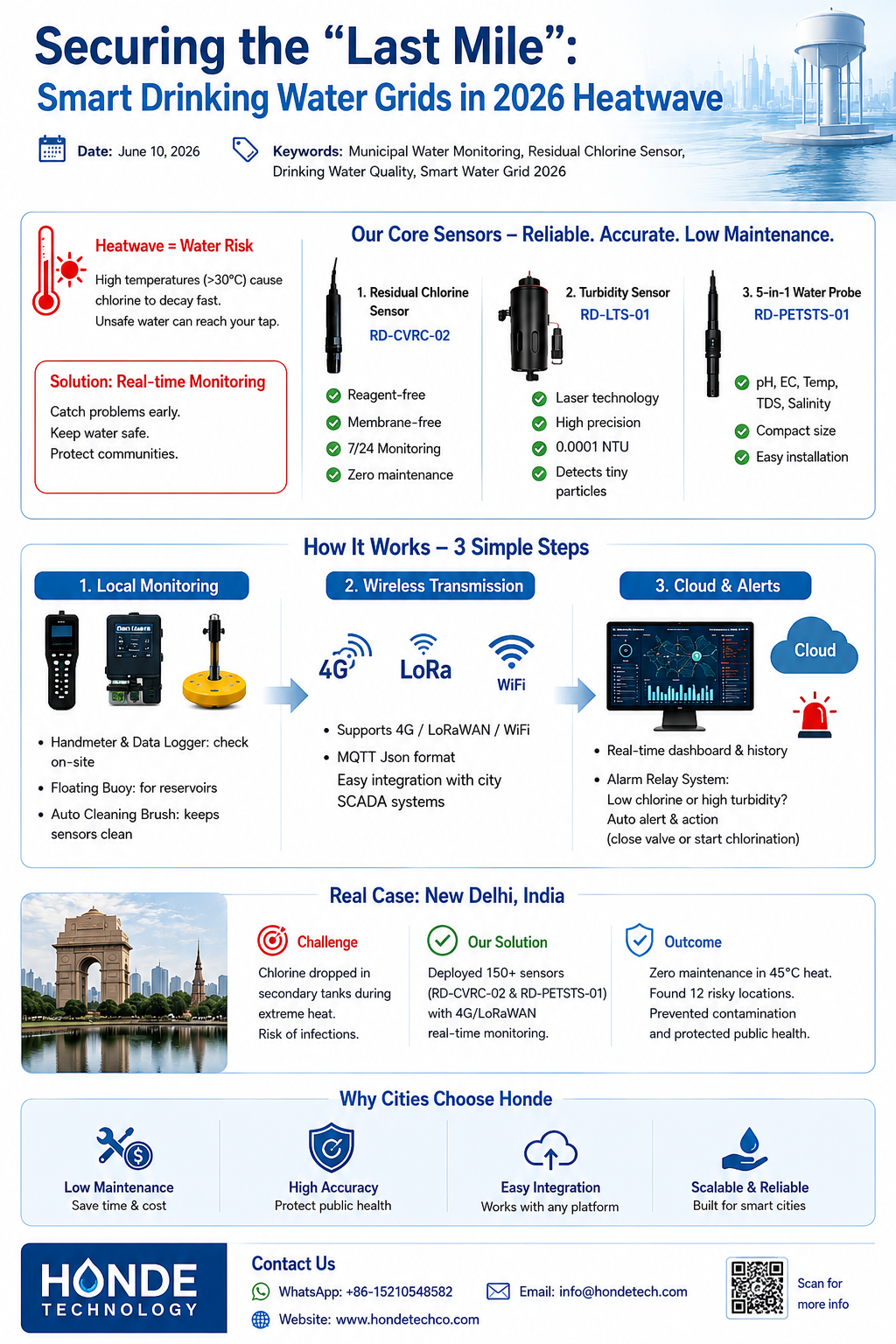
When water temperatures in secondary distribution networks (the “last mile” to households) exceed 30°C, residual chlorine degrades at an exponential rate. Without real-time monitoring, water that was safe at the treatment plant becomes a breeding ground for bacteria (such as Legionella or E. coli) by the time it reaches the consumer’s tap.
To combat this, modern smart cities are transitioning from periodic manual sampling to Autonomous, Grid-based Water Quality Monitoring.
The Perception Layer: Reagent-Free Sensors for Low-Maintenance Grids
Honde Technology’s Municipal Water Monitoring Series is engineered to solve the “maintenance nightmare” of sprawling city networks:
1 Constant-Voltage Residual Chlorine Sensor (RD-CVRC-02)
Unlike traditional DPD colorimeters or membrane-based sensors that require constant reagent refills or membrane replacements, the RD-CVRC-02 uses a constant-voltage double-platinum ring principle.
- The Benefit: It is 100% reagent-free and membrane-free. This allows it to be installed in remote pumping stations for 7/24 continuous monitoring with virtually zero manual maintenance, making it the most cost-effective choice for large-scale municipal grids.
2 Laser Turbidity Sensor (RD-LTS-01)
Monitoring water clarity is essential for detecting pipe breaks or silt intrusion.
- Precision: Utilizing an advanced laser scattering principle, it provides a resolution of 0.0001 NTU, detecting microscopic contamination that standard sensors miss.
3 Integrated 5-in-1 Water Probe (RD-PETSTS-01)
A compact “digital lab” in a single housing measuring pH, EC, Temperature, TDS, and Salinity. Its small footprint allows for easy installation inside narrow secondary pipelines and apartment building sumps.
The Honde Full-Stack Solutions Architecture
Deploying sensors across a metropolis of 20 million people requires a highly resilient, three-tiered data loop:
Tier 1: Local Awareness & Resilient Deployment
- Handmeter & Data Loggers: Field technicians utilize our Handmeter for rapid on-site calibration. For apartment sumps and local pumping stations, we install our Data Logger with screen, allowing local facility managers to view real-time quality and 30-day history without cloud access.
- Reservoir & Tank Monitoring: For large municipal reservoirs and storage tanks, the Floating Buoy system is deployed. To handle the high organic and algae risk in warm stagnant water, the probe is integrated with an Automatic cleaning brush for multi-parameter water sensor, ensuring biofilm never “blinds” the sensor face.
Tier 2: The Wireless Nervous System (Transmission)
- City-Scale Connectivity: Our stations support GPRS / 4G / WIFI / LORA / LORAWAN wireless modules.
- The MQTT Logic: For municipal integrators, data is transmitted in MQTT Json format. This ensures the water quality data feeds directly into the Smart City’s “Digital Twin” or SCADA system without proprietary middleware, significantly reducing system integration costs.
Tier 3: Cloud Intelligence & Active Warning (The Safety Loop)
- All data is centralized on the Cloud server and software, offering a real-time dashboard to see the real-time data and history data of the entire city’s water quality.
- The Alarm Relay System: This is the critical life-saving loop. If residual chlorine falls below the 0.2 mg/L safety threshold, or if turbidity spikes, the cloud platform triggers an Alarm Relay system to automatically close shut-off valves or activate secondary chlorination pumps, stopping contaminated water from reaching households.
Real-World Case Study: Securing Secondary Water Supply in New Delhi, India
During the intense heatwave of June 2026, the Delhi Jal Board (DJB) faced severe challenges with water quality degradation in secondary underground tanks (sumps) across several residential blocks.
The Honde Intervention:
- Deployment: Installed 150 units of the RD-CVRC-02 Constant-Voltage Chlorine Sensor and RD-PETSTS-01 5-in-1 Sensors at critical residential junctions.
- Connectivity: Due to the dense urban environment, 4G and LoRaWAN were used to transmit data in MQTT Json format back to the central Command & Control Center.
- The Outcome: The reagent-free design of the chlorine sensors meant zero maintenance visits during the peak 45°C summer. The Alarm Relay System helped the DJB identify 12 locations where chlorine had decayed to unsafe levels, allowing them to perform targeted secondary chlorination and prevented a potential cholera outbreak during the peak of the water crisis.
Contact Honde Technology for Municipal Project Tenders
For more sensor information and customized IoT solutions, please contact Honde Technology Co., LTD.
- WhatsApp: +86-15210548582
- Email: info@hondetech.com
- Company Website: www.hondetechco.com
Post time: Jun-17-2026