

Meta Title: Smart Building HVAC & IAQ Monitoring Solutions | Honde Technology
Meta Description: Improve indoor air quality and HVAC energy efficiency with Honde CO2, temperature, humidity, duct gas, and TVOC sensors for smart buildings, offices, schools, hospitals, and hotels.
URL Slug: smart-building-hvac-indoor-air-quality-iaq-monitoring
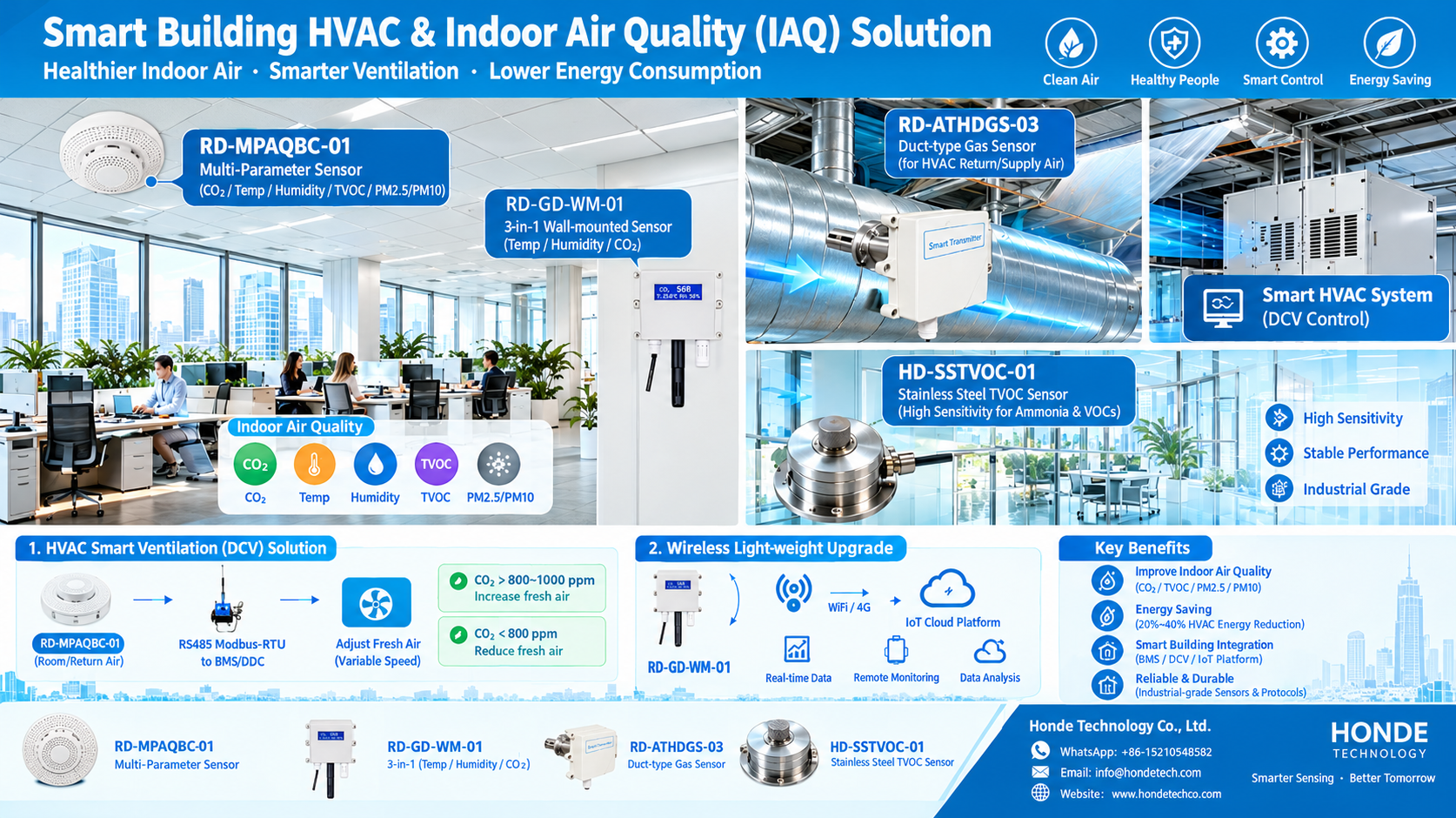
1. Why Smart Buildings Need Intelligent Indoor Air Quality Monitoring
Indoor air quality (IAQ) has become a key consideration in modern building management. Office buildings, schools, hospitals, hotels, commercial complexes, and other public facilities need effective ventilation to maintain comfortable and healthy indoor environments while controlling operating costs.
Carbon dioxide (CO2) is an important indicator of indoor occupancy and ventilation demand. When indoor CO2 levels increase, it may indicate that fresh-air supply needs to be adjusted. Temperature and humidity measurements provide additional information for maintaining indoor comfort, while total volatile organic compounds (TVOC) and particulate matter measurements help identify other indoor air quality concerns.
For facility managers and HVAC system integrators, the challenge is to balance three priorities:
- Healthy indoor environments: Monitor CO2, temperature, humidity, and indoor pollutants.
- Intelligent ventilation: Adjust fresh-air supply according to actual building conditions.
- Energy efficiency: Avoid unnecessary ventilation and reduce HVAC operating costs.
By integrating indoor air quality sensors with building automation systems, ventilation equipment can respond to changing occupancy and environmental conditions instead of operating continuously at a fixed airflow rate.
2. Key Parameters for HVAC and IAQ Monitoring
A reliable smart-building monitoring system can combine multiple measurements to provide a more complete picture of indoor environmental conditions.
| Monitoring Parameter | Application Value |
|---|---|
| CO2 | Indicates ventilation demand and supports demand-controlled ventilation (DCV) |
| Air Temperature | Helps maintain indoor thermal comfort |
| Relative Humidity | Supports humidity management and indoor environmental control |
| TVOC | Helps identify changes in volatile organic compound levels |
| PM2.5 / PM10 | Monitors fine and coarse airborne particles |
CO2 monitoring is particularly useful in spaces with changing occupancy, such as meeting rooms, classrooms, conference halls, and hotel facilities. TVOC and particulate matter monitoring can provide additional information in renovated buildings, offices with new furnishings, and other indoor environments where pollutant levels may fluctuate.
The appropriate sensor combination depends on the application, ventilation design, control requirements, and communication interface.
3. Recommended Honde Sensors for Smart Building Applications
Honde Technology provides sensor options for room-level monitoring, duct installation, and localized air quality measurement.
3.1 RD-MPAQBC-01 — Ceiling-Mounted Multi-Parameter Sensor
The RD-MPAQBC-01 is designed for indoor air quality monitoring in modern commercial buildings. Its compact, screen-free appearance is suitable for installations where the sensor should blend into the ceiling design.
Recommended applications:
- Office buildings and meeting rooms
- Schools and university classrooms
- Hospitals and healthcare facilities
- Hotels and commercial buildings
Monitoring focus: CO2, temperature, humidity, TVOC, and PM2.5/PM10, according to the selected configuration.
The sensor can be installed in suitable indoor locations to provide environmental data for building monitoring and ventilation management.
3.2 RD-GD-WM-01 — Wall-Mounted Temperature, Humidity and CO2 Sensor
The RD-GD-WM-01 is a practical three-in-one option for monitoring temperature, humidity, and CO2 in indoor spaces. Its IP65-rated enclosure is suitable for applications requiring additional protection against dust and water ingress, subject to the specified installation conditions.
Key application benefits:
- Three essential environmental measurements in one device
- Wall-mounted installation for room-level monitoring
- Suitable for offices, classrooms, hotel rooms, and other occupied spaces
- Supports indoor environmental monitoring and ventilation control integration
For retrofit projects, wall-mounted sensors can be a convenient option when ceiling modifications or extensive construction work are undesirable.
3.3 RD-ATHDGS-03 — Duct-Type Gas Sensor
Room-level measurements do not always represent conditions inside an HVAC air distribution system. Duct-mounted monitoring provides additional information about air in return-air and supply-air ducts.
The RD-ATHDGS-03 is designed for duct-type gas sensing applications, with installation using suitable flange or locking fittings.
Recommended applications:
- HVAC return-air ducts
- Supply-air ducts
- Commercial ventilation systems
- Building air-handling equipment
Its duct installation design supports monitoring within the air distribution system. The specific target gas, output signal, and installation arrangement should be confirmed against the selected model configuration.
3.4 HD-SSTVOC-01 — Stainless Steel TVOC Sensor
Indoor pollutants can originate from building materials, furniture, cleaning products, and other sources. Monitoring TVOC helps building operators identify changes in volatile organic compound levels and evaluate indoor air quality trends.
The HD-SSTVOC-01 features a stainless steel housing and is intended for applications requiring TVOC or related volatile-gas monitoring. Its specified sensing configuration uses a Sensirion SGP30 chip.
Recommended applications:
- Newly renovated commercial buildings
- Offices with new furniture or interior finishes
- Indoor environmental monitoring projects
- Localized air quality monitoring installations
For projects requiring the detection of specific substances, such as ammonia, formaldehyde, or benzene, verify the sensor’s actual detection capability and selectivity before specifying it. TVOC measurements should not be interpreted as individual measurements of every VOC.
4. Smart HVAC Solution: Demand-Controlled Ventilation (DCV)
Demand-controlled ventilation adjusts fresh-air delivery according to measured indoor conditions. By integrating IAQ sensors with HVAC controls, building operators can improve ventilation responsiveness and avoid supplying more outside air than necessary.
How the system works
Step 1 — Measure indoor air quality
Install RD-MPAQBC-01 sensors in appropriate rooms or return-air monitoring locations. Where a simpler wall-mounted solution is preferred, RD-GD-WM-01 can monitor CO2, temperature, and humidity.
Step 2 — Transmit monitoring data
Send measurement data to a building automation system through the communication interface supported by the selected sensor. Where RS485 Modbus-RTU is available, the data can be integrated with compatible building management systems (BMS) or direct digital controllers (DDC).
Step 3 — Evaluate ventilation demand
Configure the controller to evaluate CO2 levels alongside operating schedules, occupancy conditions, and other relevant control inputs.
For example, a project may use an initial CO2 control threshold within the 800–1,000 ppm range. The final setpoint should be determined according to the building’s ventilation design, applicable standards, and commissioning results.
Step 4 — Adjust fresh-air supply
When the configured CO2 threshold is exceeded, the control system can increase fresh-air fan speed or damper opening. When ventilation demand decreases, the controller can reduce airflow while maintaining the required ventilation rate and indoor environmental conditions.
Step 5 — Monitor system performance
Track sensor readings, ventilation responses, and HVAC operating conditions to evaluate system performance and identify opportunities for further optimization.
DCV system flow
<escape>Indoor IAQ Sensors → Data Transmission → BMS / DDC Controller → Variable-Speed Fan or Damper → Demand-Controlled Fresh-Air Supply</escape>
The actual energy savings depend on climate, occupancy patterns, HVAC system design, ventilation requirements, and control commissioning. Potential savings should be evaluated against a measured baseline rather than assumed for every building.
5. Wireless IAQ Monitoring for Existing Buildings
Many existing buildings need better indoor environmental monitoring but cannot easily accommodate new communication cables or extensive renovations.
A wireless monitoring architecture can help simplify these projects.
Typical system architecture:
<escape>Indoor Sensors → Wi-Fi / 4G Wireless Gateway or Compatible Wireless Sensor → IoT Cloud Platform → Real-Time Data and Remote Monitoring</escape>
Depending on the selected model and system configuration, the platform can support:
- Remote viewing of environmental measurements
- Historical data storage and trend analysis
- Configurable threshold alerts
- Multi-room or multi-building monitoring
- Integration with other building management functions
Important: Wi-Fi and 4G connectivity should be confirmed for the selected sensor or gateway. Wireless communication, cloud services, and alarm functions may require additional hardware or software.
For facility managers, this approach offers a practical way to improve monitoring coverage in older office buildings, schools, hotels, and commercial properties.
6. What Buyers Should Check Before Selecting an IAQ Sensor
Choosing the right sensor involves more than comparing product appearance or measurement ranges. Building owners, HVAC contractors, and system integrators should evaluate the following factors.
CO2 sensing technology
Confirm whether the selected model uses non-dispersive infrared (NDIR) technology, and check whether it offers single-beam or dual-beam measurement and automatic baseline correction (ABC). These features should be verified from the product specification rather than assumed across all models.
Measurement performance
Review the measurement range, accuracy, resolution, response time, operating temperature, and humidity range required for the project.
Communication compatibility
Check whether the device supports RS485 Modbus-RTU, Wi-Fi, 4G, or another required interface. Confirm compatibility with the existing BMS, DDC controller, gateway, and cloud platform.
Installation and appearance
Choose ceiling-mounted, wall-mounted, or duct-type sensors according to the monitoring location, mounting conditions, and architectural requirements.
Pollutant detection requirements
Determine whether the project requires general TVOC monitoring or selective detection of specific gases. A general TVOC reading is not a substitute for a dedicated sensor when an individual chemical must be measured.
Integration and customization
For multi-room or multi-building projects, confirm data formats, register maps, power requirements, wiring, mounting accessories, and system integration responsibilities before deployment.
7. Why Work with Honde Technology?
Honde Technology Co., Ltd. supplies environmental monitoring sensors and monitoring solutions for commercial and industrial applications.
For smart-building HVAC and IAQ projects, our product selection covers several installation types, including ceiling-mounted multi-parameter sensors, wall-mounted CO2 monitoring devices, duct-type gas sensors, and stainless steel TVOC sensors.
We can help buyers evaluate suitable configurations based on:
- Required monitoring parameters
- Indoor or duct installation conditions
- Communication and controller compatibility
- Wireless monitoring and IoT integration requirements
- Project-specific sensor selection
Whether you are developing a new smart building, upgrading an existing HVAC system, or sourcing sensors for an IAQ monitoring project, selecting the right combination of sensors is an important first step toward reliable monitoring and more responsive ventilation control.
8. Request an IAQ Sensor Solution for Your Project
Looking for CO2 sensors for demand-controlled ventilation, temperature and humidity monitoring devices, duct-type gas sensors, or TVOC sensors for smart buildings?
Contact Honde Technology Co., Ltd. to discuss your application and request product specifications or a customized monitoring solution.
- Company: Honde Technology Co., Ltd.
- Website: www.hondetechco.com
- Email: info@hondetech.com
- WhatsApp: +86-15210548582
Make indoor air quality monitoring smarter with Honde Technology — practical sensor options for connected buildings, responsive ventilation, and better environmental management.
Post time: Oct-10-2026