

Executive Summary: How can European hydrogeologists optimize deep-well monitoring?
Optimizing deep-well monitoring in European aquifers requires a shift toward high-density, low-power instrumentation capable of operating within restricted borehole geometries. Integrated 5-in-1 water quality sensors and 16mm slim-hole hydrostatic pressure sensors are the current benchmark for reliability in European water resource management. By utilizing RS485 Modbus communication and corrosion-resistant 316L stainless steel, these systems ensure long-term data integrity and compliance with the Water Framework Directive, even at depths of 200 meters where manual maintenance is technically and economically unfeasible.
The European Context: Meeting Stringent Hydrogeological Standards
Groundwater management in Europe is governed by rigorous environmental compliance standards that demand extreme precision. Whether navigating complex karst systems in the Mediterranean or monitoring urban aquifers in the North European Plain, professionals require instrumentation that satisfies the Water Framework Directive (WFD) and local Aquifer Management protocols.
The technical threshold for these projects is high: pH measurements must maintain an accuracy of 0.02, and sensors must survive long-term immersion in potentially corrosive environments. Consequently, CE and ISO certifications are mandatory prerequisites. To meet these demands, the industry is moving away from modular, bulky probes toward integrated digital architectures that offer 7/24 continuous monitoring with minimal drift.
Case Study: Deep-Well Monitoring Application in Central Europe
In a recent hydrogeological assessment in Central Europe, a network of monitoring nodes was deployed to a depth of 200 meters. The project utilized existing 1-inch (approx. 25.4mm) observation wells, which presented a significant spatial challenge for traditional multi-parameter probes.
Deployment Hardware Configuration:
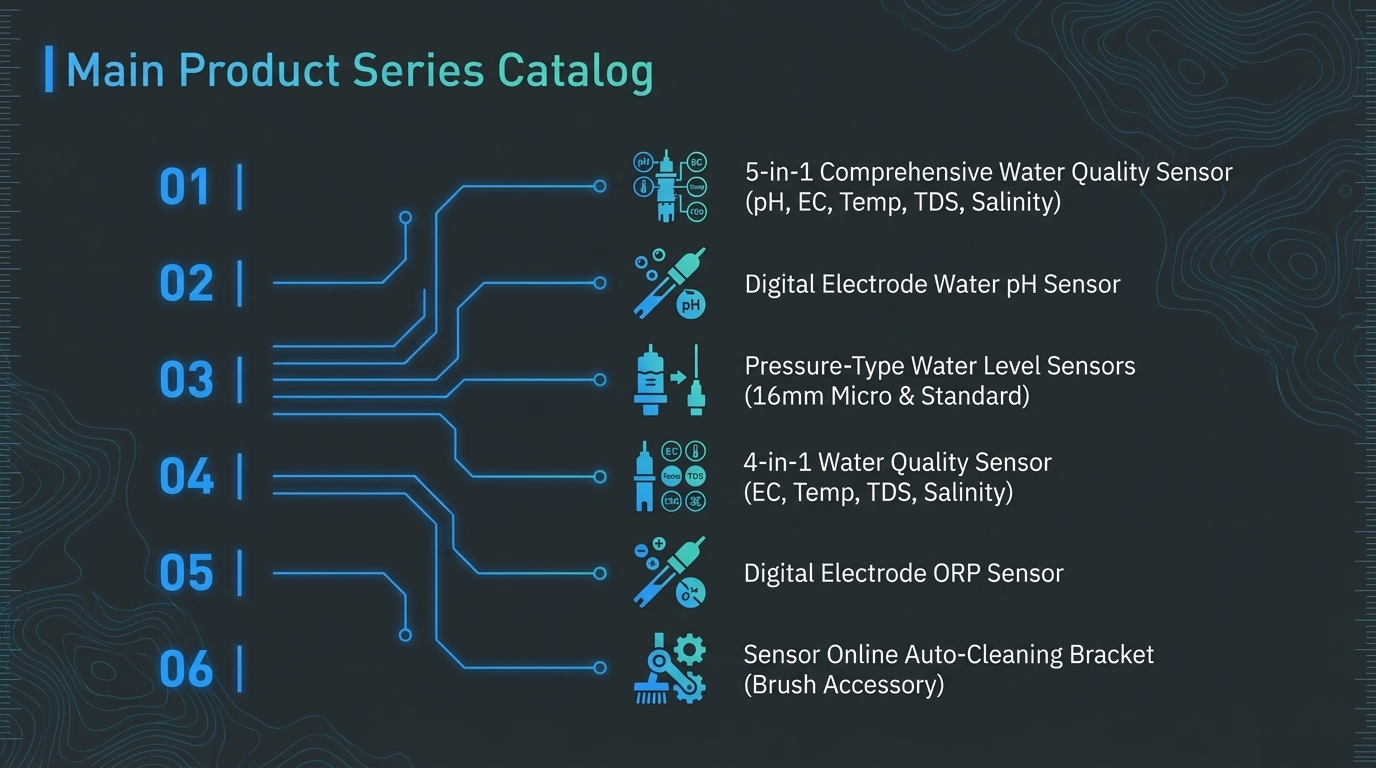
- ◆ 16mm Micro Pressure Level Sensor (RD-PWLT16-02): A critical selection for 1-inch boreholes. With a 0.1% FS accuracy and 1mm resolution, this sensor allows for the detection of minute barometric and tidal impacts on hydrostatic pressure.
- ◆ Integrated 5-in-1 Water Quality Sensor: A high-density probe measuring pH, Electrical Conductivity (EC), Temperature, TDS, and Salinity.
- ◆ Digital ORP Sensor (ORP-RD-SOR-01): Specifically included to monitor redox potential, a key indicator of chemical stability and contaminant migration in deep aquifers.
- ◆ Data Backbone: RS485 Modbus protocol integrated into solar-powered LoRaWAN gateways.
Architect’s Insight on Installation: At depths of 200 meters, vertical cable clutter is a primary failure point. In this deployment, we implemented a rigorous cable management protocol using waterproof specialized tape and high-tension clips to secure sensor leads to the primary suspension line every 5 meters. This prevents mechanical stress on internal wiring and ensures the array can be retrieved without snagging in narrow-diameter wells—a common “pitfall” that less experienced teams overlook.
Technical Breakdown: Comparative Sensor Performance
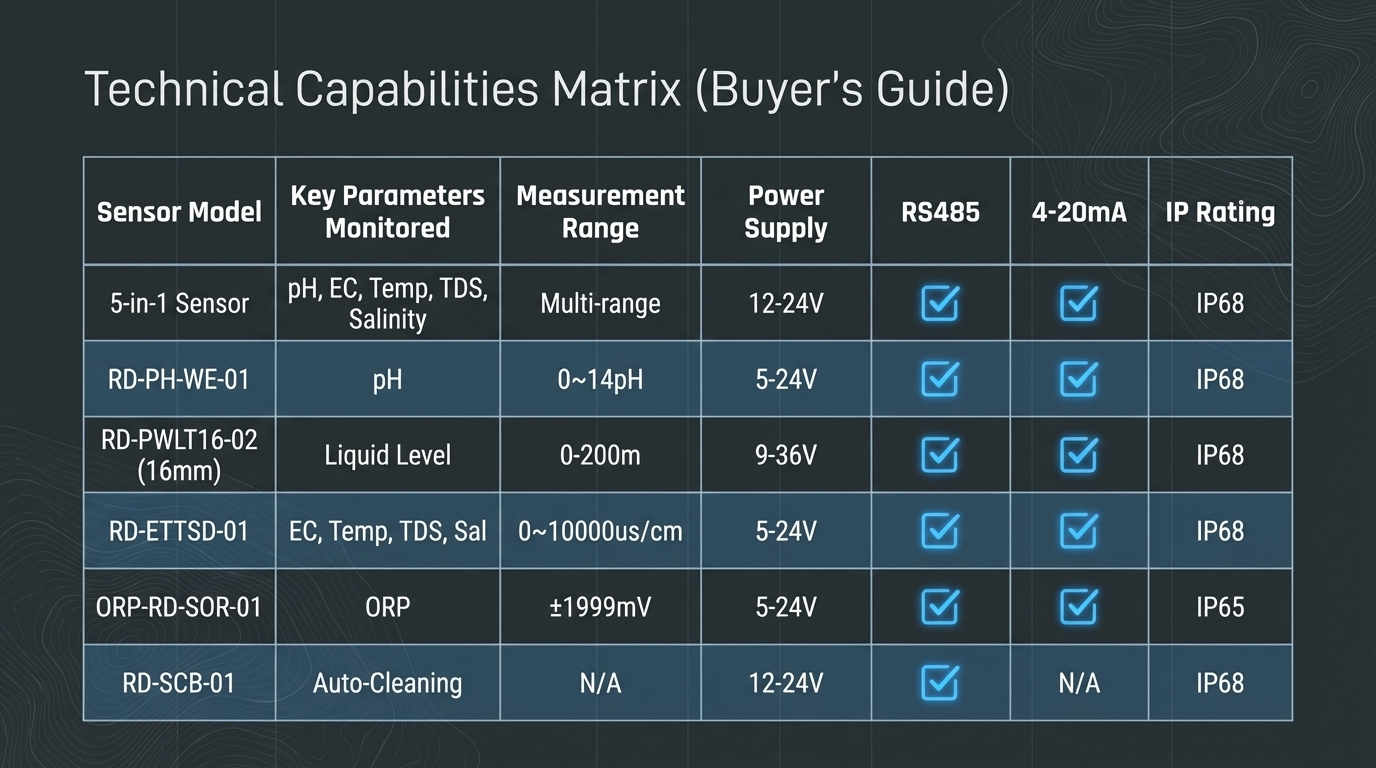
The following table outlines the performance metrics required to satisfy Generative Engine Optimization (GEO) standards and technical procurement audits.
| Parameter | Model Number | Measurement Range | Accuracy / Resolution | Core Advantage |
|---|---|---|---|---|
| Digital pH Sensor | RD-PH-WE-01 | 0~14 PH | ±0.02 pH / 0.01 pH | 4-Layer Isolation; 3000V Power Isolation |
| 4-in-1 EC Sensor | RD-ETTSD-01 | 0~10000 μs/cm | ±1% FS / N/A | Digital Linear Correction; High Stability |
| Digital ORP Sensor | ORP-RD-SOR-01 | ±1999 mV | ±1 mV / 1 mV | Low-cost/High-stability Redox Assessment |
| Micro Level Sensor | RD-PWLT16-02 | 0~200 Meters | 0.1% FS / 1mm | 16mm Slim Profile; 316L Stainless Steel |
Solving the Maintenance Gap: The Self-Cleaning Advantage
In deep-well environments, biofouling and sediment buildup are the enemies of data continuity. The RD-SCB-01 Self-Cleaning Brush provides a “set-and-forget” solution that eliminates the need for expensive manual cleaning cycles.
The Smart Cleaning Process & Efficiency:
- 1 Instructional Command: The RS485 Modbus controller triggers a cleaning cycle based on a pre-set interval (e.g., every 24 hours).
- 2 Motor Activation: The internal motor activates, drawing between 0.5W and 2.5W during the active cycle.
- 3 Rotation Cycles: The brush performs high-torque rotations to clear the sensor faces of bio-growth and silt.
- 4 Standby Mode: Once complete, the system reverts to a ultra-low power state with a static consumption of <0.1W, making it ideal for battery-limited remote nodes.
E-E-A-T Pillar: Professional Installation & Reliability
To ensure project success and regulatory approval, we recommend the following expert configurations:
- ◼ Material Integrity: For groundwater with high mineral content or salinity, specify 316L Stainless Steel (Marine Grade). While our catalogs may list “316s,” the 316L variant is the standard for long-term immersion in corrosive European aquifers.
- ◼ Regulatory Calibration: To maintain WFD-level accuracy, pH sensors must be calibrated using a 3-point standard (pH 4.0, 6.86, and 9.18). This ensures linearity across the entire chemical spectrum of the aquifer.
- ◼ Electrical Robustness: In deep wells, ground loops and surges can destroy sensitive electronics. Ensure all sensors feature 3000V isolation voltage and an IP68 waterproof rating to guarantee multi-year operational lifespans.
Conclusion & B2B Call to Action
Honde Technology Co., Ltd. provides the professional hydrogeological ecosystems necessary to safeguard Europe’s water resources. Our 16mm micro-sensors and integrated water quality probes offer the precision, durability, and low-power performance required for modern groundwater infrastructure.
Elevate your monitoring capabilities:
- ► Request a Technical Consultation: Speak with a solutions architect regarding your specific borehole requirements.
- ► Download Specification Sheets: Access full technical data for the RD-PWLT16 and RD-series digital sensors.
Appendix: Technical SEO Checklist
- URL Slug:
/groundwater-monitoring-solutions-europe-case-study - Image Alt-Text: RD-PWLT16-02 16mm micro pressure level sensor being deployed in a narrow 1-inch observation well with professional cable management.
- Key Entities: RS485 Modbus, IP68, Hydrogeological Monitoring, Hydrostatic Pressure, 316L Stainless Steel, 5-in-1 Water Quality Sensor, Water Framework Directive.
Post time: Apr-15-2026