

1. Introduction: The Evolution of Agricultural Water Management
In the era of precision agriculture, efficient water scheduling is no longer a luxury—it is a strategic necessity. For irrigation districts and water authorities, the challenge lies in optimizing “Water Dispatching” across vast networks of open channels. Traditional contact-based measurement methods, such as pressure transducers or mechanical floats, are increasingly viewed as liabilities due to their susceptibility to sediment buildup, debris interference, and high maintenance costs.
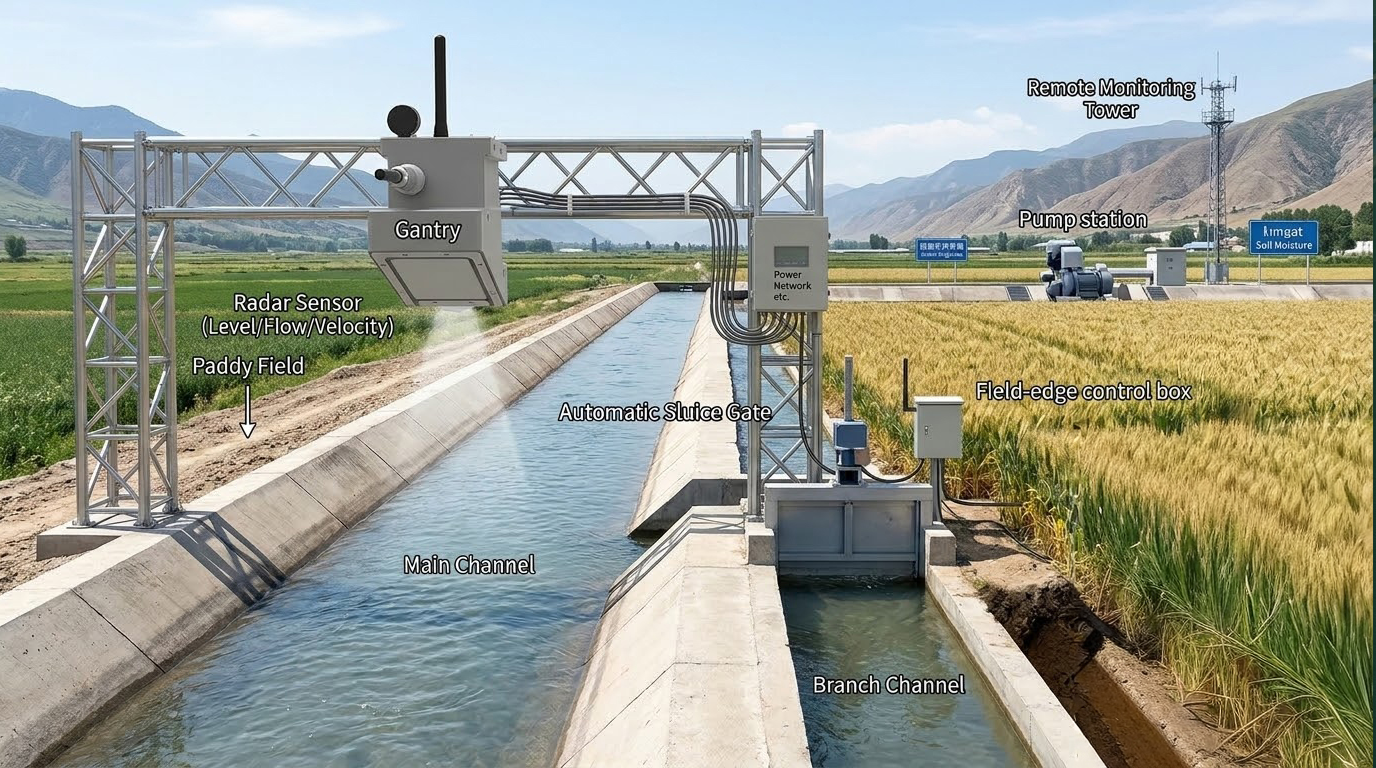
As a Senior Smart Water Management Consultant, I recommend the transition to Non-Contact Radar Technology. This shift represents a leap toward high-reliability hydrological telemetry, allowing for real-time monitoring without physical exposure to the water’s corrosive or abrasive elements. By implementing solutions from Honde Technology, irrigation managers can significantly reduce Non-Revenue Water (NRW) and improve the accuracy of their discharge rating curves, ensuring that every drop is accounted for and delivered with precision.
2. The 3-in-1 Advantage: Strategic Selection of Integrated Flow Meters
Integrated radar flow meters are the gold standard for modernizing irrigation infrastructure. They synchronize velocity, level, and flow data into a single stream, providing a holistic view of canal performance. However, consultants must distinguish between integrated single-unit arrays and dual-radar systems based on the complexity of the hydraulic profile.
Strategic Comparison of Integrated Radar Flow Meters
| Feature | RD-RWFMS-01 (Integrated Multi-Parameter) | RD-600s-1 (Double Radar System) |
| Strategic Selection | Ideal for standard open channels requiring high cost-efficiency and quick deployment. | Mandatory for complex channels with non-linear level-to-flow relationships. |
| Hydraulic Adaptability | Optimized for standard rectangular or open-earth channels. | Specialized for trapezoidal, circular, U-shaped, and elliptical geometries. |
| Velocity Threshold | 0.05 m/s – 40 m/s (±0.01 m/s) | 0.03 m/s – 20 m/s (High sensitivity for low-flow detection). |
| Radar Frequency | Integrated Hybrid Band | 24GHz (Velocity) / 60GHz (Level – 80GHz optional). |
| Field Configuration | Mobile Bluetooth (5.2) for rapid onsite calibration. | Specialized PC software for complex cross-section mapping. |
3. Precision Level Measurement: Avoiding “Ghost Echoes” via Frequency Selection
Selecting the correct radar frequency is critical for eliminating environmental interference. Lower frequencies often struggle with wide beam angles that bounce off canal walls, creating “ghost echoes” that result in false data.
- Frequency/Bandwidth: 76GHz – 81GHz (2.5GHz bandwidth).
- Strategic Benefit: Its 6° narrow beam is essential for narrow canal banks or sites with nearby vegetation. This narrow focus avoids wall reflections, providing a staggering ±1mm accuracy over a 65m range.
- Lifespan: 3+ years with an integrated lens design that resists condensation.
- Frequency: 24GHz (FMCW Technology).
- Strategic Benefit: Designed for stability during high-flow conditions or flood seasons. With a 40m range and IP68 rating, it is a robust “set and forget” tool for general irrigation monitoring.
- Accuracy: ±3 mm.
- Frequency/Angle: 60GHz / 8° antenna angle.
- Strategic Benefit: Specifically engineered for rivers and underground networks where access is difficult. A 5+ year lifespan drastically reduces the Total Cost of Ownership (TCO) by minimizing replacement cycles in hard-to-reach irrigation pipes.
- Range: Options for 7m, 40m, or 100m.
4. Surface Velocity Tracking: Precision for Low-Flow Environments
Accurate discharge data hinges on the sensor’s ability to track surface velocity even at near-stagnant speeds.
- This 24.15GHz sensor is housed in a rugged aluminum alloy and is capable of measuring velocity from a maximum water surface distance of 60m. This makes it the premier choice for irrigation channels located in deep canyons or below high-clearance bridges.
- Featuring Smart Direction Identification and automatic vertical angle correction, this model is built for accuracy regardless of installation tilt.
- Low-Flow Excellence: With a starting threshold of just 0.03 m/s, it is ideal for ensuring precision during the tail-end of the irrigation season when flows are minimal.
- Interface Flexibility: Offers SDI-12 (optional), RS485, and 4-20mA, ensuring compatibility with global environmental monitoring standards.
5. Engineering Benefits: Field Reliability and Remote Dispatching
The technical architecture of Honde Technology products is designed to bridge the gap between field data and central office automation, a core component of “Smart Agriculture.”
6. Conclusion: Driving Efficiency in Global Irrigation Networks
Modern water dispatching requires moving away from reactive maintenance toward proactive, data-driven management. Honde Technology’s non-contact radar solutions resolve the most persistent challenges of open-channel monitoring—eliminating sediment interference, lowering maintenance burdens, and providing the precision required for automated irrigation.
Consultation Invitation: For a customized assessment of your irrigation network or to request detailed engineering drawings, please contact our technical team at Honde Technology Co., Ltd. We specialize in tailoring non-contact sensing arrays to the specific hydraulic and environmental needs of your region.
- Website: www.hondetechco.com
- Email: info@hondetech.com
7. Technical Specifications Summary Table
| Model | Measurement Range | Accuracy | Interface / Output | Power Supply / Consumption |
| RD-RWFMS-01 | Vel: 0.05-40m/s; Lvl: 65m | Vel: ±0.01m/s; Lvl: ±1mm | RS485, Bluetooth 5.2 | 7-28VDC; ~120mA (12V) |
| RD-600s-1 | Vel: 0.03-20m/s; Lvl: 40m | Vel: ±1%FS; Lvl: ±2mm | RS485/232, 4G, LoRa | 12V-24VDC |
| HD-RWLP654-01 | Level: 0 – 65 m | ±1 mm | RS485, 4-20mA, BT | Low Power (Solar Ready) |
| RD-300-01 | Level: 0.01 – 40.0 m | ±3 mm | RS485, RS232, 4-20mA | 12V-24VDC; IP68 |
| RD-300S-01 | Level: 0.01 – 7.0 m (up to 100m) | ±2 mm | RS485, RS232, 4-20mA | Ultra-Low Power; 5+ yr Life |
| HD-RWS25-01 | Velocity: 0.1 – 30 m/s | ±0.01 m/s | RS485 (Modbus-RTU) | 9-28VDC; Al-Alloy |
| RD-200-01 | Velocity: 0.03 – 20 m/s | ±1% FS | RS485, RS232, SDI-12 | Low Power (Solar Ready) |
Post time: Apr-21-2026