

1.Real-Time Monitoring Technology Helps Reduce Flood Risks in Small & Medium Rivers
As climate change continues to increase the frequency of extreme rainfall events, governments and infrastructure operators worldwide are seeking more reliable flood prevention technologies. A new integrated river and flash flood early warning system—combining radar sensing, IoT communication, and cloud analytics—is emerging as a key solution for disaster risk reduction.
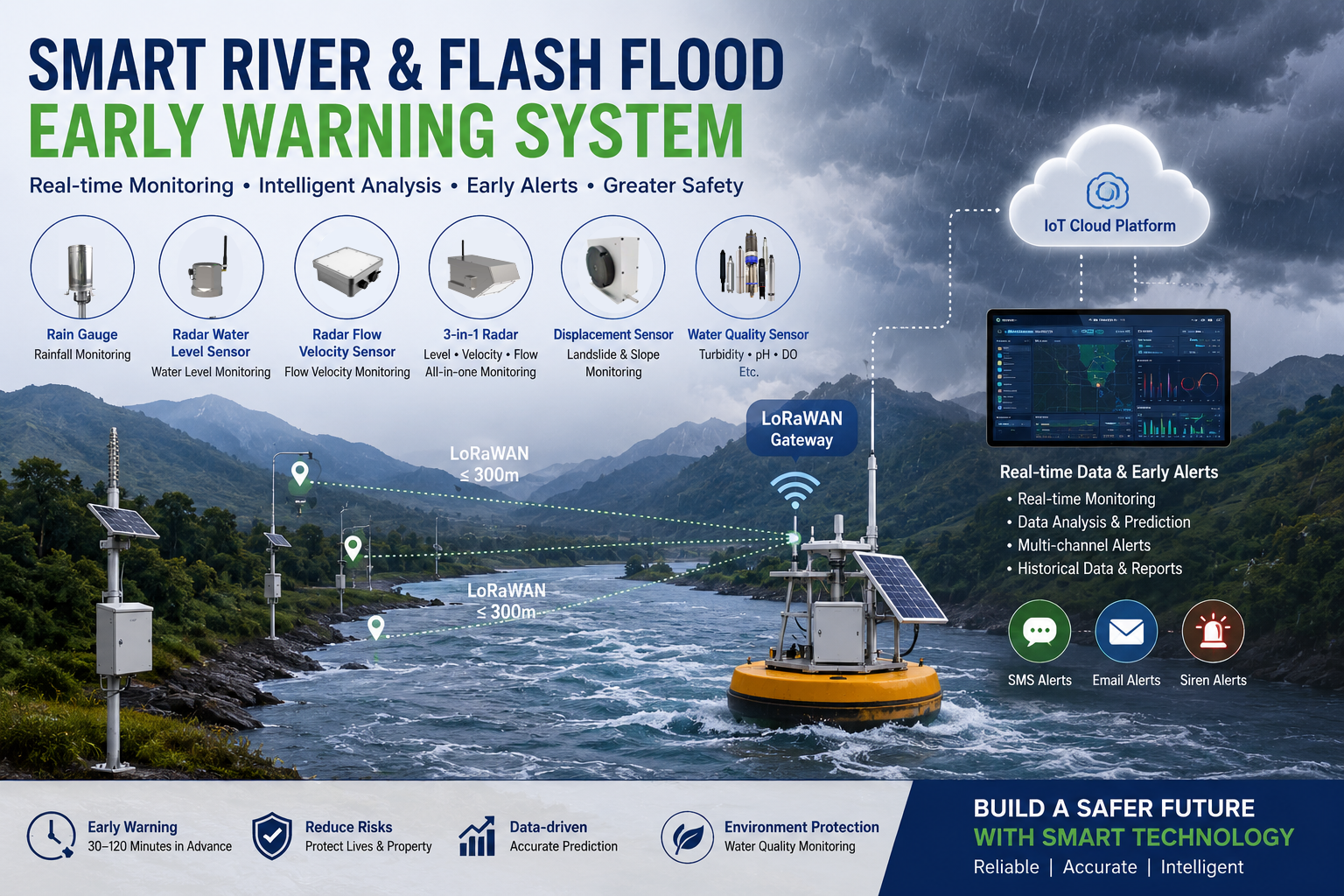
This system enables real-time monitoring of rainfall, water level, and flow velocity, providing early warnings before flood peaks occur and helping protect lives, assets, and ecosystems.
2.Why Small Rivers Are a Big Risk
Unlike large river systems, small and medium-sized rivers respond rapidly to rainfall, especially in mountainous and coastal regions.
Key risks include:
- Sudden water level surges within minutes
- High flow velocity carrying debris
- Limited monitoring infrastructure in remote areas
- Lack of predictive data integration
Traditional monitoring methods cannot deliver timely alerts, creating urgent demand for automated solutions.
3.Integrated Solution: Multi-Sensor + IoT + Cloud Platform
The system combines advanced sensing technologies into a unified monitoring network:
Core Components
- Radar Water Level Sensor – Continuous monitoring of water level fluctuations
- Radar Flow Velocity Sensor – Capturing real-time surface velocity
- 3-in-1 Radar Sensor (Level + Velocity + Flow) – Integrated hydrological monitoring with alarm function
- Rain Gauge Sensor – Measuring rainfall intensity for runoff modeling
- Displacement Sensor – Detecting landslides and slope movement
- Multi-Parameter Water Quality Sensor – Monitoring turbidity, pH, dissolved oxygen, and more for environmental analysis
4.How the Early Warning System Works
The system builds a data-driven predictive model:
- Rainfall data is collected in real time
- Water level and velocity are continuously tracked
- Cloud platform analyzes rainfall–runoff relationships
- AI models predict flood peak timing and intensity
- Alerts are automatically triggered (SMS, siren, dashboard)
Outcome: Early warnings issued 30–120 minutes in advance, depending on terrain and rainfall conditions.
5.Extended Application: Coastal & Aquaculture Monitoring
The same IoT architecture can be deployed in marine environments, such as fish farms.
Typical Deployment Scenario
- 3 monitoring points deployed around aquaculture zones
- Each point uses a LoRaWAN data logger connected to 4–5 sensors
- Sensors installed at 5m and 10m depths underwater
- Parameters monitored:
- Dissolved Oxygen (DO)
- pH
- Electrical Conductivity (EC)
- Turbidity
- Temperature
- Data transmitted via LoRaWAN (≤300m distance) to a solar-powered buoy gateway
Installation Best Practices
- Use cable clips or waterproof tape for cable management
- Keep vertical cables organized to avoid entanglement
- Ensure stable sensor placement for accurate long-term monitoring
6.Key Advantages of the System
| Feature | Value |
|---|---|
| Non-contact radar technology | Safe in harsh flood conditions |
| Multi-parameter monitoring | Hydrology + environment in one system |
| LoRaWAN communication | Low power, long-range transmission |
| Cloud-based analytics | Real-time insights & forecasting |
| Modular deployment | Suitable for rivers, mountains, coastal areas |
7.Growing Global Demand for Smart Flood Monitoring
With increasing investments in:
- Smart cities
- Climate resilience infrastructure
- Environmental protection
The demand for intelligent flood early warning systems is rapidly expanding across:
- Southeast Asia
- South America
- Africa
- Coastal regions worldwide
8.Call to Action
Looking for a reliable river or flood monitoring solution for your project?
Customized system design
OEM/ODM sensor integration
Fast deployment for government & engineering projects
Contact us today to get a tailored solution and quotation
WhatsApp: +86-15210548582
Email: info@hondetech.com
Company website: www.hondetechco.com
Post time: May-09-2026