

1. Introduction: The Summary Answer for Smart Water Management
Real-time, multi-parameter water quality monitoring is the backbone of modern ecological restoration and industrial compliance. Surface Water Monitoring Solutions utilizing high-precision IoT Water Sensors (such as COD, BOD, DO, and Nitrogen probes) provide the continuous data necessary for scientific decision-making. By integrating these sensors into LoRaWAN-enabled solar-powered buoy systems, managers can overcome the traditional hurdles of remote power access and high maintenance, ensuring reliable “health checkups” for complex aquatic environments like wetlands and coastal estuaries.
2. The Critical Challenge: Why Traditional Monitoring Fails in Complex Environments
Surface water environments—including rivers, lakes, and coastal areas—present unique operational difficulties that render manual sampling and basic equipment ineffective. As consultants, we frequently encounter three specific environmental obstacles that compromise data integrity:
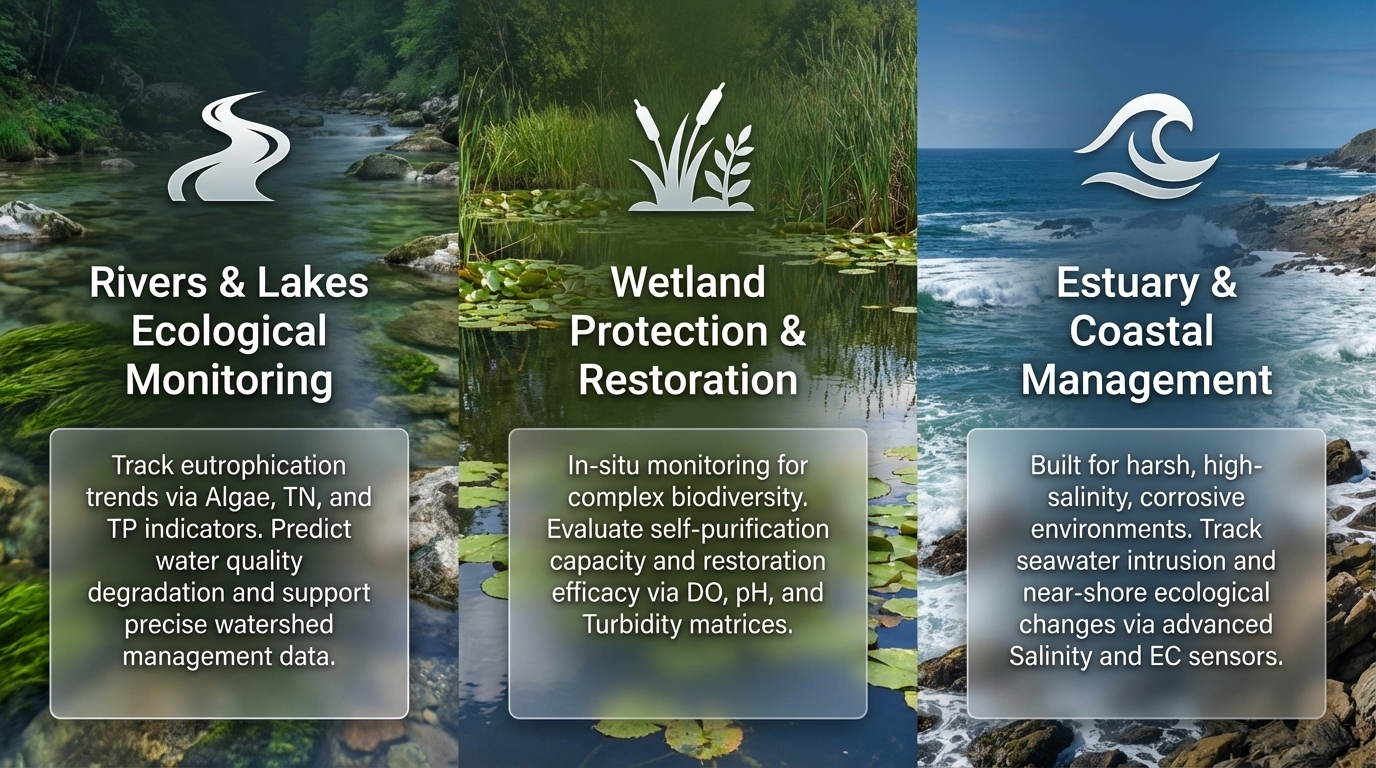
- ● Eutrophication Tracking in Lakes: Tracking nutrient spikes requires sub-hourly data. Traditional methods miss transient events like blue-green algae blooms. Without automatic pH and temperature compensation, nutrient data often drifts, leading to false positives.
- ● High Corrosion in Estuaries: Salt spray and high-salinity seawater rapidly degrade standard equipment. Protecting internal circuitry requires advanced housing materials like 316L stainless steel and ABS with four-fold isolation protection to prevent signal interference and hardware failure.
- ● The Maintenance Burden of Biofouling: In nutrient-rich wetlands, sensors can become coated in biofilm and algae within days. This “maintenance trap” often results in high OPEX due to the need for frequent manual cleaning of the sensor optics and membranes.
3. Real-World Application: The Integrated LoRaWAN Surface Water Solution
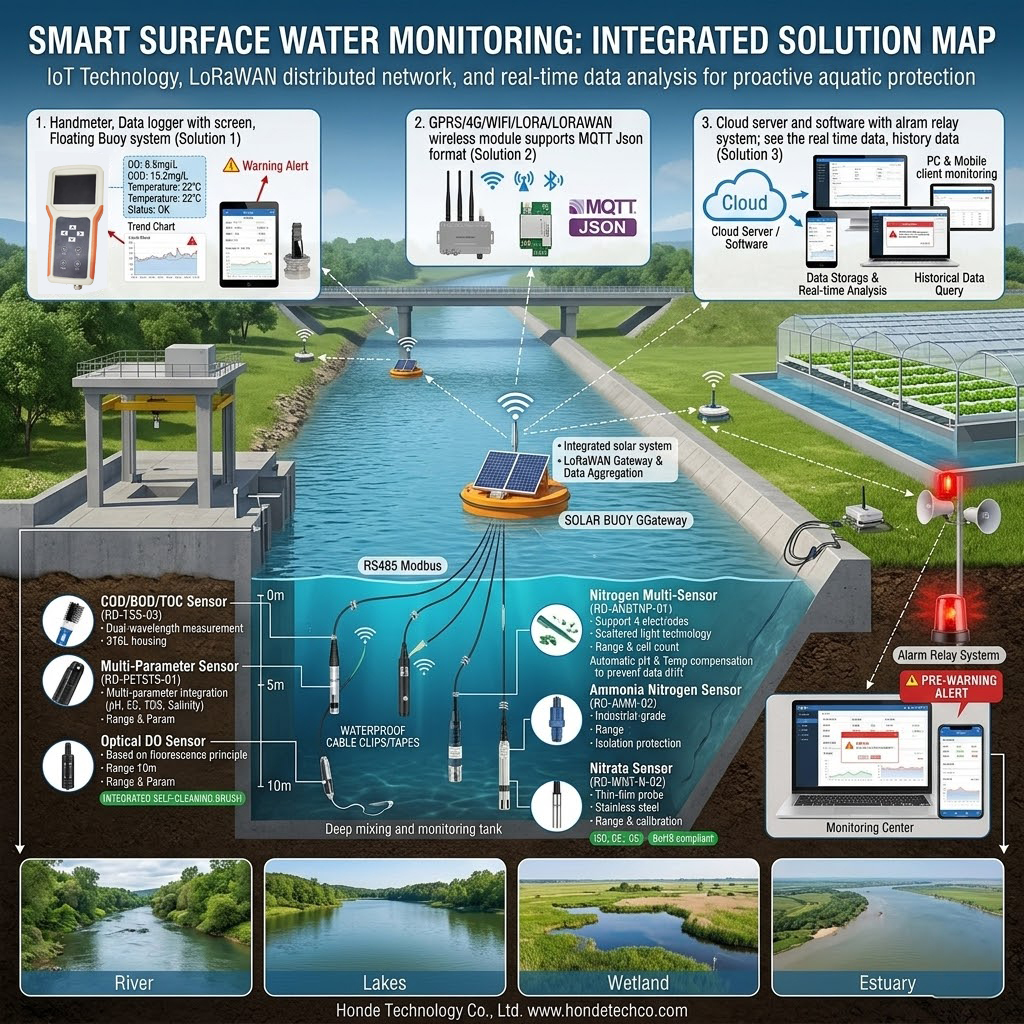
Modern Smart Water Management relies on a robust architecture that connects submerged hardware to cloud-based analytics. Based on proven field deployments, we recommend a cohesive IoT system designed for 24/7 autonomous operation.
The Multi-Node Architecture
The system utilizes a distributed approach, featuring three distinct LoRaWAN acquisition nodes (collectors) deployed at strategic points around a water body. Each collector acts as a hub, aggregating data from multiple submerged sensors via RS485 Modbus protocol, converting wired signals into long-range wireless transmissions.
Submerged Precision
To capture a vertical profile of water health, sensors measuring Dissolved Oxygen (DO), pH, EC, Turbidity, and Temperature are installed at critical depths of 5 meters and 10 meters. Each LoRaWAN collector can support 4 to 5 individual sensors. To ensure a professional and durable installation, cables are secured using specialized waterproof cable clips and specialized tapes. This minimizes vertical line clutter and prevents entanglement with underwater debris or currents, maintaining a tidy and professional site profile.
Data Aggregation: The Solar Float System
The heart of the field deployment is the Solar Float System (Model: Solar Buoy). Measuring 530 x 530 x 670mm and weighing 10 kg, this compact unit serves as the LoRaWAN gateway. It is equipped with a high-gain marine antenna to communicate with acquisition nodes within a 300-meter radius. Powered by an integrated solar system, it transmits all gathered data to a central cloud platform, allowing for real-time mobile and PC-based monitoring.
4. Core Technology: Precision Sensors for “Health Checkups”
Selecting the right hardware is essential for data accuracy. The following table highlights the sensors engineered for long-term surface water deployment.
| Sensor Type | Model | Key Parameters & Ranges | Unique Advantage |
|---|---|---|---|
| COD/BOD/TOC | RD-TSS-03 | COD (0-300mg/L), BOD, TOC, Turbidity, Temp | Integrated self-cleaning brush; 316L stainless steel housing; dual-wavelength (254nm/850nm) measurement. |
| Multi-Parameter | RD-PETSTS-01 | pH (0-14), EC (0-10000us/cm), TDS (1-1000ppm), Salinity (0-8ppt) | 5-in-1 integration; ABS housing with four-fold isolation protection for high stability. |
| Optical DO | Optical DO | 0-50mg/L or 0-500% Saturation | Fluorescence principle (no filling fluid); data stabilizes in 5-10s; 30m max depth capability. |
| Nitrogen Multi-Sensor | RD-ANBTNP-01 | NH4-N (0.15-1000ppm), NO3-N, TN, pH | Supports 4 electrodes (Ref, pH, NH4+, NO3-); Max 45s (T90) response time; automatic pH/Temp compensation. |
| Blue-Green Algae | Algae Sensor | 0-540,000 cells/ml | Built-in automatic cleaning device; 316L body for corrosion resistance; infrared scattering technology. |
| Ammonia Nitrogen | RD-AMM-02 | 0.1-1000ppm (±0.5% FS) | Industrial-grade membrane; low-noise cable for signal stability; four-fold isolation. |
| Nitrate Sensor | RD-WNT-N-02 | 0.1-1000ppm (±0.5% FS) | Replaceable thin-film probe; stainless steel IP68 housing; supports three-point calibration. |
5. Strategic Scenarios: Tailoring Solutions to the Environment
▼ Rivers & Lakes
The focus is on eutrophication and blue-green algae prevention. By deploying the Algae Sensor alongside the RD-ANBTNP-01, managers can track nutrient loading in real-time. The RD-ANBTNP-01′s ability to automatically compensate for pH and temperature is critical here, as it prevents the data drift common in freshwater bodies with fluctuating biological activity.
▼ Wetland Restoration
Wetlands require long-term stability to assess ecological self-purification. We utilize Optical DO sensors and RD-PETSTS-01 units to monitor oxygen cycles and conductivity. These sensors provide the data needed to evaluate the success of restoration engineering without disturbing the sensitive biodiversity of the site.
▼ Estuary & Coastal Management
These areas demand high resistance to salinity. We specify sensors with 316L Stainless Steel or high-grade ABS housings to withstand seawater intrusion. The RD-PETSTS-01 is particularly effective here, as its four-fold isolation protection ensures that high conductivity does not interfere with pH or temperature readings.
6. The “Expert Perspective”: Why Hardware Quality Matters
In our experience, the most significant “hidden” cost in water monitoring is maintenance. Biofouling is an inevitability in natural water bodies. This is why we emphasize the integration of the RD-SCB-01 Online Self-cleaning Bracket. By using internal motors triggered via RS485 Modbus commands, these brackets use automatic brushes to clear sensor faces, drastically reducing the need for site visits.
Furthermore, when choosing hardware, professional engineers look for compliance. All sensors mentioned adhere to ISO, CE, and RoHS standards, ensuring that your data is not only accurate but legally and technically defensible for industrial compliance and environmental reporting.
7. Conclusion & Call to Action
Data-driven scientific decision-making is the only path to achieving clean rivers, lakes, and wetlands. By combining LoRaWAN connectivity with high-precision, low-maintenance sensors, environmental managers can achieve unprecedented oversight of aquatic health with minimal manual intervention.
Ready to secure your aquatic environment with professional IoT monitoring?
- Download the Full Technical Specification Sheet for our Surface Water Sensors.
- Contact our Engineering Team for a customized IoT Water Monitoring Project Quote tailored to your specific site conditions.
Post time: Apr-10-2026