

In recent years, as global pressure on water resource management continues to rise, smart water solutions and environmental monitoring technologies have entered a phase of rapid growth. Across aquaculture, agricultural irrigation, industrial wastewater treatment, and urban river management, the demand for real-time, remote, and cost-effective water quality monitoring is increasing significantly.
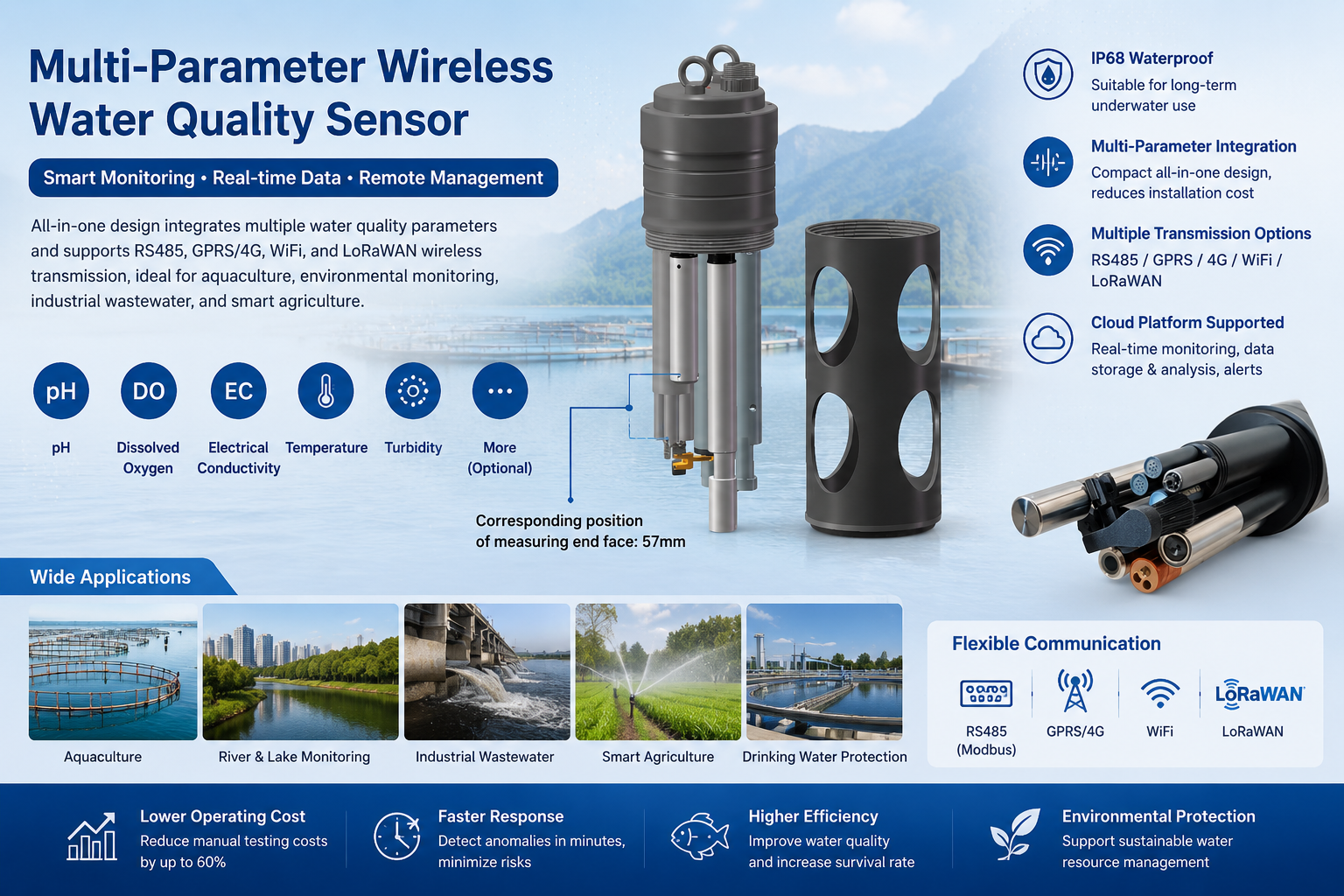
Against this backdrop, a multi-parameter online water quality sensor, integrating RS485 communication with GPRS/4G, WiFi, and LoRaWAN wireless transmission, is playing a vital role in multiple international projects.
1. Real-World Application Case: Smart Aquaculture Project in Southeast Asia
In 2025, a large aquaculture enterprise in Vietnam deployed this multi-parameter water quality monitoring system across its coastal farming base. The system is used to continuously monitor key indicators such as pH, dissolved oxygen (DO), electrical conductivity (EC), temperature, and turbidity.
According to the project manager, traditional manual testing methods suffered from data delays, high labor costs, and inconsistent accuracy. After implementing the new system, data is transmitted in real time via a LoRaWAN network to a cloud platform, enabling 24/7 unattended monitoring.
“We can now check water quality anytime via mobile or computer. Once any parameter exceeds the threshold, the system automatically triggers an alarm. This has significantly reduced fish mortality.”
— Technical Director
2. Technical Advantages: Multi-Protocol & High Integration
The core strength of this product lies in its high integration and flexible communication options:
- Supports RS485 Modbus protocol for industrial integration
- Compatible with GPRS/4G, WiFi, and LoRaWAN wireless transmission
- All-in-one multi-parameter design (pH, DO, COD, ammonia nitrogen, etc.)
- IP68 protection rating for long-term underwater operation
- Supports cloud platforms and historical data analysis
With the adoption of LoRaWAN low-power wide-area network technology, the device achieves long-distance communication (several kilometers) while maintaining low power consumption and deployment cost.
3. Global Market Trends
Industry insights indicate three major trends in the water quality monitoring market:
In particular, developing countries are experiencing strong demand for affordable and easy-to-deploy monitoring solutions, especially in agriculture, aquaculture, and environmental protection sectors.
4. Expanding Application Scenarios
This type of multi-parameter water quality sensor is widely used in:
- Aquaculture (fish farms, shrimp ponds)
- Rivers, lakes, and urban water systems
- Industrial wastewater discharge monitoring
- Drinking water source protection
- Smart agriculture and irrigation systems
5. Project Results
After deploying the system in Vietnam:
Following the success of this project, the solution has been rapidly replicated in Indonesia, Thailand, and other regions.
6. Conclusion
As global awareness of environmental protection and water resource management continues to grow, multi-parameter online water quality monitoring systems are becoming a key component of smart water infrastructure.
Looking ahead, with the integration of AI data analytics and IoT technologies, these solutions are expected to unlock even greater potential and drive widespread adoption across global markets.
Post time: Jun-02-2026