

Introduction: Why Combine Soil Moisture, Soil Tension and Air Data?
A professional agricultural monitoring system should not rely on a single soil moisture value.
A soil 4-in-1 sensor, soil tension sensor, and air temperature humidity sensor provide three complementary perspectives: what is happening inside the soil, how strongly plants must extract water from the soil, and what atmospheric conditions are affecting crop water demand.
When these sensors are connected through a LoRaWAN collector, agricultural operators can build a wireless monitoring architecture such as:
Soil 4-in-1 Sensor + Soil Tension Sensor + Air Sensor → LoRaWAN Collector → Gateway → Cloud Server → PC / Mobile
This architecture is particularly suitable for precision irrigation, greenhouse monitoring, orchards, open-field agriculture, agricultural research and distributed IoT monitoring.
Honde Technology provides configurable soil sensing, environmental sensing, wireless communication and cloud-monitoring solutions for agricultural applications. Its existing LoRaWAN architecture similarly combines field sensors, collectors, gateways and remote monitoring. (Honde)
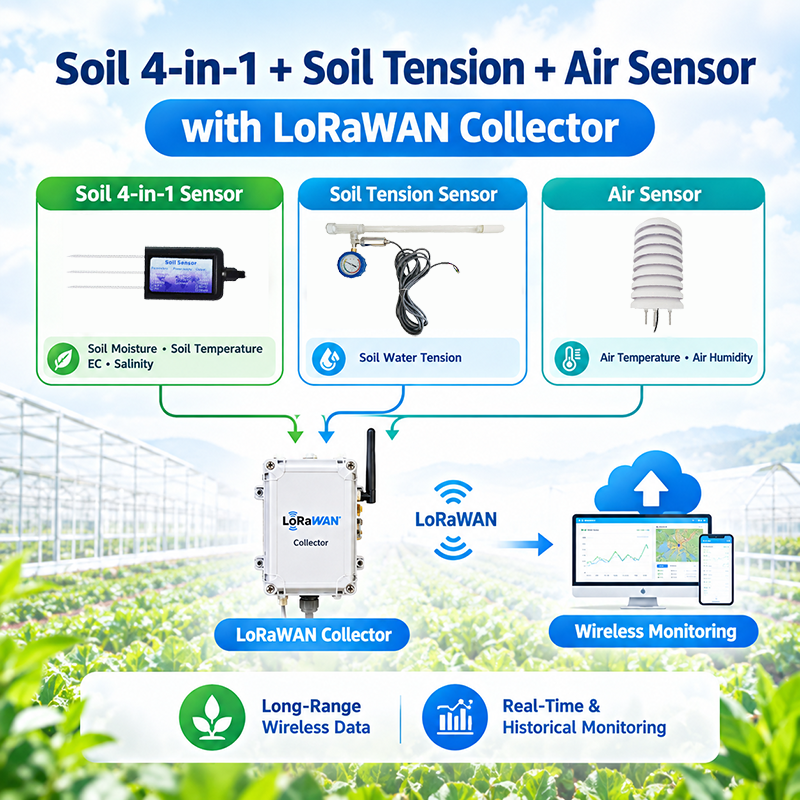
1. What Is a Soil 4-in-1 Sensor with LoRaWAN Collector?
A soil 4-in-1 sensor is a multi-parameter soil monitoring device designed to measure several important soil conditions through one sensing unit.
Depending on the selected model, the monitored parameters can include:
- Soil moisture
- Soil temperature
- Electrical conductivity (EC)
- Salinity or other soil parameters
The sensor can communicate through RS485 / Modbus, while a LoRa or LoRaWAN collector provides wireless transmission.
The basic architecture is:
Soil 4-in-1 Sensor → RS485 / Modbus → LoRaWAN Collector → LoRaWAN Gateway → Cloud
This separation between measurement, data collection, and wireless communication is important for B2B agricultural projects because system integrators can select different sensors and communication methods according to project requirements.
Honde’s published soil-monitoring products include RS485 soil sensors capable of monitoring parameters such as moisture, temperature, EC, salinity, NPK and pH, depending on the model. (Honde)
2. Why Add a Soil Tension Sensor?
Soil moisture and soil tension describe different aspects of soil-water conditions.
A conventional soil moisture sensor generally tells you how much water is present.
A soil tension sensor, or tensiometer, measures how strongly the soil holds water.
This distinction is important for irrigation management.
Soil Moisture vs Soil Tension
| Measurement | What It Indicates | Typical Application |
|---|---|---|
| Soil Moisture | Amount of water in soil | Irrigation monitoring |
| Soil Temperature | Root-zone thermal condition | Crop growth monitoring |
| Soil EC | Electrical conductivity | Fertility/salinity assessment |
| Soil Tension | Soil water suction | Irrigation decision support |
| Air Temperature | Atmospheric thermal condition | Crop environment monitoring |
| Air Humidity | Atmospheric moisture | Microclimate monitoring |
A soil tensiometer is particularly useful when irrigation decisions need to consider the energy required for plant roots to extract water, rather than simply the volumetric amount of water in the soil.
Honde’s soil tension sensor uses a porous terracotta sensing head and can be supplied in different lengths for different soil depths. The published product information specifies RS485 Modbus communication and customizable sensor lengths. (Honde)
3. Soil Tension Sensor vs Soil Moisture Sensor: Are They the Same?
No.
This is one of the most important concepts for buyers designing a precision irrigation system.
Soil Moisture Sensor
A soil moisture sensor focuses on water content.
It can help answer:
How much water is currently in the soil?
Soil Tension Sensor
A soil tension sensor focuses on soil water suction.
It helps answer:
How difficult is it for plant roots to extract the available water?
These measurements can complement each other.
For example, two soil layers may have different soil structures and water-holding characteristics even when their moisture readings appear similar. Soil tension can provide another layer of information for irrigation management.
Honde’s technical guide describes soil tension as a negative-pressure measurement related to the energy required for plants to extract soil water. (Honde)
4. Why Add an Air Temperature and Humidity Sensor?
Soil conditions do not exist independently from the atmosphere.
Air temperature and relative humidity influence:
- Evaporation
- Crop transpiration
- Microclimate
- Irrigation demand
- Plant growth conditions
- Disease-risk assessment
This is why a professional agricultural IoT system can benefit from monitoring both below-ground and above-ground conditions.
A typical architecture is:
Soil Sensor + Soil Tension Sensor + Air Sensor
↓
LoRaWAN Collector
↓
LoRaWAN Gateway
↓
MQTT / Cloud Server
↓
Remote Monitoring
Honde’s existing agricultural monitoring architecture uses the same basic concept of combining soil and air measurements with a LoRaWAN collector, gateway and cloud platform. (Honde)
5. How the Complete LoRaWAN Agricultural Monitoring System Works
The complete system can be divided into four functional layers.
Layer 1: Sensing
Field sensors collect physical measurements.
Typical sensors include:
- Soil 4-in-1 sensor
- Soil moisture sensor
- Soil temperature sensor
- Soil EC sensor
- Soil salinity sensor
- Soil tension sensor
- Air temperature sensor
- Air humidity sensor
- Light sensor
Layer 2: Data Collection
The LoRaWAN collector receives data from the field sensors.
For RS485-based sensors, the communication architecture can use:
Sensor → RS485 Modbus → Collector
This makes it possible to connect multiple sensing devices to one monitoring node, depending on the system configuration.
Layer 3: Wireless Communication
The collector sends the data through a wireless network.
Possible communication technologies include:
- LoRa
- LoRaWAN
- 4G
- GPRS
- WiFi
For distributed agricultural monitoring, LoRaWAN is particularly useful because it is designed around long-range, low-power wireless communication.
Layer 4: Cloud Monitoring
After the data reaches the gateway and server, users can access:
- Real-time data
- Historical data
- Data charts
- Device status
- Alarm information
- Remote monitoring
- Agricultural trend analysis
Honde’s agricultural IoT architecture supports cloud/software integration and MQTT-based data transmission for remote monitoring applications.
6. Why Use a LoRaWAN Collector Instead of Long Sensor Cables?
For a small greenhouse, cable installation may be relatively simple.
For a large farm, orchard or distributed research site, however, cable management can become a major engineering consideration.
| Factor | Traditional Wired System | LoRaWAN System |
|---|---|---|
| Field Cabling | More cables | Reduced wireless cabling |
| Installation | More routing work | Flexible sensor deployment |
| Large Fields | Cable routing can be complex | Suitable for distributed nodes |
| Expansion | Additional wiring | Wireless nodes can be added |
| Remote Sites | More infrastructure | Suitable for distributed monitoring |
| Cloud Connection | Additional equipment | Gateway/network integration |
| Multi-Parameter Monitoring | Possible | Possible |
The key advantage is not simply “wireless.”
The real benefit is the ability to create a distributed monitoring network in which different sensor types can be installed at different locations and depths while sending their measurements to a centralized data system.
7. What Does This Architecture Measure?
The exact configuration can be customized according to the agricultural application.
| Monitoring Layer | Sensor | Typical Parameters |
|---|---|---|
| Root Zone | Soil 4-in-1 | Moisture, temperature, EC, salinity |
| Root Zone | Soil Tension Sensor | Soil water tension |
| Crop Environment | Air Sensor | Air temperature, humidity |
| Optional | Light Sensor | Illumination |
| Communication | LoRaWAN Collector | Wireless data collection |
| Network | LoRaWAN Gateway | Data forwarding |
| Software | Cloud Server | Real-time & historical monitoring |
This multi-layer approach creates a more complete soil–plant–atmosphere monitoring model than using a single soil moisture sensor.
8. Key Applications
Precision Irrigation
Combining soil moisture with soil tension provides additional information for irrigation scheduling.
Instead of asking only:
Is the soil wet?
the system can help operators evaluate:
How much water is available, and how strongly is the soil holding it?
Greenhouse Monitoring
Greenhouses can use soil and air sensors to monitor both root-zone conditions and internal microclimate.
Typical deployment:
Soil 4-in-1 + Soil Tension + Air Temperature/Humidity → LoRaWAN Collector → Cloud
This can support irrigation management, crop growth monitoring and environmental analysis.
Honde’s existing agricultural IoT content also identifies greenhouses as an application for combined soil and air monitoring. (Honde)
Orchard Monitoring
Orchards often have distributed monitoring points.
Sensors can be installed in representative zones and connected to a wireless collector, reducing the need to route communication cables throughout the planting area.
Large-Scale Farms
For large agricultural areas, multiple sensor nodes can be distributed according to:
- Soil type
- Crop type
- Irrigation zone
- Root depth
- Field elevation
- Different growing conditions
This creates a scalable monitoring network rather than relying on one measurement point.
Agricultural Research
Research stations can combine soil moisture, soil tension, soil temperature and atmospheric measurements to study:
- Soil-water movement
- Irrigation response
- Crop growth
- Root-zone conditions
- Microclimate changes
9. How to Select Sensors for a Precision Irrigation Project
Before purchasing a LoRaWAN agricultural monitoring system, B2B buyers should evaluate the complete architecture rather than looking only at the sensor price.
1. Define the Soil Parameters
Determine whether the project needs:
- Moisture
- Temperature
- EC
- Salinity
- NPK
- pH
- Soil tension
Different crops and agricultural projects require different measurement combinations.
2. Determine Monitoring Depth
Root-zone monitoring may require sensors installed at different depths.
For soil tension sensors, Honde offers multiple length options, allowing the sensing depth to be adapted to different applications.
3. Select the Communication Interface
RS485 / Modbus is useful for industrial sensor integration.
LoRa and LoRaWAN provide the wireless communication layer.
These technologies are not necessarily alternatives.
They can work together:
Sensor → RS485 → LoRaWAN Collector → Gateway → Cloud
4. Evaluate Power Supply
Remote agricultural monitoring may require:
- Battery power
- Solar power
- External DC power
The appropriate solution depends on the deployment location and communication frequency.
5. Check Cloud Integration
For system integrators, the sensor is only one part of the project.
It is also important to confirm:
- MQTT support
- JSON data format
- Cloud API requirements
- Historical data
- Alarm functions
- Dashboard requirements
10. Honde’s Practical Approach to Agricultural IoT Integration
From an engineering perspective, an agricultural monitoring project should not be treated as a simple sensor purchase.
The real system consists of:
Sensor → Interface → Collector → Wireless Network → Gateway → Cloud → Application
This modular architecture makes it possible to customize the system according to the project.
For example:
Basic System
Soil 4-in-1 Sensor → LoRaWAN Collector → Gateway → Cloud
Irrigation-Focused System
Soil 4-in-1 Sensor + Soil Tension Sensor → LoRaWAN Collector → Gateway → Cloud
Crop Environment System
Soil Sensor + Soil Tension Sensor + Air Sensor → LoRaWAN Collector → Gateway → Cloud
Advanced Smart Agriculture System
Soil Sensors + Soil Tension + Air Sensor + Weather Station → LoRaWAN Collector → Gateway → MQTT Cloud → Alarm / Irrigation System
This modular approach allows agricultural integrators to start with essential parameters and expand the system later.
11. Experience-Based Buying Tips: What Do Buyers Often Overlook?
In agricultural monitoring projects, choosing the sensor with the longest parameter list is not always the most important decision.
There are several practical points that should be checked before deployment.
Sensor Installation Depth
A sensor should represent the actual soil layer relevant to the crop root zone.
Installing every sensor at the same depth may not provide the most useful data for crops with different root structures.
Communication Architecture
A sensor may have excellent measurement specifications but still be unsuitable if its communication interface does not match the project.
For B2B projects, confirm:
RS485 / Modbus → Collector → LoRaWAN → Gateway → Cloud
before finalizing the hardware.
Soil Tension and Moisture Should Not Be Treated as Identical Data
They describe different physical properties.
Using both measurements can provide a more comprehensive picture of soil-water conditions.
Do Not Ignore Atmospheric Conditions
Irrigation demand is affected not only by soil conditions but also by atmospheric temperature and humidity.
Therefore, adding an air sensor can provide useful environmental context.
12. Soil 4-in-1 + Soil Tension + Air Sensor: System Comparison
| Solution | Soil Data | Soil Water Availability | Air Data | Wireless | Recommended Use |
|---|---|---|---|---|---|
| Soil 4-in-1 | ✓ | Basic | — | Optional | Soil monitoring |
| Soil Tension | — | ✓ | — | Optional | Irrigation research |
| Air Sensor | — | — | ✓ | Optional | Microclimate |
| Soil 4-in-1 + Tension | ✓ | ✓ | — | ✓ | Precision irrigation |
| Soil + Air | ✓ | Basic | ✓ | ✓ | Crop environment |
| Soil + Tension + Air | ✓ | ✓ | ✓ | ✓ | Integrated smart agriculture |
The final configuration should be selected according to crop type, soil characteristics, monitoring depth, field size, power availability and required cloud integration.
13. Why This Architecture Is Suitable for Smart Agriculture
The main value of this architecture is data integration.
Instead of looking at isolated sensor readings, farmers and agricultural system integrators can compare:
Soil Moisture
Soil Tension
Soil Temperature / EC
Air Temperature / Humidity
Historical Trends
This creates a stronger information base for irrigation management and agricultural decision-making.
Honde’s existing LoRaWAN agricultural solutions similarly emphasize combining sensing, wireless communication, gateways and cloud monitoring into an integrated IoT architecture. (Honde)
14. Recommended System Architecture
For a typical smart agriculture deployment, the following architecture is a practical starting point:
        SOIL 4-IN-1 SENSOR
                 │
              RS485
                 │
        SOIL TENSION SENSOR
                 │
              RS485
                 │
            AIR SENSOR
                 │
                 ▼
       ┌──────────────────┐
       │ LoRaWAN Collector│
       └────────┬─────────┘
                │
             LoRaWAN
                │
                ▼
       ┌──────────────────┐
       │ LoRaWAN Gateway  │
       └────────┬─────────┘
                │
          4G / WiFi / Ethernet
                │
                ▼
       ┌──────────────────┐
       │ Cloud Server     │
       │ MQTT / JSON      │
       └────────┬─────────┘
                │
          PC / Mobile App
                │
                ▼
       Real-Time + Historical Data
This architecture can be expanded with additional soil sensors, weather stations, irrigation controllers or alarm systems according to the project.
15. Honde Technology: From Sensors to Complete IoT Solutions
Honde Technology Co., Ltd. was founded in 2011 and focuses on IoT solutions for smart water equipment, smart agriculture equipment and smart environmental equipment.
For agricultural monitoring projects, Honde provides solutions covering:
- Soil sensors
- Multi-parameter soil sensors
- Soil tension sensors
- Air temperature and humidity sensors
- Weather stations
- RS485 / Modbus communication
- LoRa / LoRaWAN wireless systems
- 4G / WiFi / GPRS communication
- Data loggers
- Cloud server and software
- MQTT / JSON integration
- Alarm and remote monitoring systems
The company’s published product and solution pages demonstrate this broader agricultural sensing ecosystem rather than limiting the offering to a single sensor type. (Honde)
Company Name: Honde Technology Co., Ltd.
Website: www.hondetechco.com
Email: info@hondetech.com
Conclusion: Build a More Complete Agricultural Monitoring Network
A soil 4-in-1 sensor, soil tension sensor and air sensor each provide different information.
When these sensors are integrated with a LoRaWAN collector, the result is more than a collection of individual instruments. It becomes a scalable agricultural IoT monitoring architecture.
The basic concept is:
Measure Soil → Understand Water Availability → Monitor Air Conditions → Transmit Data → Analyze Trends → Improve Irrigation Decisions
For farms, greenhouses, orchards, research stations and agricultural IoT projects, this architecture provides a flexible foundation for building remote and distributed monitoring systems.
Looking for a customized LoRaWAN agricultural monitoring solution?
Contact Honde Technology Co., Ltd. for sensor selection, communication architecture and OEM/ODM project support.
Website: www.hondetechco.com
Email: info@hondetech.com
FAQ
What is a soil 4-in-1 sensor?
A soil 4-in-1 sensor combines several soil measurements into one sensing device. Depending on the model, parameters may include soil moisture, temperature, EC and salinity.
What does a soil tension sensor measure?
A soil tension sensor measures soil water suction, indicating how strongly water is held by the soil. It provides information that is different from volumetric soil moisture measurement. (Honde)
Can a soil tension sensor work with LoRaWAN?
Yes. An RS485 soil tension sensor can be integrated with a LoRaWAN collector, allowing its data to be transmitted wirelessly to a gateway and cloud platform.
Why combine soil and air sensors?
Soil sensors describe root-zone conditions, while air sensors provide atmospheric information such as temperature and humidity. Combining both can provide a more complete picture of crop-growing conditions. (Honde)
Can multiple sensors use one LoRaWAN collector?
The exact number depends on the collector hardware and system configuration. A properly designed system can integrate multiple field sensors and transmit their data through a common wireless architecture.
Can Honde customize the agricultural monitoring system?
Honde’s published agricultural IoT solutions support combinations of soil sensors, air sensors, LoRa/LoRaWAN collectors, gateways, cloud software and MQTT communication, allowing system configurations to be adapted to project requirements. (Honde)
Post time: Sep-16-2026