

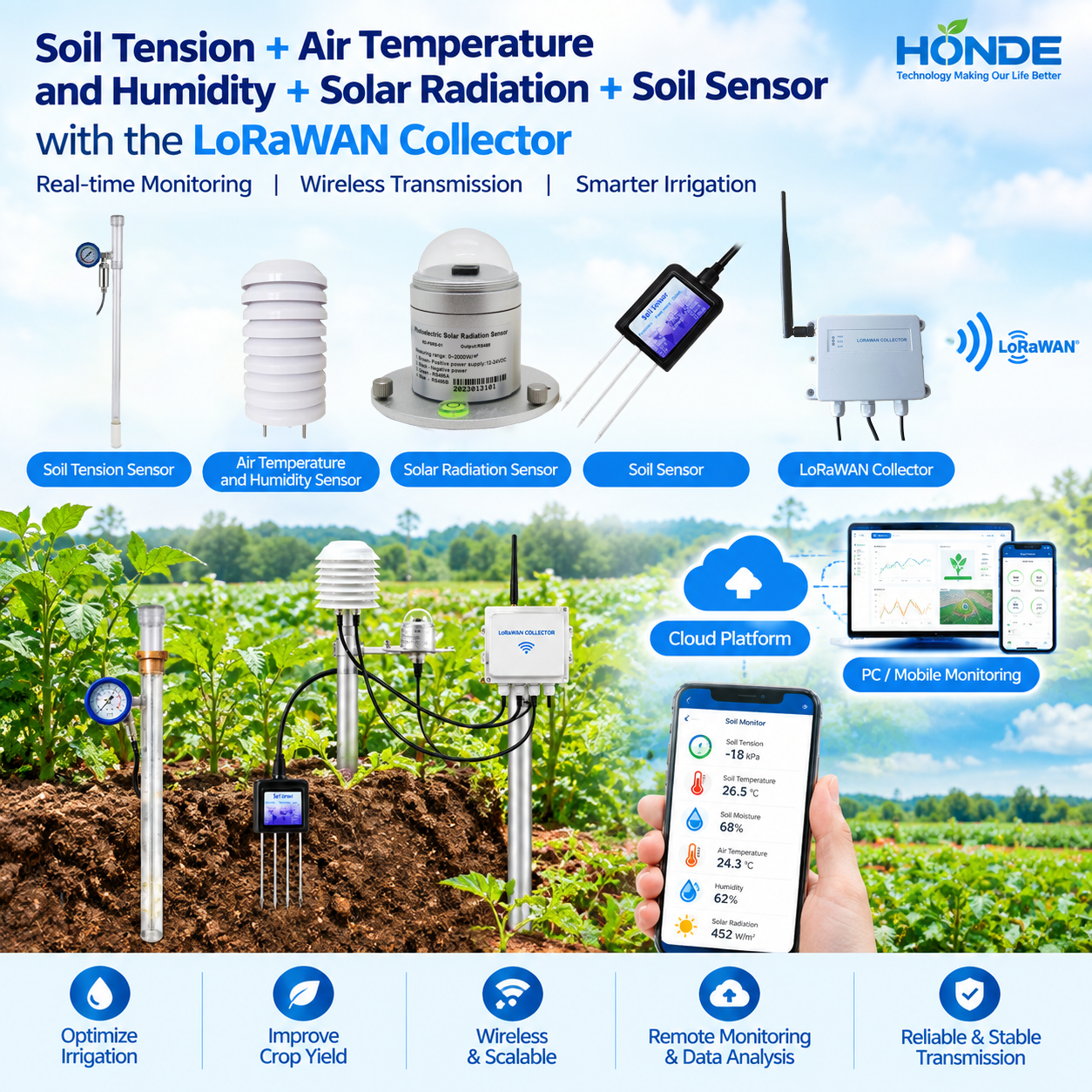
Soil tension, air conditions, and solar radiation provide three different but complementary views of the crop environment. A Soil Tension Air Radiation Sensor with a LoRaWAN Collector can connect these measurements into a wireless agricultural monitoring system, helping farms understand soil water availability, environmental conditions, and radiation changes without running communication cables throughout the field.
For precision agriculture, this architecture can be expanded with soil moisture, soil temperature, EC, weather stations, water-level sensors, and other agricultural sensors. The basic data path is:
Soil Tension Sensor + Air/Radiation Sensor → LoRaWAN Collector → LoRaWAN Gateway → Cloud Server → Remote Monitoring
Honde Technology Co., Ltd. develops IoT sensing and wireless monitoring solutions for agriculture, environmental monitoring, and smart farming applications. Its existing LoRa/LoRaWAN architecture combines distributed field sensors with wireless collectors and gateways for remote data acquisition.
What Is a Soil Tension Sensor With LoRaWAN Collector?
A soil tension sensor measures the force or suction associated with water being held in soil. Unlike simply measuring soil volumetric water content, soil tension can provide another perspective on how difficult it is for plant roots to extract water from the soil.
When connected to a LoRaWAN-based monitoring system, the sensor can become part of a distributed field network.
A typical architecture is:
| System Layer | Main Equipment | Main Function |
|---|---|---|
| Soil Monitoring | Soil Tension Sensor | Monitor soil water tension |
| Environmental Monitoring | Air / Radiation Sensor | Monitor above-ground conditions |
| Wireless Collection | LoRaWAN Collector | Collect and transmit sensor data |
| Network | LoRaWAN Gateway | Forward field data to the network |
| Cloud | Server / Platform | Store and visualize data |
| User Interface | PC / Mobile | Remote monitoring and analysis |
This type of architecture is particularly useful when monitoring points are distributed across farms, greenhouses, orchards, irrigation areas, or agricultural research sites.
Honde’s related LoRaWAN agricultural architecture follows the same sensor-to-collector-to-gateway-to-cloud concept, allowing different types of environmental sensors to share a wireless infrastructure.
Why Monitor Soil Tension for Precision Irrigation?
Traditional irrigation decisions often depend on fixed schedules, visual inspection, or limited sampling points.
However, soil water conditions can vary considerably between different locations and soil layers.
Soil tension monitoring adds another measurement layer to irrigation management.
Soil Tension Helps Identify Changes in Soil Water Availability
A soil-tension measurement can help agricultural managers understand whether soil water is becoming increasingly difficult for plants to extract.
The general decision process can be represented as:
Soil Tension Changes → Evaluate Root-Zone Water Conditions → Adjust Irrigation Strategy
This does not mean that one sensor should automatically determine irrigation. Instead, soil tension can be combined with other measurements such as:
- Soil moisture
- Soil temperature
- Soil EC
- Air temperature
- Air humidity
- Rainfall
- Solar radiation
- Wind speed
- Crop growth stage
This multi-parameter approach provides more environmental context for irrigation decisions.
Honde’s existing soil-monitoring solutions also support combinations of moisture, temperature, EC, salinity, pH and NPK measurements depending on the sensor configuration.
Soil Tension vs Soil Moisture: What Is the Difference?
One of the most important questions when selecting a smart agriculture sensor is whether to monitor soil moisture, soil tension, or both.
They describe different characteristics of the soil-water system.
| Measurement | What It Indicates | Typical Agricultural Use |
|---|---|---|
| Soil Moisture | Amount of water present in soil | Irrigation monitoring |
| Soil Tension | Soil-water suction / availability condition | Irrigation decision support |
| Soil Temperature | Thermal condition around roots | Crop and root-zone monitoring |
| Soil EC | Electrical conductivity | Salinity and fertilizer-related monitoring |
| Air Temperature | Above-ground temperature | Crop environment |
| Solar Radiation | Incoming solar energy | Crop growth and evapotranspiration analysis |
For some projects, soil moisture may be sufficient. For more advanced irrigation monitoring, combining soil moisture and soil tension can provide complementary information.
This is particularly relevant for research farms, high-value crops, greenhouse production, orchards, and precision irrigation projects.
Why Add Air and Radiation Monitoring?
Soil conditions do not exist independently from the surrounding environment.
A crop field with strong solar radiation, high air temperature and low humidity may have a very different water-demand profile from a field experiencing cloudy weather and high humidity.
Therefore, combining soil and atmospheric measurements creates a more complete monitoring picture.
Above-Ground Environmental Data
Depending on the selected sensor configuration, an agricultural monitoring system can incorporate:
- Air temperature
- Air humidity
- Solar radiation
- Light intensity
- Wind speed
- Wind direction
- Rainfall
- Atmospheric pressure
Honde’s agricultural weather monitoring systems can be configured with multiple atmospheric parameters, including temperature, humidity, wind, rainfall, radiation and other environmental measurements.
The result is a two-layer monitoring concept:
Above Ground
Air + Radiation + Weather
↓
Below Ground
Soil Tension + Soil Moisture + Soil Temperature + EC
↓
Wireless Network
LoRaWAN Collector
↓
Cloud Platform
Remote Monitoring & Data Analysis
How Does the LoRaWAN Collector Work?
The LoRaWAN collector is the communication bridge between field sensors and the wider IoT network.
Instead of connecting every sensor directly to a cellular network, multiple distributed monitoring points can communicate through a low-power wireless architecture.
A typical system can operate as follows:
Step 1: Sensors Collect Field Data
The soil tension sensor measures soil water conditions.
The air/radiation sensor measures environmental conditions above the crop.
Additional sensors can be added according to the project requirements.
Step 2: LoRaWAN Collector Receives Data
The collector gathers measurement information from connected field sensors and prepares it for wireless transmission.
Step 3: LoRaWAN Gateway Receives the Wireless Data
The gateway acts as the network connection between field devices and the network/server infrastructure.
Step 4: Data Goes to the Cloud
The collected data can be transmitted to a cloud server or agricultural management platform.
Step 5: Users Monitor Data Remotely
Farm managers, agricultural engineers and researchers can access historical and real-time information through software platforms.
Honde’s existing agricultural IoT architecture uses distributed sensors, LoRa/LoRaWAN collectors and gateways before sending data to cloud systems, providing a scalable approach for large-area monitoring.
Key Advantages of a Soil Tension and Radiation LoRaWAN System
1. Wireless Field Deployment
Large farms can contain many monitoring points.
Using wireless communication reduces the need to install long communication cables between every sensor and control room.
2. Multi-Parameter Monitoring
The system can combine soil and atmospheric measurements instead of relying on one parameter.
3. Scalable Architecture
A project can start with a small number of monitoring points and add additional sensors as the farm expands.
4. Remote Data Access
With an appropriate gateway and cloud platform, field information can be accessed remotely instead of requiring personnel to visit every monitoring location.
5. Suitable for Distributed Agricultural Areas
LoRa/LoRaWAN is particularly relevant to IoT applications where sensors are distributed across agricultural fields and low-power wireless communication is required.
Recommended Applications
A Soil Tension Air Radiation Sensor with LoRaWAN Collector can be considered for several agricultural monitoring scenarios.
| Application | Soil Monitoring | Environmental Monitoring | Main Purpose |
|---|---|---|---|
| Open-Field Agriculture | Soil Tension / Moisture | Radiation / Weather | Irrigation Management |
| Greenhouse | Soil Tension / Moisture | Air Conditions | Root-Zone Management |
| Orchard | Soil Water Conditions | Weather / Radiation | Precision Irrigation |
| Agricultural Research | Multi-Depth Soil Data | Environmental Data | Field Experiments |
| Irrigation Projects | Soil Tension | Weather | Water Management |
| Smart Farm | Multiple Soil Sensors | Weather Station | Integrated Farm Monitoring |
For larger systems, the architecture can be expanded by combining weather stations, soil sensors and water-level monitoring through a common LoRaWAN network. Honde has also documented this integrated architecture for smart agriculture applications.
How to Build a More Complete Smart Agriculture Monitoring Network
For a simple project, the architecture can be:
Soil Tension Sensor → LoRaWAN Collector → Gateway → Cloud
For a more comprehensive smart farming project, it can be expanded to:
Weather Station
Soil Tension Sensor
Soil Moisture & Temperature Sensor
Soil EC / Salinity Sensor
↓
LoRaWAN Collector
↓
LoRaWAN Gateway
↓
4G / Ethernet / Internet
↓
Cloud Server & Software
↓
PC / Mobile Phone
This modular structure allows the agricultural monitoring system to evolve with the project.
For example, a greenhouse project may initially monitor soil tension and air conditions. Later, the customer may add soil moisture, EC, radiation and water-level monitoring without completely redesigning the communication architecture.
What Should Buyers Check Before Choosing a LoRaWAN Soil Sensor System?
For B2B agricultural projects, product selection should go beyond simply comparing sensor prices.
We recommend checking the following points:
1. Measurement Parameters
Confirm whether the project requires:
- Soil tension
- Soil moisture
- Soil temperature
- EC
- Salinity
- pH
- NPK
- Air temperature
- Air humidity
- Radiation
2. Communication Method
Check whether the system requires:
- LoRa
- LoRaWAN
- RS485
- 4G
- Wi-Fi
- MQTT
- Other communication protocols
Honde’s existing product architecture supports different combinations of sensing and communication technologies depending on the application.
3. Monitoring Depth and Installation
For soil applications, sensor installation depth can influence the usefulness of the collected data.
The sensor should be installed at a representative location and depth corresponding to the crop root zone or research objective.
4. Gateway and Network Coverage
Before deployment, evaluate:
- Field size
- Monitoring-point distribution
- Obstacles
- Gateway location
- Wireless coverage
- Power availability
5. Cloud Integration
For commercial agricultural projects, confirm how the data will reach the final platform.
A practical architecture may use:
Sensor → Collector → Gateway → 4G/Ethernet → Cloud Server → Dashboard
This makes the system easier to manage remotely.
Honde Technology: From Sensors to Complete Agricultural IoT Solutions
Honde Technology Co., Ltd. was founded in 2011 and focuses on IoT technologies for smart water equipment, smart agriculture equipment, smart environmental equipment and related solutions.
Our agricultural monitoring solutions can combine different sensors and communication technologies according to project requirements.
Typical system components include:
- Agricultural weather stations
- Soil moisture sensors
- Soil temperature sensors
- Soil EC and salinity sensors
- Soil pH and NPK sensors
- Soil tension sensors
- Radiation sensors
- LoRa / LoRaWAN collectors
- LoRaWAN gateways
- 4G IoT communication
- Data loggers
- Cloud monitoring systems
Honde’s published smart agriculture architecture demonstrates how weather stations and soil sensors can be combined with LoRa/LoRaWAN collectors and gateways to create a distributed field monitoring network.
The company states that its products are sold in more than 70 countries and that it serves thousands of customers, with CE, RoHS and German TUV certifications.
Company Name: Honde Technology Co., Ltd.
Website: www.hondetechco.com
Email: info@hondetech.com
Conclusion: From Soil Tension Data to Smarter Irrigation Decisions
A Soil Tension Air Radiation Sensor with LoRaWAN Collector provides a practical way to connect soil-water monitoring with above-ground environmental data.
The key architecture is simple:
Soil Tension + Air/Radiation Monitoring → LoRaWAN Collector → Gateway → Cloud → Remote Monitoring
For precision agriculture, the real value comes from combining different measurements rather than relying on a single sensor.
Soil tension can provide information about soil-water conditions, while radiation and atmospheric measurements provide environmental context. Additional soil, weather and water-level sensors can then be integrated as the project develops.
For farms, greenhouses, orchards, irrigation projects and agricultural research, this modular architecture provides a practical foundation for building a scalable Smart Agriculture IoT Monitoring System.
Need a customized soil tension and LoRaWAN monitoring solution? Contact Honde Technology to discuss sensor parameters, communication methods, installation requirements and cloud integration for your project.
Post time: Sep-21-2026