

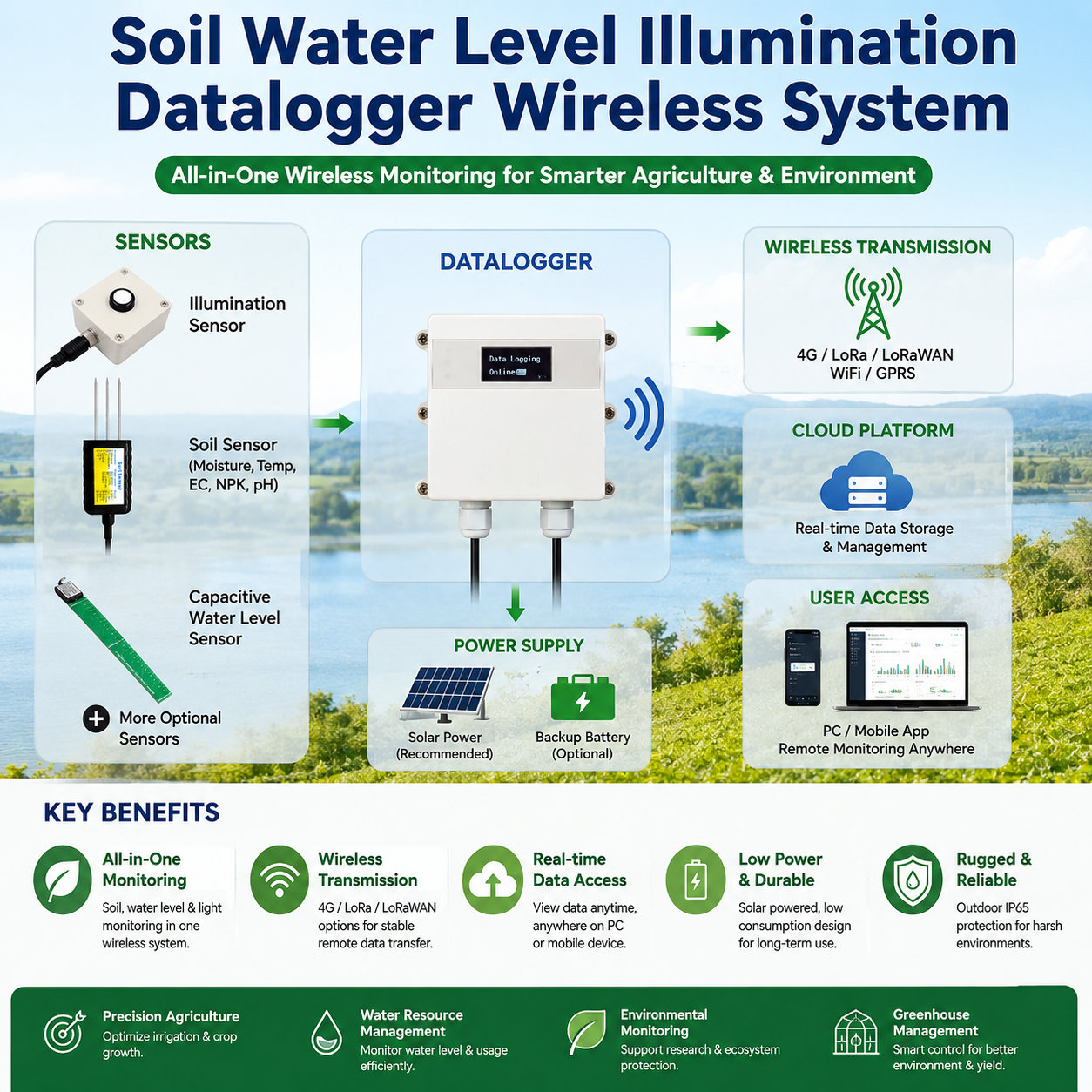
What Is a Soil Water Level Illumination Sensor Datalogger?
A soil water level illumination sensor datalogger is a multi-parameter monitoring system designed to collect and record environmental data such as soil conditions, water-level changes and light intensity, then transmit the information wirelessly for remote analysis
Unlike a conventional soil moisture sensor that measures only one parameter, an integrated monitoring system can connect several environmental measurements into a single data workflow. This makes it particularly useful for precision agriculture, irrigation management, ecological monitoring, greenhouse management and remote environmental research.
Honde Technology’s wireless monitoring solution combines soil monitoring, water-level monitoring and illumination measurement with a data logger and wireless communication architecture. The system can transmit field data through technologies such as 4G, LoRa, LoRaWAN or other wireless configurations, depending on the project requirements.
For buyers evaluating agricultural IoT equipment, the key question is therefore not simply “How accurate is the sensor?” but:
Can the complete system reliably collect, transmit, store and visualize the environmental data required by the project?
Why Combine Soil Moisture, Water Level and Illumination Monitoring?
Agricultural conditions are rarely controlled by a single environmental parameter.
Soil moisture tells growers how much water is available around the root zone. Water-level data can reveal groundwater, irrigation-channel or reservoir changes. Illumination data helps explain plant growth conditions and evapotranspiration-related changes.
When these measurements are analyzed together, the monitoring system provides a more complete picture of the field environment.
1. Soil Monitoring System Using IoT
Soil moisture is one of the most important variables in precision irrigation.
Continuous measurements can help agricultural operators identify:
- When soil moisture falls below a target range
- Whether irrigation has penetrated the root zone
- How quickly soil dries after irrigation
- Differences between locations within a field
- Relationships between soil moisture and temperature or conductivity
Honde’s soil-monitoring solutions can be configured for multi-parameter measurement, including soil moisture, temperature and electrical conductivity depending on the sensor configuration.
2. Water Level Monitoring
Water-level monitoring extends the system beyond the immediate root zone.
It can be applied to:
- Irrigation reservoirs
- Rivers
- Groundwater
- Drainage channels
- Agricultural ponds
- Wetland monitoring sites
For remote projects, continuous automatic measurement is especially valuable because it reduces the need for repeated manual inspection.
3. Illumination and PAR Monitoring
Light is another important environmental variable for crop and ecological monitoring.
A properly configured light sensor can help operators understand:
- Solar radiation conditions
- Photosynthetically active radiation
- Differences between shaded and exposed areas
- Plant-growth environments
- Relationships between light, irrigation and soil moisture
Honde also offers radiation and illumination sensors for agricultural and environmental applications.
How Does a Wireless Agricultural Datalogger System Work?
A typical architecture can be divided into five layers:
Sensors → Data Logger → Wireless Communication → Cloud/Server → PC or Mobile Dashboard
The workflow is straightforward:
- Sensors collect environmental parameters.
- The data logger receives and processes the measurements.
- The system stores data locally when required.
- Wireless communication transmits the information to a remote server.
- Users access real-time or historical data through cloud software.
This architecture is important because the sensor itself is only one part of a complete monitoring solution.
Honde states that its solutions can integrate wireless modules, server software and data visualization, while supporting communication technologies including GPRS, 4G, WiFi, LoRa and LoRaWAN.
Soil Sensor vs. Multi-Parameter Datalogger: What Is the Difference?
A common purchasing mistake is to compare a complete agricultural monitoring system directly with a single sensor.
| Feature | Conventional Soil Sensor | Multi-Parameter Wireless Datalogger |
|---|---|---|
| Soil moisture | ✓ | ✓ |
| Soil temperature | Depends on model | Configurable |
| Water level | Usually no | ✓ |
| Illumination | Usually no | ✓ |
| Local data storage | Depends on model | ✓ |
| Wireless communication | Limited/optional | ✓ |
| Remote monitoring | Limited | ✓ |
| Multi-sensor integration | Limited | ✓ |
| Cloud/software integration | Depends on system | Available |
| Suitable for remote stations | Sometimes | Yes |
| Best application | Single-point measurement | Agricultural IoT monitoring |
The main advantage of the integrated approach is data correlation.
For example, instead of asking only:
“Is the soil dry?”
an agricultural operator can investigate:
“How did soil moisture change after irrigation, under what illumination conditions, and how did the nearby water level change during the same period?”
That difference is what turns individual sensor readings into an agricultural monitoring system.
What Should Buyers Check Before Purchasing a Wireless Soil Monitoring System?
Not every wireless datalogger is suitable for every agricultural project.
Before selecting a supplier, buyers should evaluate at least seven factors.
1. Sensor Parameters
Define exactly what needs to be measured.
For example:
- Soil moisture
- Soil temperature
- Soil EC
- Water level
- Light intensity
- Solar radiation
- Air temperature
- Humidity
Choosing the parameters before selecting the hardware prevents unnecessary equipment costs.
2. Communication Method
The communication technology should match the installation environment.
| Communication | Typical Advantage | Suitable Scenario |
|---|---|---|
| 4G | Wide-area cellular connectivity | Remote farms with cellular coverage |
| LoRa | Long range and low power | Distributed sensor networks |
| LoRaWAN | Network-scale IoT deployment | Large monitoring networks |
| WiFi | Simple local connectivity | Farms, greenhouses and facilities |
| GPRS | Legacy cellular deployments | Existing infrastructure |
Honde provides multiple wireless communication options and can customize the communication module according to project requirements.
3. Local Data Storage
Remote monitoring systems should not depend entirely on continuous network availability. A local storage function can preserve measurements during temporary communication interruptions and synchronize the information after the connection is restored.
4. Power Supply
For outdoor agricultural monitoring, power consumption can directly affect maintenance costs. Solar-powered configurations are particularly useful for remote monitoring stations where conventional electrical power is unavailable. Honde’s environmental monitoring solutions include low-power architectures designed for remote deployments, including solar-powered configurations.
5. Data Protocol
If the system must connect to an existing agricultural platform, check communication protocols before purchasing.
Common requirements include:
- RS485
- Modbus
- MQTT
- JSON
- API/cloud integration
Honde’s broader IoT architecture supports server and software integration, while its recent remote-monitoring solutions describe MQTT and JSON connectivity for higher-level data systems.
6. Outdoor Durability
Agricultural sensors operate in environments containing:
- Rain
- Dust
- High humidity
- Temperature changes
- Direct sunlight
- Fertilizer
- Soil and water exposure
Therefore, enclosure protection, sensor materials, cable design and environmental testing should be evaluated before deployment. Honde reports dedicated testing capabilities including wind-tunnel testing, high/low-temperature testing, waterproof testing, salt-mist testing, sand/dust testing and sensor calibration.
7. Customization Capability
A pilot project and a large commercial agricultural deployment may require completely different configurations.
Look for a manufacturer that can customize:
- Sensor types
- Number of channels
- Communication module
- Data logger
- Display
- Power supply
- Cloud platform
- Housing
- OEM branding
Honde states that it provides OEM and ODM services and can customize wireless modules and system configurations.
Key Applications of Soil Water Level and Illumination Monitoring
Precision Irrigation
Continuous soil moisture monitoring can support irrigation decisions based on actual field conditions rather than fixed schedules. When combined with illumination and water-level information, irrigation managers can obtain a broader understanding of crop water demand. A Honde-published case describes the use of combined soil moisture and light data for irrigation management in agricultural production.
Greenhouse Monitoring
Greenhouses require close control of environmental conditions. A monitoring system can provide information about:
- Soil moisture
- Temperature
- Humidity
- Light
- Irrigation
- Other environmental variables
This allows growers to move from manual inspection toward data-driven environmental management.
Groundwater and Irrigation Management
Water-level sensors can continuously monitor changes in groundwater, reservoirs and irrigation systems. Combining water-level measurements with soil moisture data can help operators understand how water resources move through an agricultural environment.
Ecological and Wetland Research
The same technology can be used outside agriculture. Environmental researchers can monitor:
- Wetland water levels
- Soil moisture
- Forest-floor illumination
- Vegetation environments
- Seasonal environmental changes
Continuous datasets can be particularly useful for long-term ecological research.
Honde Technology: From Sensors to Complete IoT Monitoring Solutions
Choosing an agricultural sensor manufacturer is not only about purchasing hardware. For international B2B buyers, the supplier’s ability to support the complete project can be equally important.
Honde Technology Co., Ltd. was founded in 2011 and focuses on smart water equipment, smart agriculture, environmental monitoring and related IoT solutions. The company reports cooperation with customers in more than 60 countries.
Its product portfolio covers:
- Soil sensors
- Water-quality sensors
- Water-level sensors
- Weather stations
- Environmental sensors
- Data acquisition modules
- Wireless communication modules
- Agricultural machinery
- Cloud server and software solutions
The company’s R&D and testing capabilities include a wind tunnel laboratory, high/low-temperature laboratory, optical laboratory and water/gas testing facilities. This broader product ecosystem can be useful when a project needs multiple environmental parameters rather than a standalone sensor.
What Makes a Good Agricultural IoT Datalogger?
A reliable agricultural datalogger should achieve four objectives:
The strongest systems add a fifth capability:
This is why buyers should evaluate the entire data chain, rather than comparing sensors based solely on unit price.
Soil Water Level Illumination Datalogger Buying Checklist
Before sending an RFQ to a manufacturer, prepare the following information:
- Required soil parameters
- Required water-level range
- Required illumination or PAR measurement
- Number of monitoring points
- Sensor installation depth
- Wireless communication method
- Power supply requirements
- Local data storage requirements
- Cloud platform requirements
- MQTT/JSON/Modbus requirements
- Outdoor protection requirements
- Required operating temperature
- OEM logo or enclosure requirements
- Target quantity and MOQ
- Destination country
- Required certifications
Providing these specifications at the RFQ stage allows a manufacturer to recommend a more accurate configuration and quotation.
Frequently Asked Questions
Can one datalogger monitor soil, water level and illumination?
Yes. A properly configured multi-channel data acquisition system can integrate multiple sensor types into one monitoring station. The exact sensor combination should be specified according to the application.
Can the system transmit data wirelessly?
Yes. Wireless configurations can include technologies such as 4G, LoRa, LoRaWAN and WiFi. The appropriate choice depends on network coverage, distance, power consumption and deployment scale.
Can the system be used for remote farms?
Yes. Remote agricultural monitoring is one of the key applications. Solar power and low-power wireless communication can reduce the need for frequent field maintenance.
Can the system be customized?
Yes. Honde provides OEM/ODM services and offers customizable wireless modules and system configurations.
Is this system suitable only for agriculture?
No. The same monitoring architecture can be applied to ecological research, wetland monitoring, groundwater observation, irrigation management, greenhouse monitoring and other environmental applications.
Conclusion: Choose a Monitoring System, Not Just a Sensor
The future of agricultural monitoring is moving from isolated measurements toward connected environmental intelligence.
A soil moisture sensor can tell you about soil moisture. A water-level sensor can tell you about water. A light sensor can tell you about illumination.
But a soil water level illumination sensor datalogger can bring these measurements together into a single wireless monitoring architecture.
For agricultural projects that require continuous data, remote access and multi-parameter environmental analysis, the key purchasing criteria should therefore be:
- Sensor compatibility
- Measurement accuracy
- Wireless connectivity
- Local data storage
- Power efficiency
- Cloud/software integration
- Outdoor durability
- OEM/ODM customization
- Manufacturer support
Honde Technology Co., Ltd. combines sensor manufacturing, wireless communication, data acquisition and IoT software capabilities to provide configurable environmental monitoring solutions for international agricultural and environmental projects.
Ready to Build Your Agricultural Monitoring System?
If you are looking for a soil water level illumination sensor datalogger, wireless soil monitoring system or customized agricultural IoT solution, send Honde Technology your project requirements.
Company: Honde Technology Co., Ltd.
Website: www.hondetechco.com
Email: info@hondetech.com
Ask our engineering team about the appropriate soil sensors, water-level sensors, illumination sensors, wireless modules, data loggers and cloud software for your application.
Post time: Aug-20-2026