

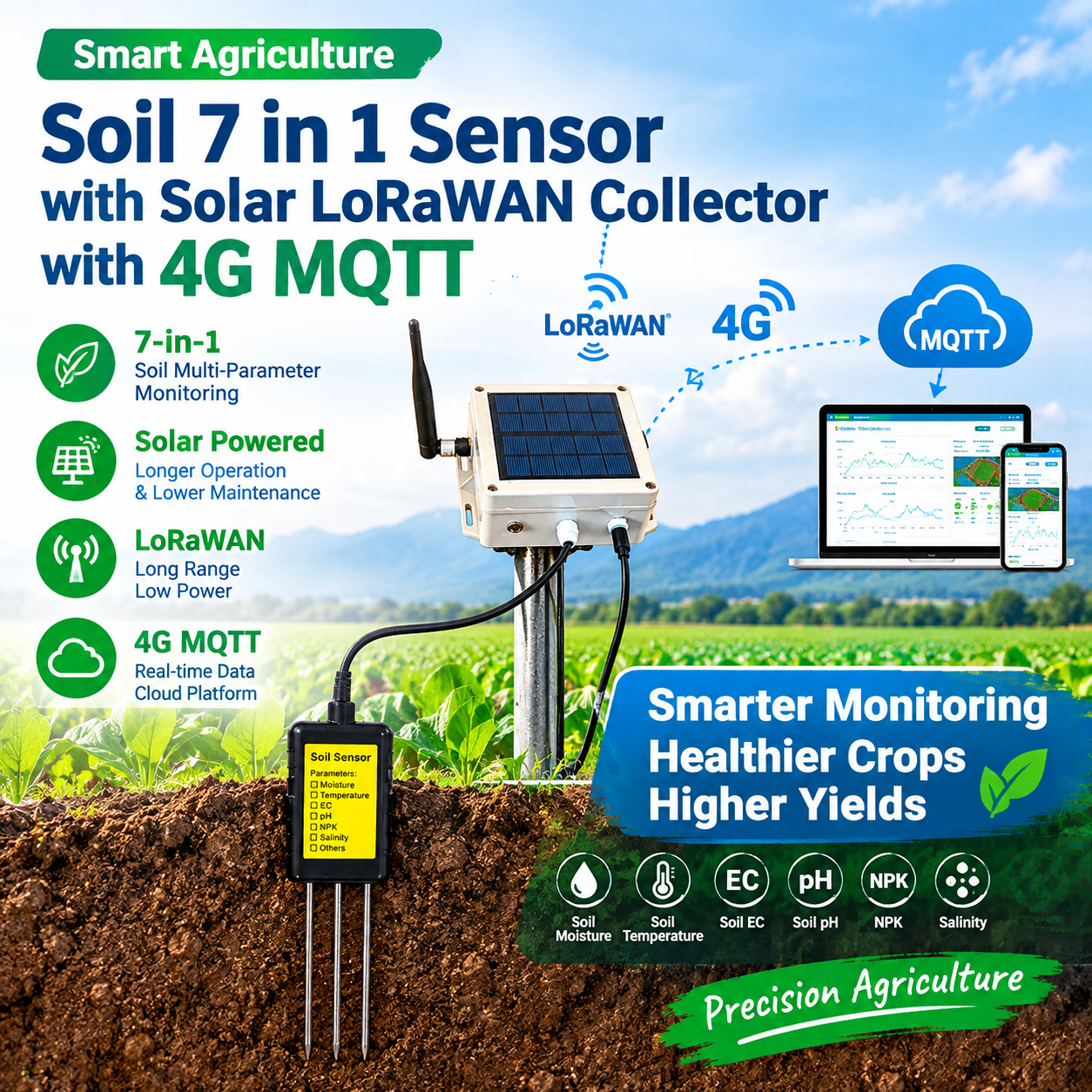
1. What Is a Solar LoRaWAN Soil 7-in-1 Monitoring System?
A solar LoRaWAN soil 7-in-1 monitoring system combines a multi-parameter soil sensor, a wireless data collector, and solar power to support remote agricultural monitoring. It helps agricultural technology providers, irrigation system integrators, and farm managers collect soil data without relying on conventional wired communication infrastructure at every monitoring point.
The system is particularly useful for precision agriculture projects that require continuous soil-condition monitoring across fields, orchards, greenhouses, and other agricultural areas.
By combining soil sensing, low-power wireless communication, and solar-powered operation, this solution can help project operators build a flexible IoT monitoring network and make better-informed irrigation and crop-management decisions.
The exact seven measurement parameters depend on the selected sensor configuration. Buyers should confirm the parameter list, measurement ranges, communication interfaces, and compatibility requirements before placing an order.
2. How Does a Solar-Powered LoRaWAN Soil Monitoring System Work?
A typical system follows a straightforward data-collection process:
- Soil data acquisition: The 7-in-1 soil sensor measures the selected soil parameters at the installation point.
- Data collection: A compatible collector receives and organizes readings from the connected sensor.
- Solar power supply: A solar power subsystem supplies energy to compatible equipment, subject to the system’s power design and environmental conditions.
- Wireless transmission: LoRaWAN communication transfers data to a compatible gateway or network infrastructure.
- Remote monitoring: Data can be forwarded to a server or agricultural platform for visualization, storage, analysis, and alerts when the complete system supports these functions.
This architecture helps reduce the need for long sensor cables and can simplify deployments in remote agricultural areas.
Important: LoRaWAN is a communication technology, not automatically a complete cloud service. Gateway availability, network-server configuration, data integration, and remote dashboards must be confirmed for each project.
compact weather and soil monitoring system with LoRa and MQTT
3. What Can a 7-in-1 Soil Sensor Monitor?
A multi-parameter soil sensor integrates several measurement functions into one device. Instead of installing separate instruments for every parameter, users can select an integrated sensor configuration that matches their agricultural monitoring objectives.
The following table provides a practical selection framework. It is not a confirmed specification list for the sensor shown in the video.
| Parameter category | Agricultural application |
|---|---|
| Soil moisture | Supports irrigation scheduling and water-management decisions |
| Soil temperature | Helps monitor root-zone thermal conditions |
| Soil electrical conductivity (EC) | Provides an indication of soil salinity and dissolved-ion conditions |
| Soil pH | Supports soil-acidity monitoring and soil-management planning |
| Additional soil parameters | Must be confirmed against the selected seven-parameter configuration |
Before purchasing, ask the supplier to confirm all seven parameters, their measurement ranges, accuracy, resolution, probe dimensions, installation requirements, and calibration recommendations.
For projects that require specific combinations of soil moisture, temperature, conductivity, pH, or other measurements, a configurable solution can help align the sensor with the actual application.
4. Why Choose Solar Power and LoRaWAN for Agricultural Monitoring?
4.1 Wireless Communication for Distributed Fields
Large agricultural sites may contain multiple monitoring points spread across substantial distances. A wireless network can reduce the amount of signal cabling required and make it easier to expand a monitoring deployment.
LoRaWAN is designed for low-power, long-range IoT communication. Actual coverage depends on terrain, buildings, vegetation, antenna placement, radio settings, interference, and local regulations.
For this reason, buyers should evaluate the proposed communication architecture under real installation conditions rather than relying on a theoretical maximum range.
4.2 Solar Power for Remote Locations
Some agricultural monitoring points have limited access to grid electricity. A properly designed solar-powered system can provide an alternative power source for remote deployments.
When evaluating a solar-powered collector, check:
- Solar panel output and mounting orientation.
- Battery capacity and battery chemistry.
- Daily energy consumption of the sensor and collector.
- Expected sunlight conditions and seasonal variation.
- Autonomy during cloudy or rainy periods.
- Enclosure protection and maintenance requirements.
Solar power does not automatically guarantee uninterrupted operation. The power system should be sized for the local climate and the complete equipment load.
4.3 Flexible IoT System Integration
Agricultural monitoring is most useful when collected data can be integrated into the operator’s existing workflow.
Depending on the selected hardware and software configuration, a monitoring project may include a LoRaWAN gateway, network server, application server, data logger, dashboard, or third-party farm-management platform.
Before ordering, confirm whether these components are included or need to be supplied separately.
5. Typical Applications of a Solar LoRaWAN Soil Sensor
Precision Agriculture
Soil monitoring data can help farm managers understand changing root-zone conditions and make more informed decisions about irrigation and field management.
mini weather station for smart agriculture and environmental monitoring
Smart Irrigation Systems
Soil moisture readings can serve as inputs for irrigation rules when integrated with a compatible controller. Actual automatic irrigation control requires additional control hardware, software, and validated operating logic.
Greenhouse and Horticulture Monitoring
Multi-parameter soil monitoring can support the management of growing media, root-zone conditions, and irrigation practices in greenhouses, nurseries, and horticultural production.
Orchards and Remote Farms
Solar-powered wireless monitoring can be useful where sensor locations are distributed across orchards or remote fields and conventional power or wired infrastructure is inconvenient.
Agricultural Research
Integrated soil sensing can support environmental data collection for crop trials, soil studies, and agricultural research. Researchers should verify sensor calibration and measurement uncertainty before using readings in formal studies.
6. Solar LoRaWAN Soil Sensor vs. Conventional Wired Monitoring
| Selection factor | Solar LoRaWAN system | Conventional wired system |
|---|---|---|
| Field cabling | Can reduce communication cabling | Usually requires signal cables |
| Power supply | Can use solar power if properly designed | Often uses a wired power source or local supply |
| Installation | Wireless deployment may simplify distributed sites | Cable routing may increase installation work |
| Expansion | Additional nodes may be possible within network capacity | Expansion may require additional wiring and controller capacity |
| Connectivity | Requires compatible LoRaWAN network infrastructure | Depends on the selected wired interface |
| Maintenance | Includes power-system and wireless-network checks | Includes cable, connector, and power-system checks |
| Best fit | Suitable for many remote or distributed monitoring projects | Suitable for sites with established wired infrastructure |
Neither approach is universally better. The right choice depends on installation cost, sensor count, transmission reliability, power availability, required response time, and the existing monitoring infrastructure.
7. How to Select the Right Soil 7-in-1 Monitoring Solution
Before requesting a quotation, prepare the following project information.
Step 1: Define the measurement requirements. List the seven required parameters and specify the measurement ranges, accuracy, and resolution needed for the application.
Step 2: Confirm installation conditions. Provide the soil type, installation depth, expected environmental conditions, and required probe dimensions.
Step 3: Evaluate the communication network. Confirm the LoRaWAN frequency plan, gateway compatibility, network-server requirements, and expected coverage.
Step 4: Size the solar power system. Request confirmation of power consumption, solar panel specifications, battery capacity, and expected autonomy.
Step 5: Check data integration. Determine whether the project needs local data logging, a cloud dashboard, third-party software integration, or alarm notifications.
Step 6: Confirm customization and support. Ask about available sensor configurations, communication options, calibration documentation, sample availability, and project-specific customization.
A complete specification review helps prevent common procurement problems, such as selecting an incompatible gateway, overlooking battery requirements, or purchasing a sensor that does not measure all the required parameters.
8. Frequently Asked Questions
Q1. What is a 7-in-1 soil sensor?
A 7-in-1 soil sensor combines seven measurement functions in one device. The exact parameters vary by model and configuration, so buyers should obtain the manufacturer’s confirmed parameter list.
Q2. Can a LoRaWAN soil sensor operate without a power cable?
It can operate without a conventional external power cable when the selected sensor and collector use a suitable local power source, such as a compatible battery or solar-powered system. The complete power design must be verified.
Q3. Does LoRaWAN require a gateway?
In a typical LoRaWAN deployment, end devices communicate with a LoRaWAN gateway, which forwards messages to the network server. The precise network architecture depends on the project.
Q4. Can soil data be viewed remotely?
Yes, remote viewing is possible when the monitoring system includes compatible gateways, network services, and a dashboard or application that makes the data accessible.
Q5. Can the system automatically control irrigation?
It can support automatic irrigation when integrated with compatible controllers, software, and validated control rules. A soil sensor alone does not guarantee automatic irrigation functionality.
Q6. What information should I provide to obtain a quotation?
Provide the required soil parameters, installation depth, number of monitoring points, communication requirements, power conditions, gateway and software preferences, target market, and expected order quantity.
9. Build Your Smart Agriculture Monitoring Project with Honde
A solar-powered LoRaWAN soil monitoring system can provide a practical foundation for remote agricultural data collection. By selecting the right soil parameters, wireless architecture, and power configuration, project developers can build a monitoring solution suited to their field conditions and data-management requirements.
Honde Technology Co., Ltd. provides environmental monitoring and IoT-related equipment for agricultural and other monitoring applications.
Contact our team to discuss your project requirements, confirm the seven soil measurement parameters, and evaluate a suitable sensor and wireless data-collection configuration.
- Company Name: Honde Technology Co., Ltd.
- Website: www.hondetechco.com
- Email: info@hondetech.com
Request a customized quotation for your solar LoRaWAN soil monitoring project.
integrated weather station for smart agriculture and IoT monitoring
Post time: Oct-19-2026