

As water utilities and industrial treatment facilities move toward continuous digital monitoring, turbidity measurement is becoming an increasingly important part of modern water-quality management.
Instead of relying only on periodic manual sampling, operators are increasingly looking for online turbidity sensors that can measure continuously, transmit data remotely and generate alarms when water conditions change.
This trend is particularly relevant to drinking-water treatment, wastewater treatment, river monitoring, aquaculture and industrial process-water applications.
The European Union’s Drinking Water Directive includes turbidity at the water supply plant as an operational monitoring parameter for controlling the effectiveness of filtration. For water supplies producing more than 10,000 m³ per day, the directive specifies continuous monitoring.
In the United States, EPA guidance also recognizes turbidity monitoring as an important part of filtration performance monitoring, with continuous monitoring used in relevant drinking-water treatment systems.
Practical Requirements for Water-Treatment Operators
That is where a stainless steel online turbidity sensor combined with IoT communication and cloud software can become part of a complete water-monitoring solution.
Why Online Turbidity Monitoring Is Becoming More Important
Turbidity is not simply a visual indicator of whether water looks clear.
Changes in turbidity can provide useful information about suspended particles, sediment loading, filtration performance and changes in water-treatment processes.
The U.S. EPA’s technical guidance notes that turbidity data can support assessment and optimization of drinking-water treatment processes, while continuous instruments can provide more frequent information than periodic grab sampling.
Traditional Workflow:
Modern IoT-Enabled Workflow:
This difference becomes especially important when water quality changes rapidly or when monitoring points are distributed across a large site.
Where Is the Demand Coming From?
The strongest application scenarios are concentrated around water treatment and environmental monitoring.
| Application | Typical Monitoring Requirement | Recommended System |
|---|---|---|
| Drinking Water Treatment | Raw water and filtration monitoring | Online turbidity |
| Wastewater Treatment | Treatment-process and discharge monitoring | RS485 / 4–20mA |
| Industrial Wastewater | Process and final-effluent monitoring | Online + alarm |
| River Monitoring | Long-term environmental observation | LoRaWAN / 4G |
| Aquaculture | Water clarity and suspended particles | Direct immersion |
| Water Reuse | Treatment-process verification | Online monitoring |
| Remote Stations | Distributed water-quality monitoring | Wireless IoT |
For larger water supplies in the EU, the regulatory framework specifically connects turbidity monitoring with filtration effectiveness.
This makes turbidity monitoring particularly relevant for water utilities, engineering companies, treatment-system integrators and industrial facilities looking to modernize their monitoring infrastructure.
Stainless Steel Turbidity Sensor Designed for Online Water Monitoring
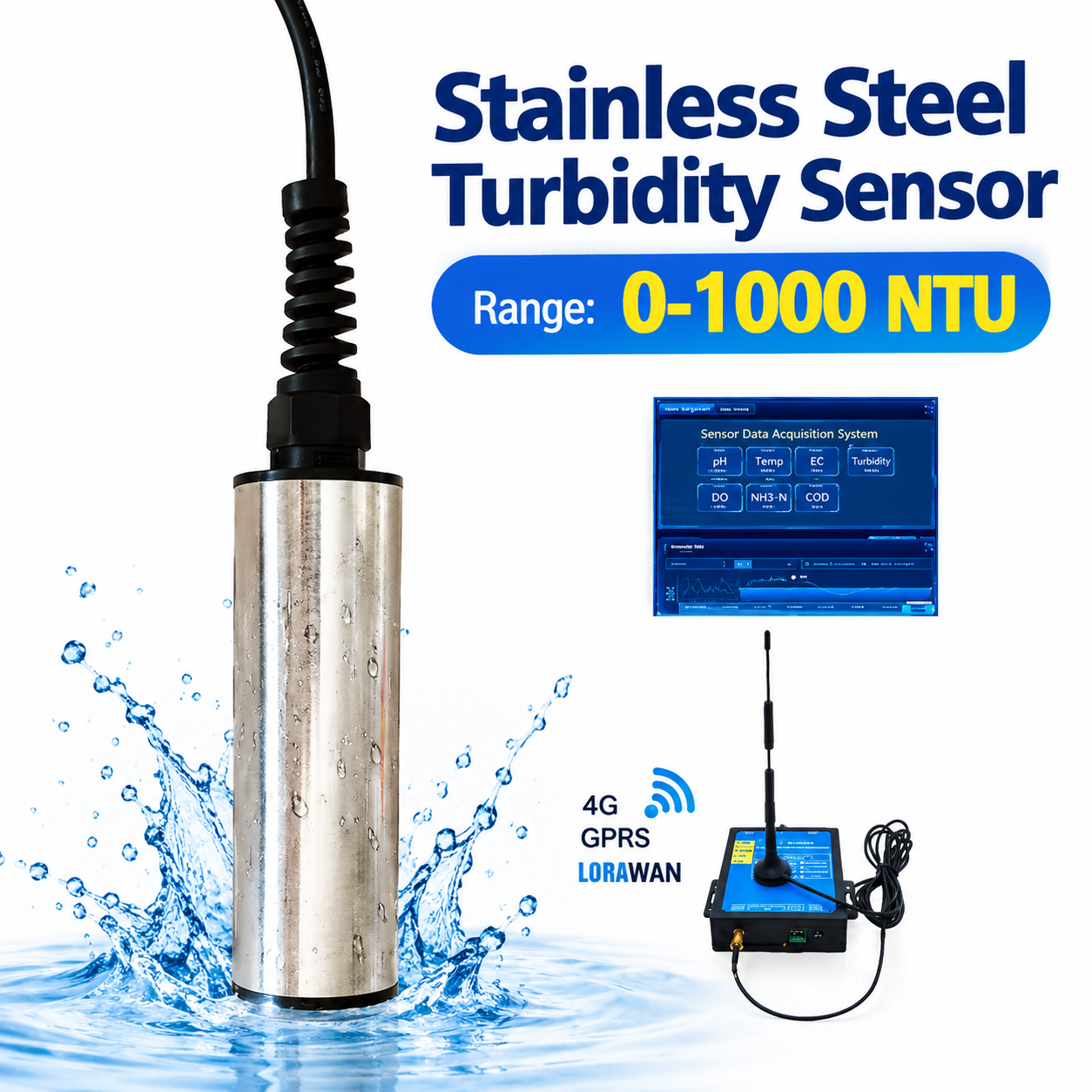
Honde Technology’s stainless steel turbidity sensor is designed for direct water-quality measurement in applications such as wastewater treatment, river monitoring and aquaculture.
The sensor uses an optical scattered-light measurement principle and is available with a 0–1000 NTU measurement range.
Supported Signal Outputs
RS485 / 4–20mA / 0–5V / 0–10V
Wireless Communication Options
GPRS / 4G / Wi-Fi / LoRa / LoRaWAN
This allows the same sensor platform to be integrated into different water-monitoring architectures.
Key Product Data
| Parameter | Specification |
|---|---|
| Product | Stainless Steel Turbidity Sensor |
| Measurement Range | 0–1000 NTU |
| Measurement Principle | Optical Scattered Light |
| Output Options | RS485 / 4–20mA / 0–5V / 0–10V |
| Wireless Options | GPRS / 4G / Wi-Fi / LoRa / LoRaWAN |
| Installation | Direct Immersion |
| Typical Applications | Wastewater / River / Aquaculture / Water Treatment |
| Data Protocol | MQTT / JSON supported with suitable wireless module |
Important: Exact output, communication and system configurations can be selected according to the customer’s project requirements.
From a Sensor to a Complete IoT Water Monitoring System
A major requirement in current water-monitoring projects is not simply purchasing a probe.
Customers often need a complete data chain:
The Honde solution can be configured around three levels.
1. Handmeter and Data Logger for Field Measurement
For installation, commissioning and maintenance teams, a Handmeter + Data Logger with Screen can provide convenient local measurement and data recording.
Technicians can use the equipment to:
- Check water quality directly in the field
- Record turbidity measurements
- Compare readings at different monitoring points
- Support equipment maintenance
- Verify operating conditions
This makes the solution suitable for both fixed online monitoring and field inspection.
2. Wireless Communication for Remote Monitoring
For remote monitoring points, wired communication is not always practical.
The system can be configured with GPRS / 4G / Wi-Fi / LoRa / LoRaWAN and support MQTT / JSON data transmission.
This creates a flexible architecture for remote river stations, wastewater discharge points, aquaculture ponds and distributed industrial monitoring systems.
Typical Remote Deployment Architecture
This allows operators to monitor multiple locations without visiting every site manually.
3. Cloud Software and Alarm Relay for Real-Time Management
The final layer is the cloud platform. Instead of simply receiving a numerical value from a sensor, operators can view:
The system can also use an alarm relay to trigger an external device when a user-defined threshold is exceeded.
Automated Response Example
This creates a closed monitoring loop rather than leaving the sensor data unused.
Application Case: Drinking Water Treatment
Consider a surface-water treatment facility supplying a regional community. After heavy rainfall, runoff can introduce additional suspended particles into the raw-water source.
Simplified Treatment Process Flow:
At different stages, turbidity measurements can help operators understand how the treatment process is performing.
The EU Drinking Water Directive specifically identifies turbidity at the water supply plant as an operational parameter for controlling the effectiveness of physical removal by filtration. The United States also has established turbidity monitoring requirements and guidance for filtered public water systems.
| Stage | Function |
|---|---|
| Raw Water | Detect incoming turbidity changes |
| Treatment | Observe process response |
| Filtration | Monitor filtration performance |
| Final Water | Check treated-water condition |
| Cloud Platform | Store and display data |
| Alarm System | Notify operators of abnormal changes |
The result is a continuous stream of operational information instead of isolated sampling records.
Application Case: Industrial Wastewater Treatment
Industrial wastewater presents another important application.
A manufacturing facility may have several treatment stages before discharge:
A turbidity sensor can be installed at selected process points. For example:
- Inlet Monitoring: Helps identify sudden changes in incoming wastewater.
- Treatment Monitoring: Helps operators observe changes during the treatment process.
- Final Discharge Monitoring: Provides an additional online indicator of treated-water conditions.
The monitoring data can then be transmitted through RS485 and a suitable wireless communication module to a cloud platform.
This architecture is particularly useful for facilities that need to manage multiple treatment points or reduce the frequency of manual site inspections.
Application Case: Remote River Water Monitoring
River monitoring creates a different challenge. A monitoring station may be located far from a treatment plant, office or electrical infrastructure.
Practical Deployment Setup
Several monitoring stations can be distributed along a river:
If turbidity suddenly changes at one monitoring point, the cloud platform can record the event and alert the responsible operator.
This approach is particularly suitable for:
- Environmental monitoring
- River-water observation
- Watershed management
- Industrial discharge supervision
- Long-term water-quality research
Why Stainless Steel Matters in Water Monitoring
In practical projects, sensor material and installation conditions are important considerations.
A stainless steel sensor housing provides a robust physical format for direct water-contact applications and is suitable for installations where the probe needs to remain positioned in water for ongoing measurements.
Combined with multiple signal-output options, the sensor can be adapted to different monitoring systems.
High-Intent Keywords for Global Buyers
For international B2B searches, the commercial opportunity is not limited to the generic term “turbidity sensor.” More specific search terms connect the product directly with customer applications.
Core Keywords
| Keyword Category | High-Intent Keywords |
|---|---|
| Product | water turbidity sensor |
| Product | online turbidity sensor |
| Product | stainless steel turbidity sensor |
| Measurement | 0–1000 NTU turbidity sensor |
| Output | RS485 turbidity sensor |
| Output | 4–20mA turbidity sensor |
| IoT | IoT turbidity sensor |
| Wireless | LoRaWAN turbidity sensor |
| Wireless | 4G turbidity sensor |
| Wastewater | wastewater turbidity sensor |
| Treatment | water treatment turbidity sensor |
| Environmental | river water turbidity sensor |
| Aquaculture | aquaculture turbidity sensor |
| System | online water quality monitoring system |
| Remote | remote water quality monitoring |
These keywords can be used across product pages, technical articles, Google search campaigns, Alibaba listings and distributor materials.
The Business Value: From Measuring Turbidity to Managing Water Quality
The real value of an online turbidity sensor is not the measurement alone.
It is the ability to connect:
For customers, this means one sensor can become part of a larger water-management system.
For system integrators, the same platform can also be expanded into multi-parameter monitoring by adding other water-quality sensors such as:
This provides a path from a single-parameter monitoring project to a complete water-quality monitoring network.
A Practical Solution for the Next Generation of Water Monitoring
Water monitoring is moving toward systems that are more continuous, connected and accessible.
Regulatory frameworks in the EU and United States already demonstrate the importance of turbidity monitoring in relevant drinking-water treatment processes.
At the same time, industrial facilities, environmental monitoring projects and aquaculture operations increasingly need data that can be accessed remotely.
A stainless steel 0–1000 NTU turbidity sensor + RS485/4–20mA + GPRS/4G/Wi-Fi/LoRa/LoRaWAN + MQTT/JSON + cloud software + alarm relay provides a practical foundation for these applications.
The objective is simple:
For water-treatment companies, engineering contractors, system integrators and industrial users looking for an online turbidity monitoring solution, the sensor can be configured according to the required output, communication method and application environment.
Product & Solution Inquiry
Stainless Steel Turbidity Sensor
Applications: Wastewater Treatment | Water Treatment | River Monitoring | Aquaculture | Industrial Water Monitoring
For OEM, system integration and project-based water monitoring requirements, contact Honde Technology for sensor configuration and monitoring-system solutions.
Post time: Sep-30-2026