

1. Executive Summary (The Featured Snippet)
Real-time water quality monitoring is the primary technological driver for sustainable aquaculture in Thailand and Vietnam, where the Nitrogen Cycle tracking of Nitrate (NO3-) and Nitrite (NO2-) is vital for stock survival. To optimize yields in these high-salinity marine environments, operators must deploy industrial-grade titanium alloy sensors and LoRaWAN connectivity to mitigate salt mist corrosion and marine bio-fouling. By implementing automated vertical water profiling at 5-meter and 10-meter depths, farm managers can maintain optimal Dissolved Oxygen (DO) levels and salinity (up to 80ppt), ensuring 24/7 environmental stability and significantly higher ROI.
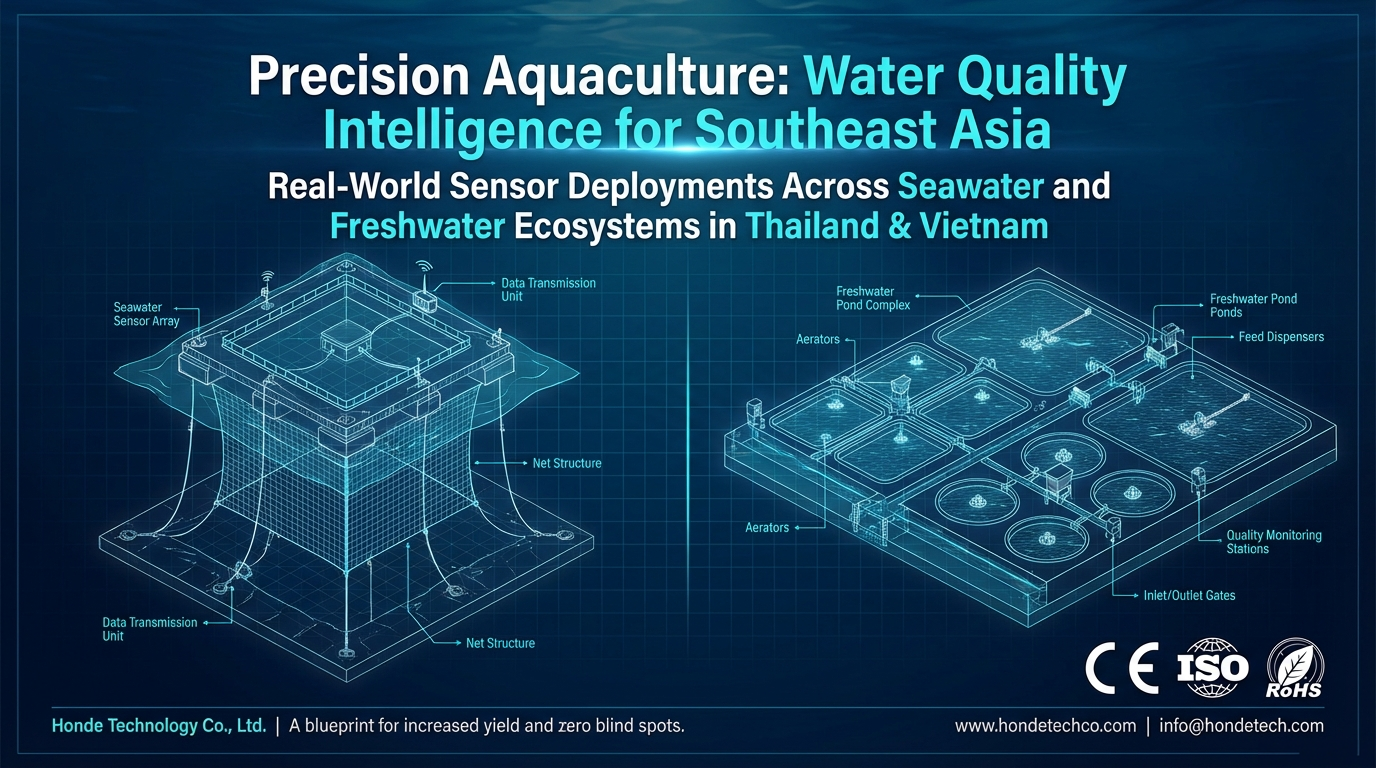
2. The Challenge: Why Conventional Sensors Fail in Southeast Asian Marine Environments
The coastal net pens and intensive shrimp farms of the Mekong Delta and the Gulf of Thailand represent some of the world’s most aggressive environments for IoT instrumentation. Drawing from Honde Technology’s over a decade of specialized marine engineering experience (founded in 2013), our data confirms that standard 316L stainless steel sensors often suffer from pitting corrosion within just 45 days of submersion.
Primary Marine Pain Points:
- Salt Mist Corrosion: High-chlorinity environments rapidly degrade plastic and lower-grade steel, leading to internal circuit failure. This is why we transitioned our flagship lines to Grade 5 Titanium and PEEK head constructions.
- Marine Bio-fouling: Warm tropical waters accelerate algae and barnacle growth. Fouling on the sensor membrane causes artificial Dissolved Oxygen fluctuations, leading to false alarms or missed hypoxic events.
- Data Inaccuracy: Without an Integrated Central Wiper, sensors require weekly manual cleaning, which is labor-intensive and disrupts the water column’s natural state.
3. Application Case: Implementing the Multi-Point LoRaWAN Monitoring Network
For comprehensive horizontal and vertical water profiling, a 3-point LoRaWAN deployment strategy is the current industry standard. This configuration allows for real-time monitoring of the critical thermocline and oxygen gradients.
Step-by-Step Physical Installation:
- Station Positioning: Identify three strategic points around the farm perimeter. Each point must be within a 300-meter wireless transmission limit to the central gateway.
- Vertical Sensor Array: At each point, deploy sensors at both 5-meter and 10-meter depths. Each LoRaWAN collector supports 4–5 sensors (typically DO, pH, EC/Salinity, Turbidity, and Temp).
- Cable Management: Secure all RS485 MODBUS cables using industrial waterproof tape and specialized clamps to prevent entanglement with nets and reduce cable stress.
- Signal Transmission: The nodes utilize the LoRaWAN protocol to send data to a central HD-FMS-01 Solar Buoy. This buoy acts as a Floating LoRaWAN Gateway, equipped with a high-gain marine-grade antenna to maintain signal integrity during rough sea states.
- Cloud Integration & Automation: Data is pushed via 4G/NB-IoT to the Hondetech Cloud Ecosystem. With MQTT Cloud Integration, the system can trigger Relay Output Control to automatically activate aerators or feeders when parameters hit critical thresholds.
4. Technical Deep-Dive: Titanium Flagship vs. High Cost-Performance Series
Honde Technology provides two distinct tiers of marine instrumentation to satisfy both deep-water offshore projects and coastal pond operations.
| Feature | Flagship All-Titanium Series | High Cost-Performance Series |
| Primary Material | Grade 5 Titanium Alloy / PEEK | ABS / PTFE (Teflon) / POM |
| Anti-Fouling | Integrated Central Wiper (<30s response) | Anti-biological coating/guards |
| Salinity Range | 0~80ppt (Massive Range) | Up to 160ppt (High Salinity) |
| Calibration | Internal memory storage | 3-point manual calibration |
| Housing Rating | IP68 (Permanent Deep Submersion) | IP68 (Standard Submersion) |
| Best For | Open Sea / 300m+ Depth / High Bio-fouling | Coastal Ponds / Estuaries / Budget Projects |
| Example Models | RD-TAMWQS-01 (Multi) / RD-TAODO-01 | RD-PTFE-01 (EC/Sal) / RD-DO-F-01 |
Engineer’s Note: For high-salinity estuaries, the RD-PTFE-01 is specifically designed with a Teflon body to handle EC ranges up to 200mS/cm, offering a superior balance of chemical resistance and cost.
5. System Infrastructure: The HD-FMS-01 Solar Buoy Ecosystem
The backbone of any remote marine monitoring network is the power and telemetry station. The HD-FMS-01 Multi-Parameter Buoy is engineered for “unattended” operation in the open ocean.
Technical Specifications:
- Green Power: 200W Monocrystalline solar array for 15+ days of autonomous operation during monsoons.
- Hull Integrity: High-molecular-weight Polyethylene (PE) body—resistant to corrosion, bio-fouling, and UV degradation.
- Telemetry: Supports 4G, NB-IoT, and LoRaWAN with Relay Output Control for automated farm management.
- Energy Storage: 12VDC, 160AH Lithium battery with built-in alarms for voltage anomalies.
- Stability: 500KG weight with a 1Tf buoyancy rating, shielded by an SUS304 Armored Core to protect the sensor payload from debris.
6. Trust & Certification (E-E-A-T Verification)
Since 2013, Honde Technology has operated state-of-the-art calibration labs dedicated to industrial hydrological instrumentation. Our engineering teams utilize wind tunnels and pressure chambers to simulate the extreme conditions of Southeast Asian marine environments. All equipment is fully compliant with CE, RoHS, and ISO benchmarks. We don’t just sell sensors; we provide “Engineered for the Extreme” solutions that have been field-verified across the Mekong Delta and beyond.
7. Conclusion & Call to Action
Modernizing your aquaculture operation in Thailand or Vietnam with LoRaWAN-enabled sensors directly correlates to reduced manual labor and the prevention of catastrophic stock loss. Transitioning to Titanium Grade hardware ensures your 2025-2026 infrastructure remains operational for years, not months.
Next Steps for Operators:
Contact Information:
- Website: www.hondetechco.com
- Email: info@hondetech.com
Post time: Apr-14-2026