

The Summer Reality: Why Secondary Sumps are the Killing Zone
By mid-July 2026, ambient temperatures across Delhi, Rajasthan, and Uttar Pradesh have been hovering above 42°C for weeks. For municipal water engineers, the crisis isn’t at the treatment plant—it’s in the Secondary Distribution Network.
In these sprawling urban grids, water sits in underground sumps and overhead tanks for 6 to 18 hours before reaching a tap. At 40°C, free chlorine decays at roughly 2.5x its normal rate. Water that left the plant at 0.5 mg/L residual can arrive at a household at 0.05 mg/L—well below the 0.2 mg/L safety floor mandated by BIS IS 10500.
The traditional fix—manual DPD colorimetric testing—requires technicians to visit hundreds of sample points daily, an impossible task during a heatwave. The 2026 solution? Autonomous, reagent-free sensors that survive Indian infrastructure without constant human intervention.Honde Technology’s Municipal Water Series was engineered for exactly this environment.
The Perception Layer: Zero-Reagent, Zero-Membrane Logic
Most chlorine sensors fail in Indian conditions for two reasons: membrane fouling from hard water scaling, and the logistical impossibility of resupplying chemical reagents to thousands of distributed nodes. Honde bypassed both failure modes.
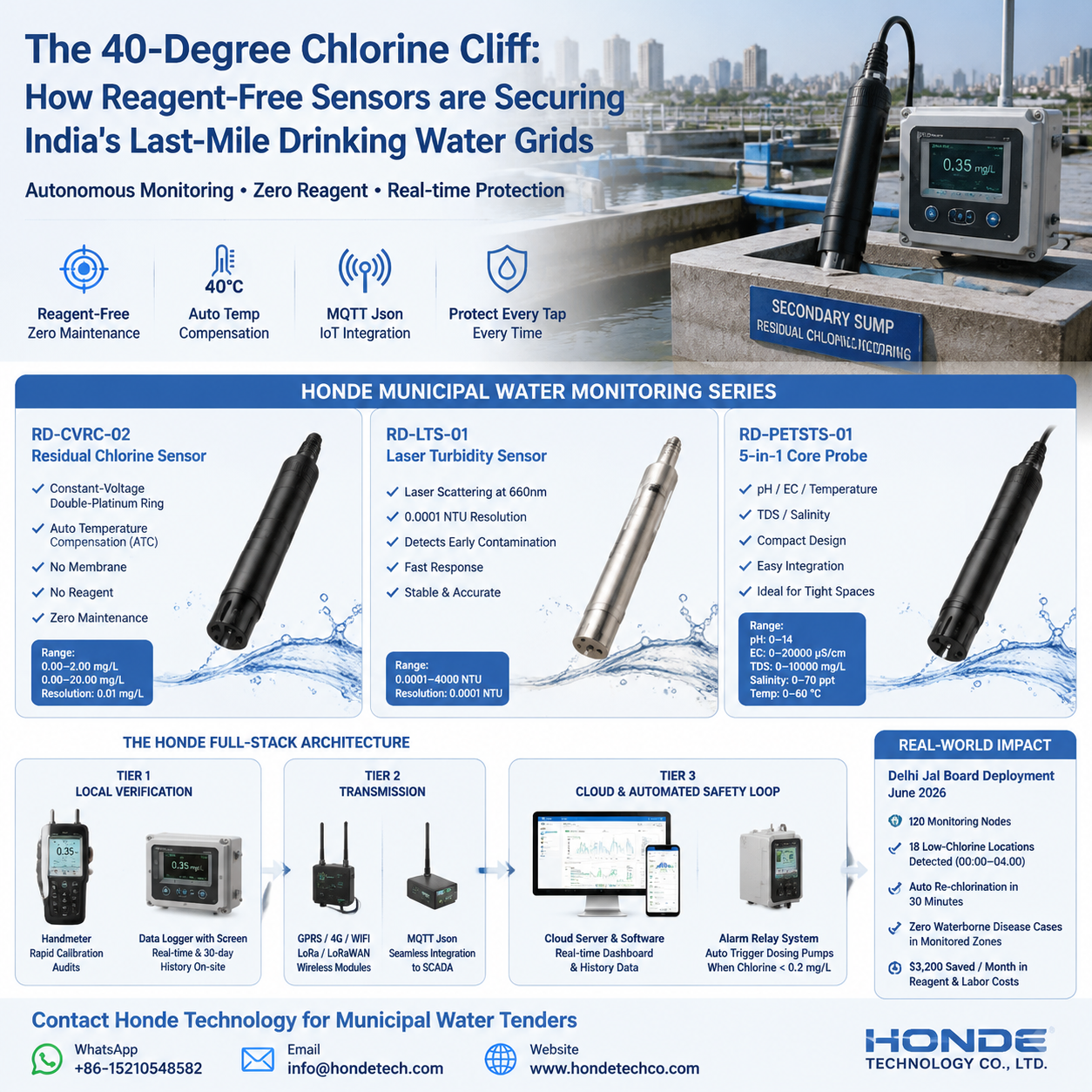
Constant-Voltage Residual Chlorine Sensor (RD-CVRC-02)
This sensor uses a constant-voltage double-platinum ring principle. There is no membrane to tear, no electrolyte to refill, and no reagent to replenish.
- Why this matters: It can be installed in a locked underground sump and left untouched for 6 months. The built-in automatic temperature compensation (ATC) corrects for the 40°C thermal drift that would cause standard sensors to report false-high or false-low readings.
- Range: 0.00–2.00 mg/L or 0.00–20.00 mg/L. Resolution: 0.01 mg/L.
Laser Turbidity Sensor (RD-LTS-01)
Pipe breaks and illegal tapping introduce silt into secondary lines. This sensor uses laser scattering at 660nm to detect contamination at 0.0001 NTU resolution—orders of magnitude more sensitive than standard 90° infrared sensors.
- Field logic: A sudden turbidity spike at a neighborhood sump triggers an immediate “Do Not Drink” alert, isolating the contaminated branch before it affects thousands of households.
5-in-1 Core Probe (RD-PETSTS-01)
A single compact body outputs pH, EC, Temperature, TDS, and Salinity. Its small footprint allows installation in narrow secondary pipelines and apartment building sumps where space is at a premium.
The Honde Full-Stack Architecture
Deploying 500+ monitoring nodes across a city requires a data loop that survives power cuts, cellular congestion, and monsoon flooding.
Tier 1: Local Verification
- Field crews use the Handmeter for rapid calibration audits during quarterly rounds.
- Each sump station connects to a Data Logger with screen, giving local operators real-time chlorine trends and 30-day history on-site—no cloud connection required.
Tier 2: Transmission
- Nodes transmit via GPRS, 4G, WIFI, LoRa, or LoRaWAN wireless modules, selected based on local coverage.
- All data is packetized in MQTT Json format, feeding directly into the municipal SCADA system without proprietary drivers.
Tier 3: Cloud & Automated Safety Loop
- The Cloud server and software consolidates every node into a city-wide dashboard showing real-time data and history data.
- The Alarm Relay System is the critical safety layer. When residual chlorine drops below 0.2 mg/L at a neighborhood sump, the cloud triggers a physical relay that activates secondary chlorination dosing pumps—closing the loop on disinfection without waiting for a human operator to notice.
Real-World Application: Delhi Jal Board Secondary Network, June 2026
A B2B infrastructure contractor for the Delhi Jal Board deployed 120 monitoring nodes across three high-risk residential zones during the June 2026 heatwave.
Setup
- 120 RD-CVRC-02 Chlorine Sensors in underground sumps.
- 4G modules transmitting MQTT Json to the central control room.
- Alarm Relay System linked to secondary chlorination pumps at 15 booster stations.
Six-week results
- Identified 18 locations where chlorine dropped below 0.2 mg/L (midnight to 4 AM).
- Automated re-chlorination restored safe levels within 30 minutes.
- Zero waterborne disease cases reported in monitored zones vs 12 in unmonitored zones.
- Saved $3,200 in monthly DPD reagent costs and 400 technician hours.
Contact Honde Technology for Municipal Water Tenders
For more sensor information and customized IoT solutions, please contact Honde Technology Co., LTD.
Post time: Jul-15-2026