

When the Network Fails, the River Doesn’t Wait
A flood-warning system can be highly connected—and still fail at the moment it matters most.
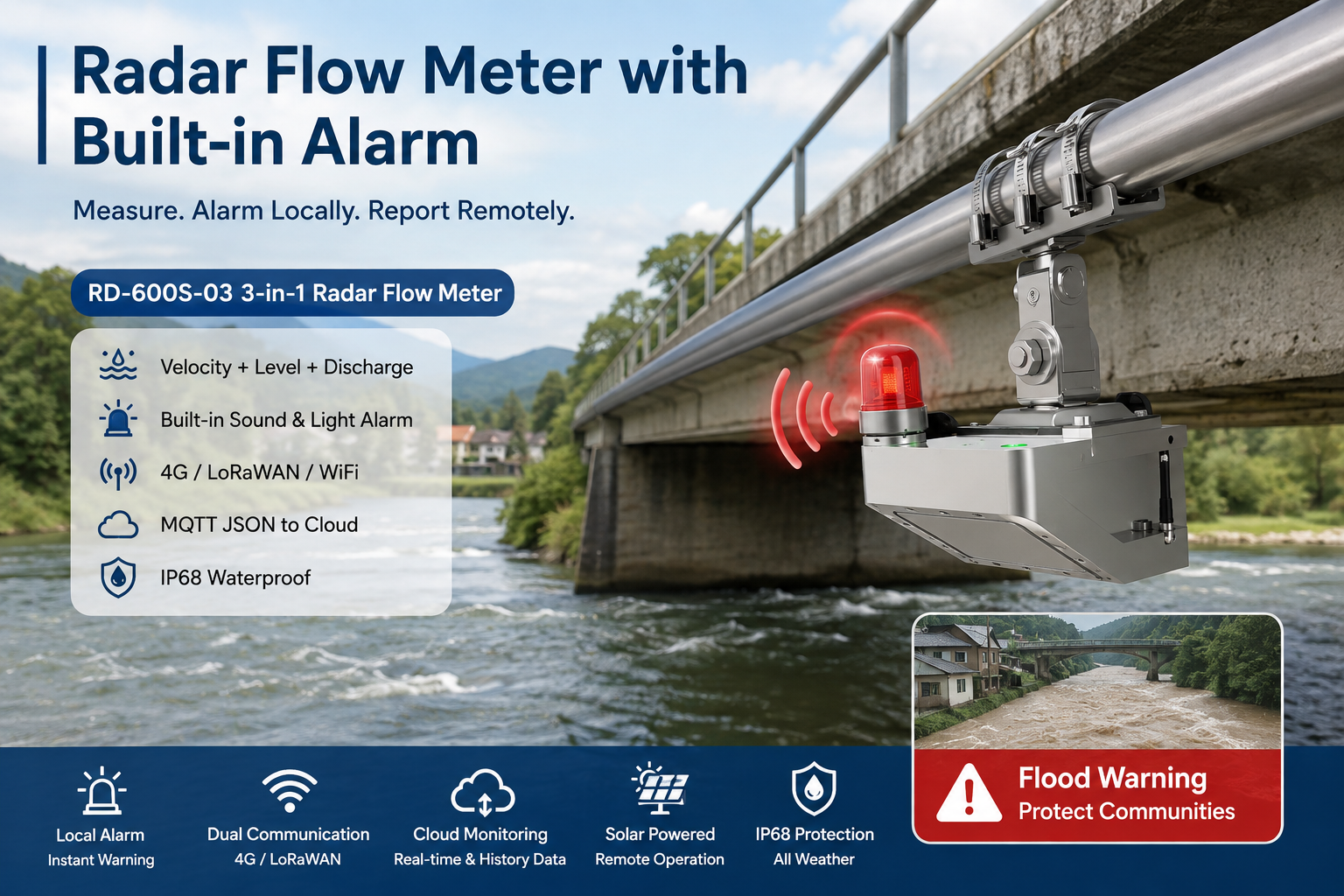
The traditional architecture is straightforward: a river sensor measures rising water levels or flow velocity, transmits the data through a cellular or wireless network, sends it to a cloud platform, and waits for the platform to trigger an alarm.
But every additional communication link introduces another potential point of failure.
- A cellular outage.
- A failed gateway.
- A damaged power supply.
- A dead SIM card.
- A server communication delay.
For mountain rivers and flash-flood-prone catchments, where water levels can change dramatically within minutes, that delay can be critical.
This is why a new generation of radar flow meters with autonomous local alarm capability is attracting increasing attention for flood monitoring, river management, irrigation channels, and remote hydrological stations.
Honde Technology’s RD-600S-03 3-in-1 Radar Flow Meter is designed around a different principle:
The cloud should improve the warning system—not be the only thing that makes the warning work.
The RD-600S-03 combines water velocity measurement, water-level measurement, discharge calculation, local threshold logic, and sound-and-light alarm output in one monitoring solution.
When a configured danger threshold is exceeded, the local alarm can be activated directly through the sensor’s relay logic—without waiting for a cloud command.
Why Local Alarm Matters for Flash-Flood Monitoring
The biggest difference is architectural.
Traditional Cloud-Dependent Warning
If communications fail, the warning may be delayed or interrupted.
Dual-Path Warning Architecture
↘ 4G / LoRaWAN → Cloud Platform → Remote Alarm
The local warning path continues operating independently, while the wireless/cloud path provides centralized monitoring, historical data, remote management, and escalation.
The Key Engineering Advantage
| Function | Conventional Remote Alarm | RD-600S-03 Dual-Path Architecture |
|---|---|---|
| Water-level measurement | ✓ | ✓ |
| Velocity measurement | ✓ | ✓ |
| Discharge monitoring | ✓ | ✓ |
| Local threshold logic | Limited / Optional | Built in |
| Local sound alarm | Optional | Supported |
| Local light alarm | Optional | Supported |
| Cloud monitoring | ✓ | ✓ |
| 4G / GPRS | ✓ | ✓ |
| LoRa / LoRaWAN | ✓ | ✓ |
| Local data logging | Optional | Available |
| Operation during network outage | Limited | Local alarm remains available |
The result is a simple but important shift: measure locally, alarm locally, report remotely.
RD-600S-03: 3-in-1 Radar Flow Monitoring + Local Alarm
The RD-600S-03 is designed for non-contact monitoring applications where submerged sensors can be difficult to maintain or vulnerable to debris, sediment, corrosion, or high-flow conditions.
The radar system can be installed above an open channel, river, bridge, or other monitoring point.
Core Specifications
| Parameter | RD-600S-03 |
|---|---|
| Measurement | Velocity + Water Level + Discharge |
| Measurement Principle | Planar Microstrip Array Antenna |
| Radar Technology | CW + PCR |
| Velocity Range | 0.03–20 m/s |
| Velocity Accuracy | ±0.01 m/s / ±1% FS |
| Level Range | Up to 7 m |
| Communication | RS485 Modbus-RTU |
| Wireless Options | GPRS / 4G / WiFi / LoRa / LoRaWAN |
| Alarm | Sound-and-light alarm / Relay output |
| Housing | Stainless Steel, Weatherproof |
| Typical Applications | Rivers, Flood Monitoring, Open Channels, Irrigation, Hydrology |
Three Measurements. One Monitoring Point.
Detect rising water and configurable flood stages.
Monitor rapid changes in river dynamics.
Convert field measurements into practical flow information for hydrological management.
This makes the RD-600S-03 more than a conventional water-level sensor.
It becomes a complete radar-based river monitoring node.
What Happens When the Network Goes Offline?
This is where the local alarm architecture becomes particularly valuable.
Imagine a remote mountain monitoring station during a severe storm. Rainfall increases rapidly. The river rises. The water level reaches the configured warning threshold.
At that moment, the RD-600S-03 does not need to wait for:
- a cellular connection;
- a LoRaWAN gateway;
- a cloud server;
- a remote operator;
- or a command from a central control room.
The sensor’s local threshold logic can activate the sound-and-light alarm through its relay output.
At the same time, when communications are available, measurement data can continue to flow toward the cloud platform.
Dual-Path Alarm Logic
                 RIVER
                   │
                   ▼
          ┌─────────────────┐
          │   RD-600S-03    │
          │ Radar Flow Meter│
          └────────┬────────┘
                   │
          ┌────────┴─────────┐
          ▼                  ▼
   LOCAL ALARM PATH      DATA PATH
          │                  │
          ▼                  ▼
  Sound + Light       4G / LoRaWAN
          │                  │
          ▼                  ▼
 Local Warning        Cloud Platform
                             │
                    ┌────────┴────────┐
                    ▼                 ▼
             Remote Alarm       Data & History
Local alarm protects the immediate site. Cloud monitoring connects the wider network.
From Sensor to Flood-Warning Platform
For larger monitoring networks, the RD-600S-03 can be integrated into a multi-layer IoT architecture.
1 Tier 1 — Autonomous Local Warning
The sensor continuously measures:
- water level;
- flow velocity;
- calculated discharge.
Site-specific thresholds can be configured according to the monitoring requirements.
When a threshold is reached, the local sound-and-light alarm can be triggered through the relay output. This layer does not depend on cloud processing.
2 Tier 2 — Wireless Transmission
Depending on the site conditions, different communication options can be selected:
GPRS / 4G / WiFi / LoRa / LoRaWAN
Remote stations can transmit measurement data to gateways or cloud platforms, while RS485 Modbus-RTU provides integration with local data loggers and control equipment.
For IoT applications, the system can support MQTT JSON data transmission, making integration with cloud monitoring platforms more flexible.
3 Tier 3 — Cloud Monitoring & Remote Escalation
The cloud platform can consolidate data from multiple monitoring points. Operators can view:
- Real-time water level
- Flow velocity
- Discharge
- Alarm status
- Historical trends
- Communication status
- Event records
The cloud layer then provides centralized monitoring and remote alarm escalation.
The Architecture in One Sentence
The sensor handles the immediate warning; the cloud handles the network-wide intelligence.
Local Alarm vs Cloud Alarm: Why Use Both?
A modern flood-warning network does not have to choose between local and cloud alarms. The strongest architecture uses both.
| Scenario | Cloud Alarm | Local Alarm |
|---|---|---|
| Normal operation | ✓ | ✓ |
| Network available | ✓ | ✓ |
| Network outage | ✕ / Delayed | ✓ |
| Cloud server unavailable | ✕ | ✓ |
| Local staff near river | Limited | ✓ Immediate |
| Central control room | ✓ | — |
| Historical data analysis | ✓ | — |
| Remote multi-site management | ✓ | — |
Recommended Architecture
Local alarm = first line of defense
Cloud alarm = centralized coordination
This redundancy is particularly valuable in mountain rivers, remote valleys, urban drainage channels, irrigation infrastructure, and other locations where communication reliability cannot be guaranteed.
Field Deployment Concept
A typical monitoring station can combine the RD-600S-03 with local display, wireless communication, solar power, and cloud software.
| Component | Function |
|---|---|
| RD-600S-03 | Measures velocity, level and discharge |
| Sound & Light Alarm | Provides immediate local warning |
| Data Logger with Screen | Displays real-time measurements and alarm status |
| Handmeter | Supports field verification and maintenance |
| 4G / LoRaWAN Module | Sends data to remote platform |
| Solar + Battery System | Supports remote operation |
| Cloud Server & Software | Real-time and historical monitoring |
| Alarm Relay System | Supports escalation and control logic |
This configuration transforms a single radar sensor into a complete flood-monitoring station.
A More Resilient Flood-Warning Model
The value of this architecture becomes clearer when looking at the warning chain.
Conventional Architecture
100% dependence on communication
Sensor
  │
  ▼
Network
  │
  ▼
Cloud
  │
  ▼
Alarm
A network failure can interrupt the complete chain.
Dual-Path Architecture
                  ┌──→ Local Siren / Strobe
                  │
River → Sensor ───┤
                  │
                  └──→ Network → Cloud → Remote Alarm
Even when the communication path is interrupted, the local warning path remains independent.
That is the core product value.
From Flood Detection to Early Warning
For flood-monitoring projects, buyers are increasingly looking beyond a single sensor specification. They need a system that can answer five questions:
| Question | RD-600S-03 Solution |
|---|---|
| What is happening? | Water level + velocity + discharge |
| How fast is it changing? | Continuous radar monitoring |
| Who needs to know locally? | Sound-and-light alarm |
| How does the control center receive data? | 4G / LoRaWAN / WiFi / LoRa |
| What happens when communications fail? | Local threshold alarm continues independently |
This is why the product should be positioned not simply as a radar flow meter, but as a:
Radar-Based Flood Monitoring & Local Early Warning System
That positioning significantly expands the potential application value.
High-Value Application Scenarios
1. Mountain River Flood Warning
Rapidly changing water levels require immediate local warning.
2. Remote Valley Monitoring
LoRaWAN communication can connect remote stations to centralized monitoring platforms.
3. Bridge-Based Hydrological Monitoring
Non-contact radar installation reduces exposure to high-flow water and floating debris.
4. Irrigation Canal Monitoring
Measure velocity, water level and discharge for water-management decisions.
5. Urban Drainage & Flood Control
Combine local alarms with centralized cloud monitoring for critical drainage channels.
6. Reservoir & River Outlet Monitoring
Use level and velocity thresholds to support early warning around downstream communities.
Why Radar Instead of a Submerged Sensor?
For difficult river environments, non-contact measurement offers another important advantage.
| Challenge | Submerged Sensor | Above-Water Radar |
|---|---|---|
| Direct contact with water | Yes | No |
| Sediment exposure | Higher | Lower |
| Floating debris impact | Higher | Lower |
| Installation in fast flow | More difficult | Suitable |
| Maintenance access | Often difficult | Easier |
| Bridge installation | Possible | Well suited |
| Flood-event measurement | Risk of exposure | Non-contact measurement |
The radar sensor remains above the water while monitoring the river surface, making it particularly attractive for high-flow and hard-to-access monitoring locations.
Product Conversion: Sell the Complete Solution, Not Just the Sensor
For engineering companies, distributors, environmental monitoring integrators, municipalities, and flood-control contractors, the purchasing decision is rarely based on the sensor alone.
The real requirement is usually:
Sensor + Alarm + Data Logger + Communication + Cloud Platform + Solar Power
That is why Honde Technology can provide a complete solution architecture around the RD-600S-03.
RD-600S-03 Solution Value at a Glance
| Buyer Requirement | Honde Solution |
|---|---|
| Non-contact river measurement | Radar technology |
| Water-level monitoring | Integrated |
| Velocity monitoring | 0.03–20 m/s |
| Discharge monitoring | 3-in-1 solution |
| Immediate local warning | Sound & light alarm |
| Network-independent alarm path | Local threshold logic |
| Remote monitoring | 4G / LoRaWAN / WiFi / LoRa |
| Industrial integration | RS485 Modbus-RTU |
| IoT integration | MQTT JSON |
| Historical data | Cloud platform + data logger |
| Remote sites | Solar + battery option |
| Project customization | Supported |
The Business Case for System Integrators
For distributors and system integrators, the biggest opportunity is not selling one radar sensor. It is building a complete monitoring project around each measurement point.
Project-Level Product Package
- RD-600S-03 Radar Sensor
- Sound & Light Alarm
- Data Logger
- 4G / LoRaWAN Communication
- Solar Power
- Cloud Monitoring Software
- Alarm Relay System
This turns a single hardware SKU into a scalable flood-warning monitoring solution.
For multi-site projects, the same architecture can be replicated across dozens or hundreds of monitoring points.
The Future of Flood Monitoring: Local Intelligence + Cloud Connectivity
The next generation of flood-warning systems will not be defined simply by how much data a sensor can send to the cloud.
The more important question is:
What can the sensor do when the cloud is unavailable?
A resilient monitoring station should be able to:
Measure locally.
Analyze locally.
Trigger an alarm locally.
Store data locally.
Transmit data remotely when communications are available.
The RD-600S-03 is designed around this principle.
The cloud remains essential for regional coordination, historical analysis, remote management, and multi-site monitoring—but the first warning does not have to wait for the cloud.
Looking for a Radar Flow Meter with Local Alarm?
Honde Technology provides radar-based monitoring solutions for river flow, flood warning, open-channel flow, irrigation canals, hydrological monitoring, and remote IoT applications.
The RD-600S-03 can be configured with:
- 3-in-1 velocity + level + discharge measurement
- Integrated sound-and-light alarm
- RS485 Modbus-RTU
- 4G / GPRS / WiFi / LoRa / LoRaWAN
- MQTT JSON
- Data logger with screen
- Cloud server & software
- Alarm relay system
- Solar power system
- Customized monitoring solutions
Build a Flood Warning System That Keeps Working When the Network Doesn’t.
Website: www.hondetechco.com
Email: info@hondetech.com
WhatsApp: +86-15210548582
For distributors, engineering companies, environmental monitoring integrators and hydrological projects, contact Honde Technology for RD-600S-03 specifications, communication options, system configuration and project customization.
SEO Optimization Metadata
radar flow meter | radar water level sensor | flood warning system | river flow meter | open channel flow meter | radar velocity sensor | river flood monitoring | water level monitoring | flood monitoring sensor | LoRaWAN flow meter | 4G radar flow meter | non contact flow meter | hydrological monitoring | river velocity sensor | open channel flow monitoring | local alarm sensor | flood early warning sensor | radar discharge meter | smart water monitoring | IoT flood monitoring
Radar Flow Meter with Local Alarm: A New Approach to Flood Warning & River Monitoring
Discover how the Honde RD-600S-03 radar flow meter combines velocity, water level, discharge, local sound-and-light alarm, LoRaWAN/4G and cloud monitoring for resilient flood warning and river monitoring.
Get RD-600S-03 Solution → Request Datasheet → Get Project Configuration → Contact Honde Technology
Post time: Aug-17-2026