

In a recirculating aquaculture system, oxygen gets all the attention. Every RAS facility in the developed world has redundant dissolved oxygen sensors, automatic oxygenation systems, and alarm logic that pages operators at 3 AM when DO drops. Carbon dioxide gets none of that.
The biology is unforgiving. A salmon smolt consuming 1 kilogram of feed produces roughly 1.2 kilograms of CO₂ through respiration — more mass of CO₂ than mass of feed converted to growth. In a flow-through system, that CO₂ washes out with the water. In a recirculating system, where 95–99% of the water is treated and returned, the CO₂ accumulates. Without active removal, tank concentrations climb to 30–50 mg/L within days of full stocking density.
The damage threshold is not where most operators expect it. Fish can survive oxygen levels down to 60% saturation. They cannot survive chronic CO₂ above 15–20 mg/L — the level at which respiratory acidosis begins. The fish’s blood pH drops, feed conversion efficiency falls, growth rate stalls, and gill damage becomes visible only at necropsy. In a land-based salmon facility where a single tank holds $400,000 of fish biomass, a two-month growth stall from unrecognized CO₂ accumulation is a six-figure loss that never appears in any alarm log.
The Measurement Problem: Why CO2 Sensors Are Hard
Dissolved CO₂ measurement uses the Severinghaus electrode principle. CO₂ diffuses through a gas-permeable membrane into a thin layer of internal electrolyte, changing its pH. The pH change, measured against a reference electrode, is proportional to the CO₂ partial pressure. The measurement is reliable — when the sensor is maintained.
The practical problem in RAS is drift. The membrane fouls with biofilm. The internal electrolyte depletes. The reference junction blocks with suspended solids. A CO₂ sensor left unmaintained for a month can drift 30–50% from its calibration point — reading 8 mg/L when the tank is actually at 25 mg/L. That is the difference between “safe” and “chronic acidosis” reported as a normal value on the SCADA screen.
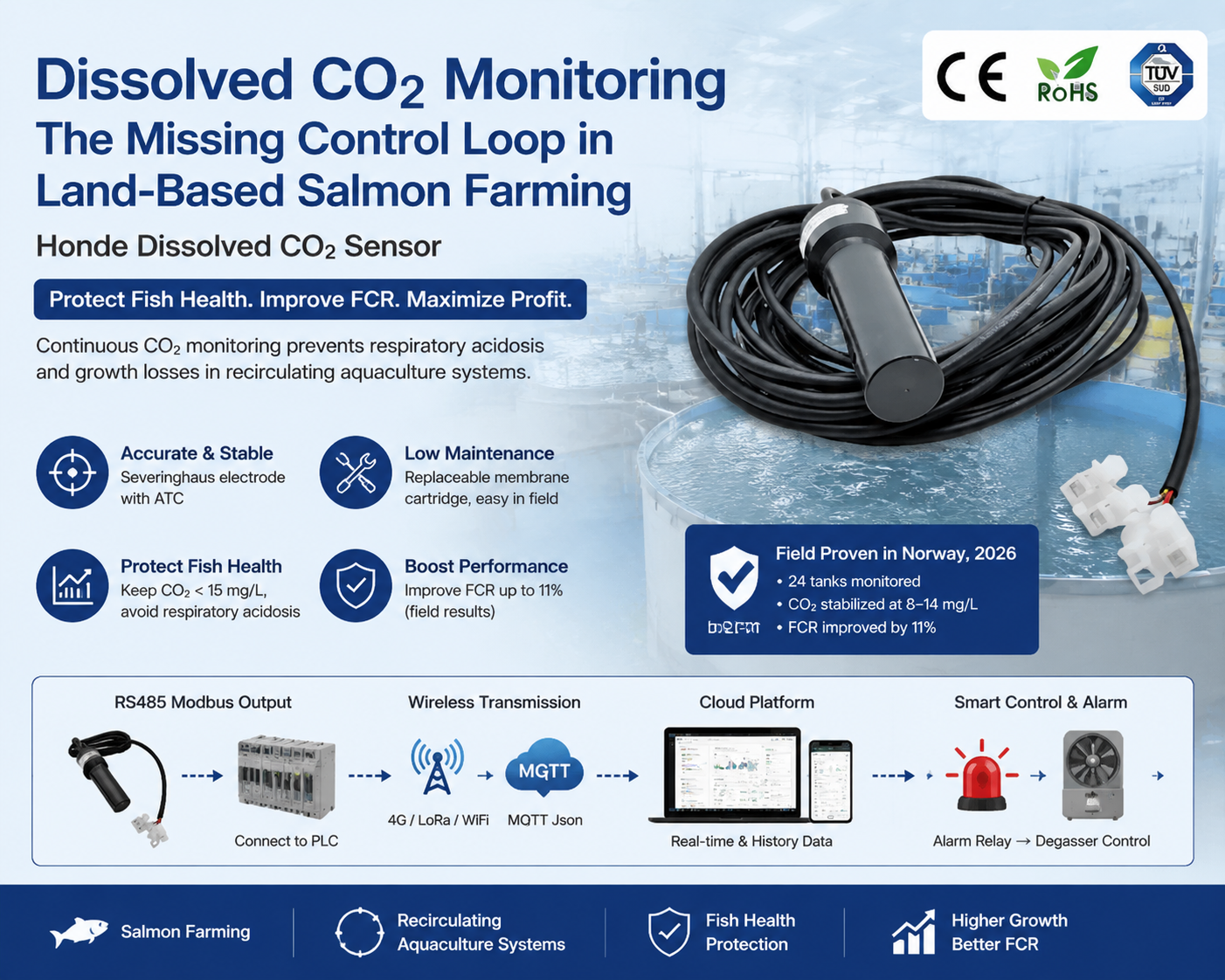
The Honde dissolved CO₂ sensor is specified for RAS deployments because its membrane cartridge is user-replaceable in the field, its RS485 Modbus-RTU output connects directly to the facility PLC, and its automatic temperature compensation holds accuracy across the 8°C to 20°C range of typical RAS operation.
The Control Loop That Was Missing
A modern land-based salmon facility operates with the following control architecture:
Oxygen is controlled automatically — DO sensors drive oxygenation systems in a closed loop. Temperature is controlled automatically — heaters and chillers respond to tank sensors. pH is controlled automatically — sodium bicarbonate dosing responds to pH probes. CO₂ is measured — if at all — as a manual grab sample once a week, analyzed with a benchtop meter in the lab.
The result is a process controlled in four dimensions, with the fifth dimension managed blind. The degassing column — the packed tower or vacuum stripper that removes CO₂ — runs at a fixed rate, sized for peak load, regardless of actual demand. The operator has no data to answer the most basic question: is the degasser removing enough CO₂ today?
Installing the Honde CO₂ sensor in the tank return line closes that loop. The sensor measures the actual CO₂ concentration in the water entering the tank. The RS485 output drives the degasser control: when CO₂ approaches 15 mg/L, the stripping airflow increases; when it falls below 8 mg/L, the airflow decreases. The degasser runs at the efficiency the water actually requires, and the fish never experience the acidosis threshold.
The Solution Architecture for a Land-Based Salmon Facility
The CO₂ sensor is installed in the tank return line, downstream of the oxygenation system, upstream of the tank inlet — the point where the water’s gas composition represents what the fish will actually experience. A Data logger with screen at the RAS control room displays real-time CO₂, DO, pH, and temperature for each tank group. The production manager reviews the CO₂ trend during morning rounds alongside the feed records — the two datasets now correlate.
The facility’s water-quality team uses the Handmeter with a CO₂-capable probe during weekly verification — a grab sample from the tank, measured with the portable reference, compared against the installed sensor. Drift beyond ±2 mg/L triggers membrane cartridge replacement, a 10-minute procedure.
The RS485 Modbus-RTU output connects directly to the RAS PLC — every commercial RAS facility runs a Siemens or Allen-Bradley control system with native Modbus support. For multi-building facilities — hatchery, grow-out, and smolt units spread across a campus — the sensors transmit via GPRS, 4G, WIFI, LoRa, or LoRaWAN wireless modules, packetized in MQTT Json format, to the central production management platform.
The Cloud server and software consolidates CO₂, DO, pH, and temperature data from all tanks, showing real-time data and history data across the entire facility. The Alarm relay system operates two levels: at 15 mg/L, the relay increases the degasser airflow; at 20 mg/L — the acidosis threshold — the relay escalates an alarm to the on-call production manager and logs the event for the facility’s fish-welfare records. In EU and Norwegian jurisdictions where fish-welfare documentation is a regulatory requirement, the timestamped CO₂ history is the evidence trail that audits require.
Field Results: Land-Based Smolt Facility, Western Norway, 2026
A commercial Atlantic salmon smolt facility in western Norway — producing 2.5 million smolts annually in a fully recirculating system — installed Honde CO₂ sensors across its 24 grow-out tanks between January and March 2026.
Operational results after 5 months (through the spring smolt production peak):
- • The continuous sensors revealed that tank CO₂ concentrations cycled between 6 and 24 mg/L daily — driven by feeding cycles and degasser performance — while the previous weekly grab sampling had consistently reported a benign 10–12 mg/L average. The fish in the highest-density tanks had been living at chronic acidosis levels for an estimated 30–40% of the production cycle.
- • After the degasser control loop was closed — the relay modulating stripping airflow against the sensor reading — average tank CO₂ stabilized between 8 and 14 mg/L across all 24 tanks.
- • Feed conversion ratio improved by 11% during the May–June grow-out period compared to the same period in 2025, which the production manager attributed directly to the elimination of CO₂-driven acidosis.
- • The Alarm relay system logged 37 escalation events at the 20 mg/L threshold during the first month — before the degasser control loop was fully tuned — and zero escalation events in the final month of the trial.
- • The facility’s fish-welfare documentation for the 2026 spring audit included the continuous CO₂ history for the first time, replacing the previous spot-sample records with a complete, timestamped dataset.
Contact Honde Technology for RAS and Aquaculture Monitoring
Honde Technology is a Germany TUV & Alibaba verified manufacturer. We supply the dissolved CO₂ measurement hardware, the RS485 PLC-native interface, and the degasser control logic required for land-based aquaculture operations where every percentage point of feed conversion affects the bottom line.
For more sensor information and customized IoT solutions, please contact Honde Technology Co., LTD.
- WhatsApp: +86-15210548582
- Email: info@hondetech.com
- Company Website: www.hondetechco.com
Post time: Aug-11-2026