

American water utilities are running out of operators. The average age of a certified water treatment plant operator in the United States is over 50, and the American Water Works Association has documented the retirements outpacing replacements for a decade. The result is that the same number of distribution points, booster stations, and treatment facilities must be maintained by fewer, older, and more expensive hands.
Chlorine monitoring has historically been one of the most labor-intensive tasks in a water system. A conventional DPD-based online analyzer requires a technician to refill reagents every 1 to 4 weeks, depending on consumption. A membrane-covered amperometric sensor requires electrolyte refills and periodic membrane replacement. In a utility operating 40 booster chlorination stations across a metropolitan area, that maintenance load translates to one technician spending roughly two days per week driving between stations — changing reagents, replacing membranes, recalibrating.
Two days per week of a $45-per-hour operator’s time, every week, for the life of the system. That is the cost the EPA’s Method 334.0-compliance environment does not capture on any form. And it is the reason a growing number of American utilities are switching to the reagent-free, membrane-free constant-voltage chlorine sensor.
1 The Product Logic: Remove the Consumable, Remove the Visit
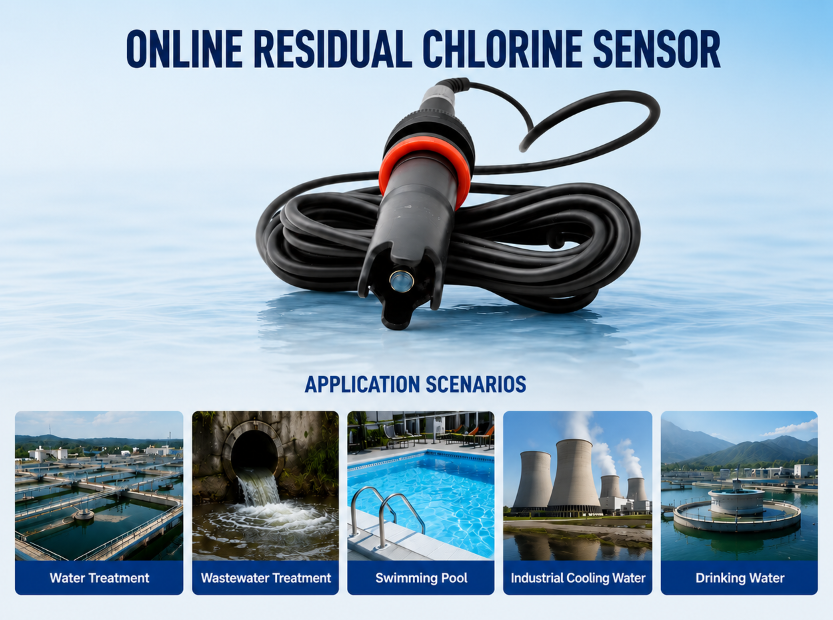
The Honde online residual chlorine sensor applies a constant voltage across two platinum rings immersed directly in the water flow. Free chlorine reacting at the electrode surface generates a current proportional to its concentration. The sensor converts this to a reading in mg/L, outputs it over RS485 Modbus-RTU, and compensates for temperature automatically.
- No reagent to refill
- No membrane to replace
- No electrolyte to top up
- Quarterly vs Weekly visits
- $600 annual savings per station
- 1,000 hours recovered operator time
Across a 40-station distribution network, that is $24,000 per year in eliminated consumables and an estimated 1,000 hours per year of recovered operator time.
2 Scenario 1: Municipal Distribution Booster Chlorination
US distribution systems are required to maintain a detectable chlorine residual at all points in the network — the EPA’s Total Coliform Rule requires testing for residual at every routine sample location, and the Stage 2 Disinfectants and Disinfection Byproducts Rule sets a maximum of 4.0 mg/L. Between “detectable” and “4.0 mg/L” lies the operational band where utilities actually manage: typically 0.5 to 1.2 mg/L, adjusted seasonally.
Booster chlorination stations are where this band is managed. A booster station adds chlorine to water that has traveled hours from the treatment plant and lost residual to pipe-wall demand and organic load. The station’s sensor continuously measures the residual and drives the dosing pump to hold the setpoint.
The EPA Method 334.0 requirement is the compliance gate: online chlorine analyzers used for regulatory compliance must meet this method’s acceptance criteria. The Honde sensor’s amperometric measurement principle and documented accuracy (±1% FS) position it for Method 334.0-compliant installations at treatment plants and distribution nodes.
The sensor connects directly to the station’s SCADA via the RS485 Modbus interface — every American water utility operates SCADA, and Modbus is the native language of every RTU and PLC in the industry.
3 Scenario 2: Commercial Building Cooling Towers
The Legionella angle is the faster-growing demand driver. ASHRAE Standard 188-2021 requires building owners to implement a formal Water Management Program for cooling towers — and several US jurisdictions, including New York City, have gone further with local laws mandating cooling tower registration and water quality monitoring.
A cooling tower is an ideal Legionella environment: warm water, 30–40°C, nutrient-rich from atmospheric dust, and aerosol generation that disperses any contamination across a neighborhood. The control strategy is chlorine or bromine dosing to maintain a residual in the tower sump, combined with continuous monitoring.
The building engineering market has historically used simple test-strip or DPD-kit testing — a facility manager dips a strip weekly and logs the color match on a clipboard. That approach fails exactly when it matters most: between the weekly test and the next one, a tower can swing from 0.3 mg/L (safe) to 0.0 mg/L (uncontrolled) during a heat wave that increases water demand and chlorine consumption.
The reagent-free sensor changes the building economics. Installed in the tower’s recirculation line, connected to the building management system via RS485, the sensor reports residual chlorine continuously. The BMS alarms when the residual falls below the ASHRAE-recommended minimum.
The Solution Architecture for US Deployments
The sensor mounts in a bypass loop at the chlorination point. A Data logger with screen at each station displays the current residual and the 24-hour trend. The utility’s laboratory uses the Handmeter during quarterly verification — a grab sample analyzed with the portable reference and compared against the installed sensor.
The RS485 Modbus-RTU output connects directly to the station’s PLC or RTU. For distributed assets, the sensors transmit via GPRS, 4G, WIFI, LoRa, or LoRaWAN wireless modules, packetized in MQTT Json format, to the central SCADA or building management system.
The Cloud server and software consolidates chlorine data from all monitored points. The Alarm relay system operates the control loop: when residual falls below the 0.5 mg/L minimum, the relay adjusts the dosing pump and escalates alarms to the on-call operator if necessary.
Field Results: Southeastern US Water Utility, 2026
A mid-sized municipal utility in the southeastern United States, serving 380,000 customers across three counties, replaced DPD-reagent analyzers with Honde reagent-free sensors at 28 booster chlorination stations and 2 treatment plant finished-water points.
Operational results after 4 months:
- The 28 booster stations eliminated their weekly reagent-refill visits, converting to quarterly inspection rounds. The utility recovered an estimated 880 operator-hours.
- Consumable costs for the converted stations dropped from an estimated $16,800 to zero for the period.
- The Alarm relay system detected 7 dosing-pump failures within minutes of residual drop — previously, these failures would have been detected at the next weekly station visit.
- Zero regulatory violations were recorded. The utility’s compliance team cited the continuous residual data as the strongest documentation package ever produced for state review.
- The two treatment plant sensors passed the state’s initial acceptance review without exception.
Contact Honde Technology for Utility and Building Water Monitoring
Honde Technology is a Germany TUV & Alibaba verified manufacturer. We supply the reagent-free chlorine monitoring hardware, the SCADA-native RS485 interface, and the automated dosing-control logic required by utilities and building owners.
- WhatsApp: +86-15210548582
- Email: info@hondetech.com
- Website: www.hondetechco.com
Post time: Aug-10-2026