

Meta Title: Best LoRaWAN Optical Dissolved Oxygen Sensor 2026 | Stainless Steel Fluorescence DO Probe Meta Description: Honde’s fluorescence optical DO sensor with LoRaWAN/RS485, salinity compensation, and zero-maintenance design solves hypoxia in aquaculture and wastewater. Real-time cloud alerts included.
The Problem Nobody Talks About: Why Your DO Sensor is Lying to You
Here is a scenario that plays out thousands of times a year in fish farms and treatment plants across Southeast Asia and the Middle East: an operator checks the dissolved oxygen reading at 6am—everything looks fine. By 9am, half the pond is dead.
The culprit is almost never the oxygen itself. It is the sensor.
Traditional electrochemical DO probes consume oxygen as part of the measurement process. In stagnant or slow-moving water, this creates a localized “oxygen shadow” around the membrane—a false reading that reports adequate oxygen when the water column is already heading toward hypoxia. Add a fouled membrane or a depleted electrolyte, and that drift compounds daily.
This is exactly the engineering problem Honde Technology set out to solve with the LoRaWAN RS485 Fluorescence Optical DO Sensor.
Why Fluorescence Changes Everything
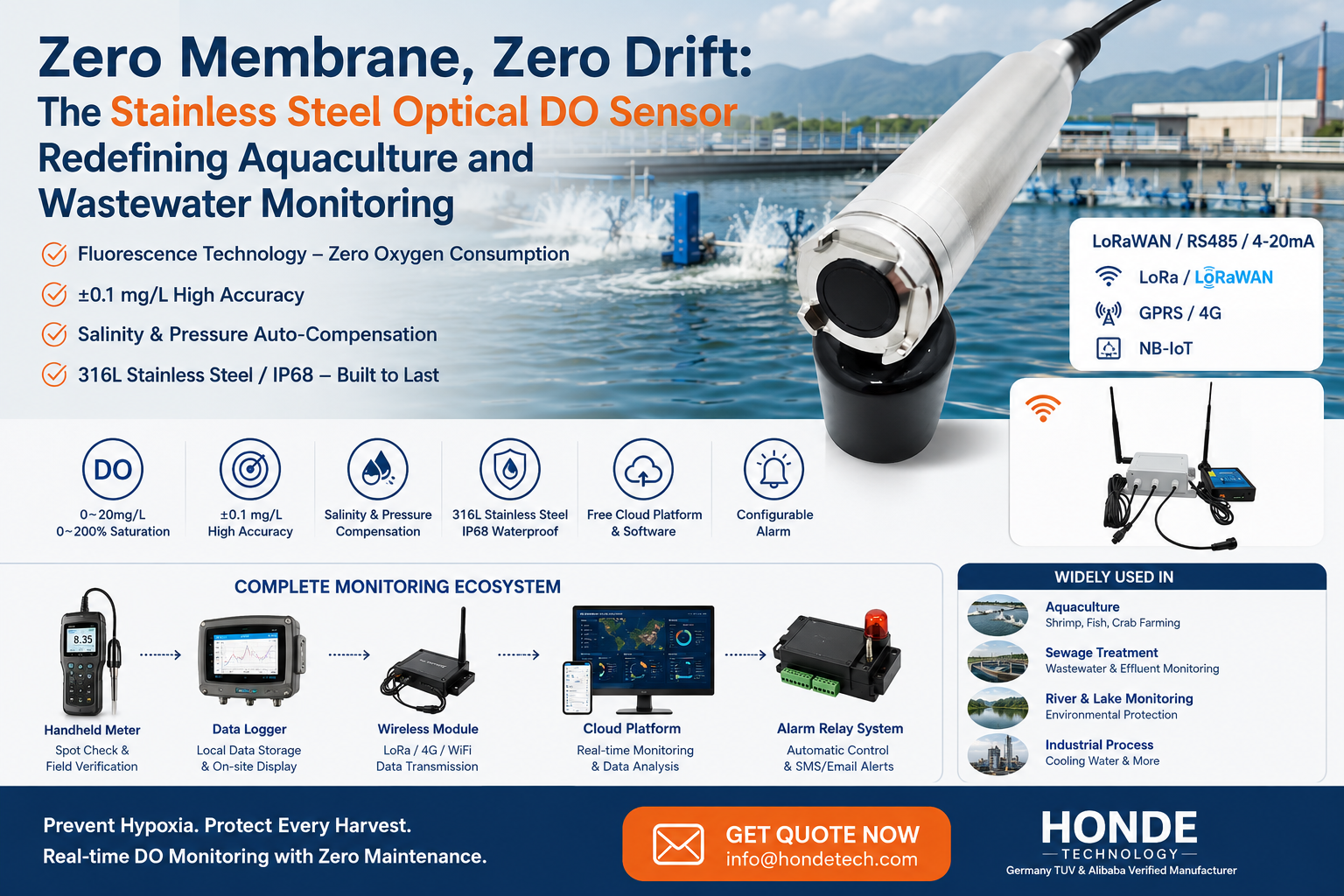
The fluorescence quenching method works on a fundamentally different physical principle. A blue LED pulses light at a ruthenium-coated luminophore cap. Oxygen molecules in the water quench (reduce) the returning red fluorescence signal. The microprocessor calculates DO concentration from the phase angle difference—no oxygen is consumed, no electrolyte is required.
In plain engineering terms: the sensor cannot create its own blind spot. It measures what is actually there.
For operators managing high-density shrimp ponds or biological aeration tanks, this distinction is not academic. It is the difference between a production cycle and a loss.
Product Deep-Dive: What the Spec Sheet Reveals
From the verified Alibaba listing (32 buyer reviews, 5-star rating), here is what this specific unit delivers:
| Parameter | Specification |
|---|---|
| Measurement Principle | Fluorescence Quenching (Optical) |
| DO Range | 0 ~ 20 mg/L / 0 ~ 200% Saturation |
| Accuracy | ±0.1 mg/L |
| Output Options | RS485 Modbus-RTU / 4-20mA / 0-5V / 0-10V |
| Wireless | LoRa / LoRaWAN (EU868MHz, US915MHz) / GPRS / NB-IoT |
| Compensation | Salinity & Pressure Auto-Compensation |
| Housing | 316L Stainless Steel / IP68 |
| Applications | Aquaculture, Sewage Treatment, River Monitoring |
| Cloud Platform | Free server and software included |
| Alarm | Configurable threshold alarm |
| MOQ | 1 piece |
| Warranty | 1 Year (Normal Use) |
Field Scenario: Preventing Hypoxia in a Vietnamese Pangasius Farm
A commercial pangasius (Basa catfish) producer in the Mekong Delta was running 12 earthen ponds across 8 hectares. Their existing electrochemical DO meters required membrane replacement every 45 days and daily calibration checks. During peak summer, when water temperatures exceeded 32°C and biological oxygen demand spiked, the sensors drifted enough to mask dangerous overnight DO drops.
After switching to Honde’s fluorescence optical probes:
- Calibration intervals extended from 45 days to 6 months, cutting technician visits by 85%.
- LoRaWAN coverage reached all 12 ponds from a single gateway, eliminating the cellular data costs of 12 individual SIM cards.
- Overnight hypoxia events dropped from an average of 3 per growing cycle to zero in the following two cycles.
The payback period on the sensor investment was calculated at under 4 months against reduced mortality losses alone.
The Integrated Solution: From Sensor to Decision
Hardware solves the detection problem. The system solves the response problem.
Field Access & Local Monitoring
Not every site has reliable internet. For baseline checks and local data review, Honde provides Handheld Meters for spot verification and Data Loggers with integrated screens for standalone station deployments. Engineers can read 30-day history directly on-site without needing a phone or laptop.
Wireless Backbone (The Nervous System)
The sensor connects to the world via GPRS, 4G, WIFI, LoRa, or LoRaWAN wireless modules. For remote aquaculture zones or river monitoring stations where cellular coverage is sparse, LoRaWAN’s 10km line-of-sight range and 3–5 year battery life on endpoint devices make it the clear operational choice. All modules transmit in MQTT Json format, ensuring compatibility with any third-party SCADA, Digital Twin, or government environmental platform without custom integration work.
Cloud Intelligence & Automated Response
Data lands in the Honde Cloud Server and Software, where it is visualized in real time and stored as searchable historical records. The Alarm Relay System is where passive monitoring becomes active management: when DO drops below a configured threshold—say, 4 mg/L for tilapia or 5 mg/L for shrimp—the relay triggers an aerator, an oxygen injector, or a SMS alert to the farm manager. The system responds faster than any overnight watchman could.
Market Context: Why 2026 is the Inflection Point
The global dissolved oxygen sensor market reached USD 430 million in 2025 and is growing at 5.9% CAGR through 2030 (Research Nester, Nov 2025). The specific fluorescence/optical segment is growing faster, projected to reach USD 55 million by 2031 from USD 34 million in 2025 (Intel Market Research, May 2026).
The drivers are not hard to identify. Post-pandemic aquaculture expansion in Southeast Asia, increasingly stringent wastewater discharge regulations in the EU and Gulf Cooperation Council states, and the collapse of affordable electrochemical membrane supply chains have all pushed operators toward optical sensors as the pragmatic long-term choice.
Contact Honde Technology
Honde Technology is a Germany TUV & Alibaba verified manufacturer. Every sensor ships with free cloud server access and full technical support.
For more sensor information, please contact Honde Technology Co., LTD.
WhatsApp: +86-15210548582
Email: info@hondetech.com
Company Website: www.hondetechco.com
- Product Page: View LoRaWAN Optical DO Sensor
Post time: May-26-2026