

1. Executive Summary
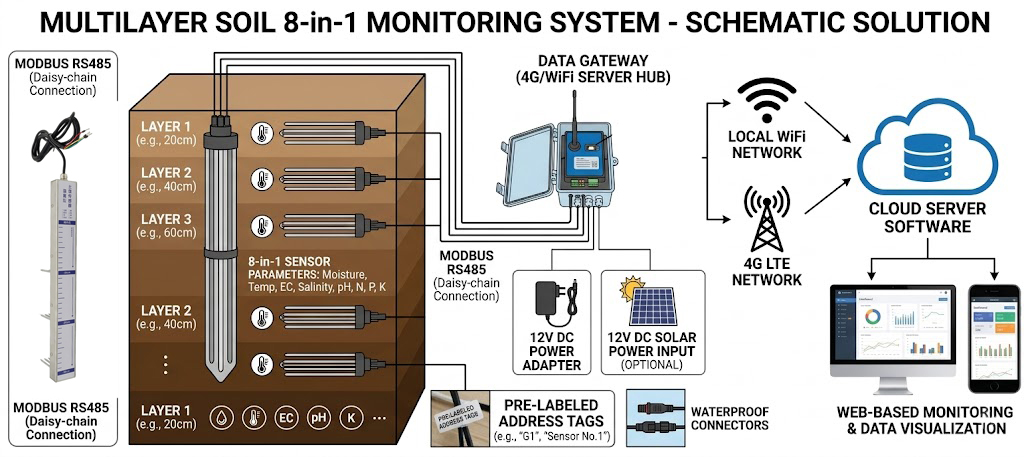
A multilayer soil 8-in-1 sensor is a high-precision agricultural instrument designed for comprehensive moisture profile analysis and soil health monitoring. This tubular sensor, featuring a sleek black design with waterproof multi-pin connectors, measures eight critical parameters—temperature, electrical conductivity (EC), salinity, pH, and NPK—at each of its three distinct vertical layers. By delivering 24 unique data points per sensor, the system provides an unparalleled view of the underground environment. These sensors interface with dual-connectivity 4G/WIFI gateways, transmitting real-time data to a centralized server for advanced precision fertigation and large-scale crop management.
2. Technical Specifications & Data Dimensions
| Parameter | Measurement Type | Value / Capability |
|---|---|---|
| Sensor Structure | Physical Form | 3-Layer Tubular Probe (Black, High-Durability Resin) |
| Monitored Parameters | Data Density | 24 Total Data Points (8 Parameters x 3 Soil Depths) |
| Total Sensors per Gateway | Network Capacity | Gateway 1: Sensors 1–3; Gateway 2: Sensors 4–7 (7-Sensor Array) |
| Power Options | Input Supply | 12V DC (Solar Optimized) or standard Power Adapter |
| Communication Protocols | Data Transmission | Dual-Mode 4G LTE and WIFI |
3. Smart Connectivity: Integrating 4G and WIFI Server Software
The Honde Technology ecosystem utilizes a dual-mode communication gateway to bridge the gap between field-level sensors and cloud-based analytics. The gateway is housed in a white, IP67-rated waterproof enclosure featuring two external screw-on mounts for black whip-style antennas. For a successful signal handshake, correct antenna orientation is mandatory: the left terminal is dedicated to WIFI, while the right terminal handles 4G connectivity.
For cellular deployments, the gateway includes a specialized SIM card slot protected within the enclosure. To install the card, use the provided tool to press the integrated yellow button, which causes the SIM tray to punch out. It is critical that the SIM card’s Access Point Name (APN) settings match the credentials previously provided to the manufacturer to ensure seamless network registration. Once powered, the system offers a “plug-and-play” experience where users simply log into the web-based server software to visualize real-time data streams.
- Antenna: Correct left (WIFI) and right (4G) mounting orientation.
- Power: Connection to a stable 12V DC solar source or AC adapter.
- SIM/APN: Verified 4G SIM card with APN configurations matching Honde factory settings.
4. Expert Installation Logic: Ensuring Data Accuracy
In our experience with Honde Technology hardware, precision in addressing logic is the foundation of a reliable agricultural IoT network. Because each sensor in the 7-unit array possesses a unique address, installers must follow a strict mapping protocol.
- Match Labels: Each sensor is physically labeled (e.g., “G1″ or “G2″). You must connect sensors labeled G1 exclusively to Gateway 1 and those labeled G2 to Gateway 2.
- Sequential Addressing: Connect sensors 1, 2, and 3 to Gateway 1. Sensors 4, 5, 6, and 7 are reserved for Gateway 2. Note an “Expert Tip”: within a specific gateway’s port array (e.g., ports 1–3 on G1), there is no specific order requirement; any G1 sensor can occupy any of the three G1 ports via the waterproof multi-pin connectors.
- Power Management: For remote agricultural sites, we recommend the 12V DC solar configuration. This ensures 24/7 uptime for the gateways without the infrastructure costs of AC grid extension, which is vital for maintaining continuous data logs.
5. Why Multilayer Sensing is Critical for Modern Agriculture
Traditional single-point sensors often miss the “big picture” of soil dynamics. By utilizing a 3-layer monitoring approach, B2B clients can perform detailed moisture profile analysis and detect nutrient leaching below the root zone—a critical factor in ROI for commercial growers.
Monitoring NPK and pH at three depths allows for precision fertigation, ensuring that expensive inputs are reaching the target roots rather than draining into the water table. The hardware is designed for industrial longevity; the tubular sensors are ruggedized, and the gateways are built to withstand extreme environmental exposure. This high-density data (24 parameters per probe) allows farm managers to transition from reactive irrigation to proactive, data-driven soil management.
6. Technical Checklist for B2B Buyers
Before field deployment, procurement and technical officers should verify the following engineering requirements:
- SIM card APN settings confirmed and matched to the gateway configuration.
- WIFI credentials successfully provisioned per Honde technical instructions.
- Sensors correctly mapped to their respective G1/G2 gateway enclosures.
- 12V DC power stability verified for all solar-powered remote nodes.
- Antenna positions verified (WIFI on left, 4G on right) to prevent signal interference.
7. Conclusion & Call to Action
The Honde Technology multilayer 8-in-1 sensor system provides the granular data necessary for the next generation of smart farming. By integrating 24-point soil sensing with robust 4G/WIFI gateway communication, this system eliminates guesswork and maximizes resource efficiency.
To integrate this hardware into your next agricultural project, please [Link to Product Page] or [Link to Specification PDF] to download our comprehensive technical data sheets.
- Company: Honde Technology Co., Ltd.
- Website: www.hondetechco.com
- Email: info@hondetech.com
Post time: May-28-2026