

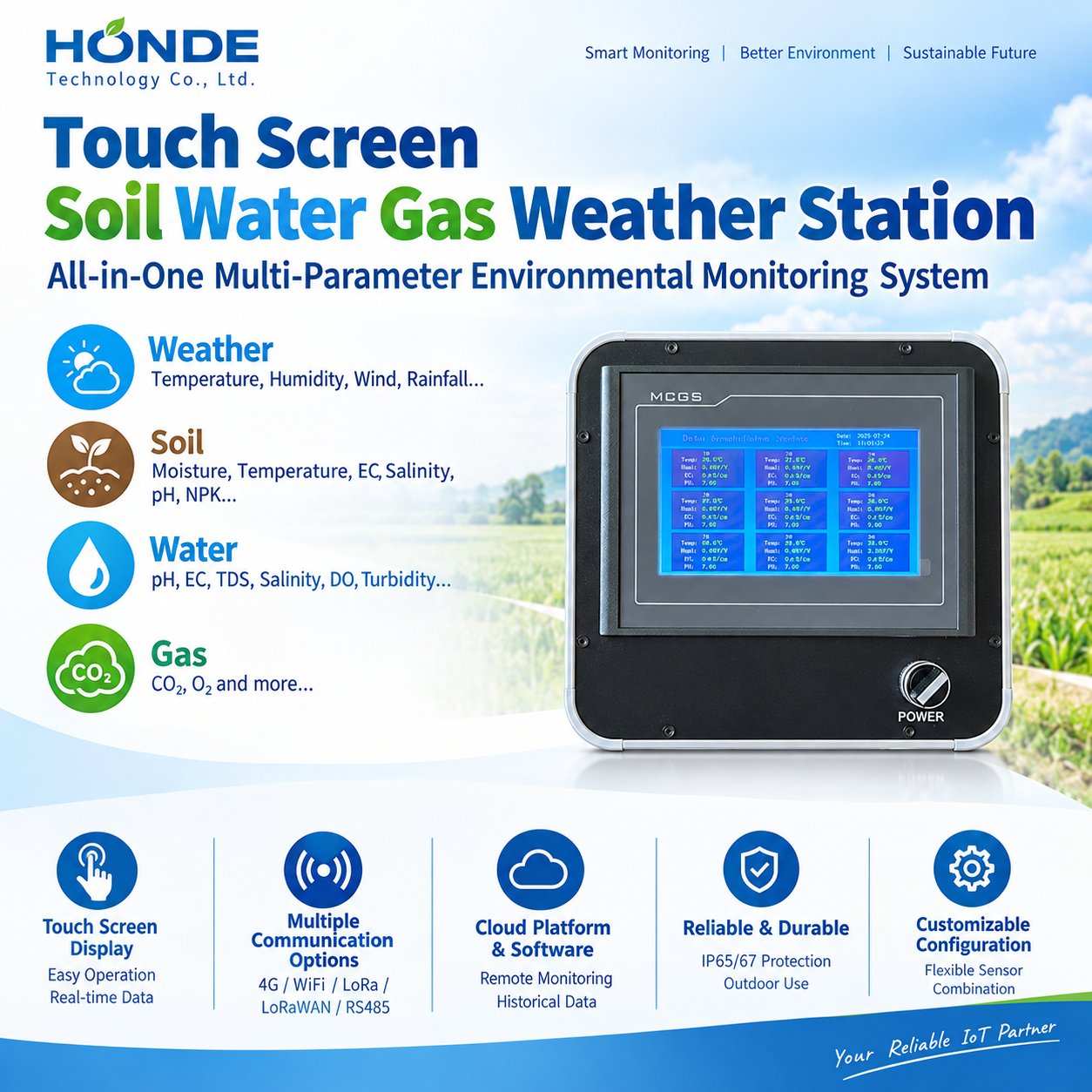
When an agricultural or environmental monitoring project needs to observe weather, soil, water and gas conditions from one monitoring system, a multi-parameter touch screen monitoring station can simplify data collection, visualization and daily operation.
Honde Technology’s touch screen soil water gas weather station concept integrates multiple environmental sensing functions into one monitoring architecture. Instead of checking separate instruments one by one, users can connect different sensors, view measurements through a touch screen, and build a data acquisition system suitable for agriculture, greenhouse monitoring, environmental monitoring, water management and research applications.
This article explains how a touch screen weather station with soil, water and gas sensors works, which parameters can be monitored, how the system can be customized, and how wireless IoT communication can extend the system for remote monitoring.
1. What Is a Touch Screen Soil Water Gas Weather Station?
A touch screen soil water gas weather station is a multi-parameter environmental monitoring system designed to collect measurements from different sensing layers.
A typical architecture can include:
Weather Sensors + Soil Sensors + Water Sensors + Gas Sensors → Data Acquisition → Touch Screen → Wireless Communication → Cloud Platform
The weather layer can monitor atmospheric conditions such as temperature, humidity, pressure, rainfall, wind speed and wind direction.
The soil layer can measure parameters such as soil moisture, soil temperature, EC, salinity, pH or NPK, depending on the selected sensor configuration. Honde’s multi-depth soil sensor platform, for example, supports simultaneous monitoring at different soil depths and can be configured with parameters including moisture, temperature, EC, salinity, NPK and pH.
The water layer can be configured for parameters such as pH, EC, temperature, TDS, salinity, dissolved oxygen or turbidity. Honde also provides multi-parameter water-quality sensors and wireless communication options for remote monitoring.
The gas layer can be configured according to the application, including agricultural or environmental gas monitoring.
This modular architecture allows the system to be configured around the actual project rather than forcing every customer to use exactly the same sensor combination.
2. Why Use a Touch Screen for Environmental Monitoring?
A monitoring system is only useful when operators can easily understand the data.
A local touch screen provides an immediate human-machine interface between the sensors and the operator.
Instead of connecting a computer every time a measurement needs to be checked, the operator can view key parameters directly on the display.
Typical functions can include:
- Real-time parameter display
- Sensor status monitoring
- Parameter switching
- Data acquisition
- Alarm threshold configuration
- Local equipment operation
- Connection status checking
- Integration with wireless communication
- Remote data transmission
For field technicians, this can make installation and troubleshooting easier because the measurement information is available directly at the monitoring point.
3. What Parameters Can the System Monitor?
The biggest advantage of this architecture is its ability to combine different environmental sensing layers.
| Monitoring Layer | Typical Parameters | Typical Applications |
|---|---|---|
| Weather | Temperature, humidity, pressure, rainfall, wind speed, wind direction, radiation | Agriculture, meteorology, environmental monitoring |
| Soil | Moisture, temperature, EC, salinity, pH, NPK | Precision irrigation, crop monitoring, research |
| Water | pH, EC, temperature, TDS, salinity, DO, turbidity | Aquaculture, irrigation, rivers, water treatment |
| Gas | CO₂, O₂ and other application-specific gases | Greenhouses, environmental monitoring, industrial applications |
| Communication | RS485, Modbus, 4G, WiFi, LoRa, LoRaWAN | Local and remote IoT monitoring |
| Display | Touch screen / local display | On-site data visualization |
The exact parameter combination should be selected according to the project requirements.
For example, a greenhouse project may prioritize air temperature + humidity + CO₂ + soil moisture + soil temperature, while an irrigation project may focus on soil moisture + soil EC + water quality + rainfall + weather conditions.
4. How Does the Multi-Parameter Monitoring System Work?
The system can be divided into four functional layers.
Layer 1: Environmental Sensors
Different sensors collect measurements from the surrounding environment.
For agriculture, this may include:
- Weather station
- Soil moisture sensor
- Soil temperature sensor
- Soil EC or salinity sensor
- Water quality sensor
- Gas sensor
The sensors can be selected according to the crop, monitoring environment and required parameters.
Layer 2: Data Acquisition
The sensor signals are collected by the monitoring controller.
For industrial and agricultural projects, RS485 with Modbus communication can provide a standardized way to connect compatible sensors.
Honde’s weather monitoring products support RS485/Modbus communication as well as wireless communication options, allowing the monitoring system to be expanded according to project requirements.
Layer 3: Touch Screen Visualization
The collected information is presented through the touch screen.
This provides an intuitive interface for operators who need to check the monitoring point locally.
Instead of looking at several independent meters, users can view multiple environmental parameters through one interface.
Layer 4: Remote Communication and Cloud Monitoring
For remote projects, the local monitoring system can be connected to a wireless communication module.
Possible communication methods include:
- 4G
- GPRS
- WiFi
- LoRa
- LoRaWAN
Honde’s existing monitoring architecture also supports cloud software for real-time data viewing, historical data access and alarm management.
For large agricultural areas, LoRaWAN is particularly relevant because it is designed as a low-power wide-area networking technology for connecting battery-operated IoT devices. The LoRa Alliance describes LoRaWAN as an LPWA networking protocol designed for regional, national and global IoT networks.
5. Touch Screen + Weather + Soil: A Practical Smart Agriculture Architecture
Agricultural production is affected by multiple environmental variables simultaneously.
For example, soil moisture alone does not explain why a crop is experiencing water stress.
The same soil moisture value can have different implications depending on:
- Air temperature
- Relative humidity
- Rainfall
- Solar radiation
- Wind speed
- Soil temperature
- Soil EC
- Crop growth stage
By combining weather and soil monitoring, agricultural managers can obtain a more complete picture of field conditions.
Honde’s existing smart agriculture architecture combines weather stations and distributed soil sensors with LoRa/LoRaWAN data collectors and gateways for large-area agricultural monitoring.
This creates a monitoring chain:
Atmosphere → Soil → Crop Root Zone → Data Collection → Wireless Network → Cloud Platform
Such an architecture can support applications including precision irrigation, greenhouse management, orchard monitoring and agricultural research.
6. Water and Gas Monitoring Can Extend the System
The system does not have to stop at weather and soil monitoring.
For projects involving water resources, a multi-parameter water-quality sensor can be added.
For example, Honde’s water-quality sensor solutions can measure combinations of:
- pH
- EC
- Temperature
- TDS
- Salinity
- Dissolved oxygen
- Turbidity
- ORP
- Other project-specific parameters
Honde also provides LoRaWAN-compatible water-quality solutions for applications such as aquaculture, hydroponics, river monitoring and sewage treatment.
Gas monitoring can similarly be integrated when the project requires environmental or greenhouse gas measurements.
This makes the system particularly useful for projects where air + soil + water + gas information needs to be evaluated together.
7. Local Touch Screen vs Remote IoT Monitoring
A common question is whether a project needs only a local touch screen or a complete remote monitoring system.
The answer depends on the application.
| Requirement | Touch Screen | Wireless + Cloud |
|---|---|---|
| Local real-time viewing | ✓ | ✓ |
| On-site operation | ✓ | Optional |
| Remote monitoring | — | ✓ |
| Historical data | Optional | ✓ |
| Alarm notification | Optional | ✓ |
| Large-area deployment | Limited | ✓ |
| Multi-site management | Limited | ✓ |
| Mobile/PC access | — | ✓ |
For a laboratory, greenhouse or equipment room, a local touch screen may be sufficient.
For farms, remote environmental stations, reservoirs or distributed monitoring networks, adding wireless communication and cloud software can provide a more complete solution.
8. What Should Buyers Check Before Choosing a Multi-Parameter Station?
A common mistake in environmental monitoring projects is choosing the display first and considering the sensor architecture later.
For B2B projects, the following points should be confirmed before ordering.
1. Define the Required Parameters
Do not simply request an “all-in-one environmental monitor.”
First determine exactly what needs to be measured.
For example:
Agriculture:
Soil moisture + soil temperature + EC + air temperature + humidity + rainfall
Greenhouse:
Air temperature + humidity + CO₂ + soil moisture + light/PAR
Aquaculture:
Water temperature + pH + DO + EC + turbidity
Environmental Monitoring:
Weather + gas + water quality + data transmission
2. Confirm Communication Protocols
Check whether the sensors use:
- RS485
- Modbus-RTU
- 4-20mA
- 0-5V
- 0-10V
- Wireless communication
This is important when integrating sensors from different suppliers.
3. Consider the Installation Environment
Outdoor agricultural systems may require waterproof and durable sensor construction.
For example, Honde’s multi-depth soil sensor uses a stainless-steel housing and IP68 protection for long-term buried applications.
Water-quality monitoring may also require IP68 probes, corrosion-resistant materials and suitable cable lengths depending on the installation environment.
4. Plan the Communication Network
For a single local monitoring point, wired RS485 may be sufficient.
For distributed fields, wireless communication can reduce wiring requirements.
LoRaWAN is designed around low-power wide-area IoT networking and can support networks containing distributed battery-operated devices.
5. Think About Future Expansion
A good monitoring architecture should leave room for additional sensors.
Instead of designing a system that can only measure today’s parameters, consider whether additional:
- Soil sensors
- Weather sensors
- Water sensors
- Gas sensors
- Radiation sensors
- Water-level sensors
may be required later.
9. Honde Technology’s Modular Approach to Environmental Monitoring
At Honde Technology, we approach environmental monitoring as a system engineering problem rather than simply a single-sensor purchase.
Our product portfolio includes weather stations, soil sensors, water-quality sensors, gas sensors, data acquisition equipment, wireless communication modules and cloud monitoring solutions.
For example, Honde’s weather station portfolio supports multiple sensor configurations and wireless communication options, while its soil sensing solutions can measure multiple parameters and multiple soil depths.
For remote projects, Honde can also integrate wireless communication and cloud software so customers can view real-time data, historical records and alarm information.
This modular approach is useful for OEM and project-based customers because the system can be configured according to:
- Measurement parameters
- Sensor quantity
- Sensor depth
- Communication method
- Power supply
- Installation environment
- Data protocol
- Cloud platform
- Display requirements
10. Recommended System Architecture for a Complete IoT Project
A typical complete system can be designed as:
Weather Station
↓
Soil / Water / Gas Sensors
↓
Data Acquisition Controller
↓
Touch Screen Display
↓
RS485 / Modbus
↓
4G / WiFi / LoRa / LoRaWAN
↓
Gateway / Internet
↓
Cloud Server
↓
PC + Mobile Monitoring
This architecture allows local operators to see the data while remote managers can access the same monitoring system from another location.
For large agricultural projects, the architecture can be further expanded into multiple field monitoring nodes connected through LoRaWAN and a gateway.
Honde has already developed related weather-soil monitoring architectures using LoRa/LoRaWAN collectors and gateways, demonstrating how distributed environmental sensors can be integrated into a wider agricultural IoT network.
11. Related Honde Solutions
If your project focuses on a specific monitoring layer, you can also explore these related Honde solutions:
Multi-Depth Soil Monitoring:
Honde Multi-Depth Soil 8-Parameter Sensor
Water Quality Monitoring:
Honde LoRaWAN Multi-Parameter Water Quality Sensor
Weather & Wireless Monitoring:
Honde Outdoor Wireless Weather Monitoring System
These internal links create a logical content cluster around weather monitoring → soil monitoring → water quality → wireless IoT, which is useful for both users and search engines.
Conclusion: Build One Connected Environmental Monitoring System
A touch screen soil water gas weather station can serve as the local visualization and data-management center for a broader environmental IoT system.
Instead of monitoring weather, soil, water and gas independently, a modular architecture can combine them into one data workflow:
Sensors → Data Acquisition → Touch Screen → Wireless Communication → Cloud Platform
The key is not simply adding as many sensors as possible. The better approach is to select the parameters, communication protocol, power supply, display interface and software architecture according to the actual application.
For agriculture, this can mean combining weather and root-zone soil information.
For aquaculture, it can mean combining water-quality monitoring with environmental data.
For environmental projects, it can mean integrating weather, water and gas monitoring into one remote monitoring network.
Need a Customized Multi-Parameter Monitoring System?
Honde Technology Co., Ltd. provides environmental and agricultural IoT monitoring equipment and customized system solutions.
Company Name: Honde Technology Co., Ltd.
Website: www.hondetechco.com
Email: info@hondetech.com
If you are planning a project involving a touch screen weather station, soil sensor, water-quality sensor, gas sensor, LoRaWAN/4G communication or cloud monitoring platform, contact Honde Technology to discuss the required parameters, sensor configuration and communication architecture.
Post time: Sep-22-2026