

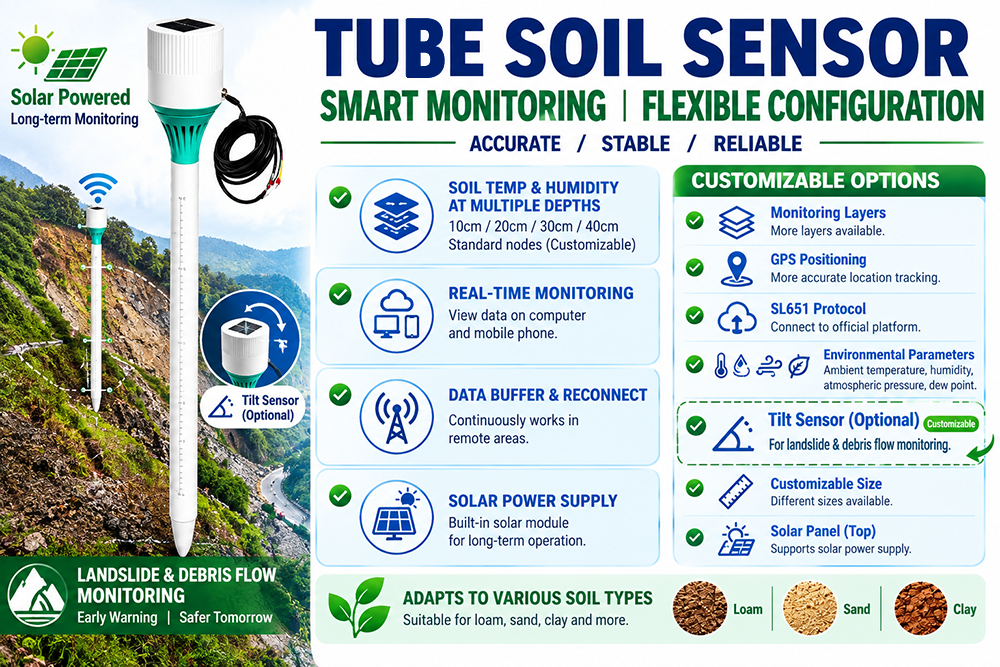
A tube soil sensor with an optional tilt sensor provides an integrated solution for monitoring soil conditions and potential slope movement in landslide-prone areas. By combining multi-depth soil temperature and moisture measurements with tilt monitoring, the system can help identify changes in ground conditions and provide data for landslide early warning systems.
For remote mountainous areas, a solar-powered tube soil sensor with 4G wireless communication offers continuous data collection, remote monitoring, and data buffering. Customizable measurement depths, GPS positioning, environmental parameters, and communication protocols make it suitable for different geological disaster monitoring projects.
Honde Technology provides customizable tube soil monitoring solutions for landslide monitoring, debris flow monitoring, agricultural applications, and environmental monitoring projects.
1. Why Is Soil and Tilt Monitoring Important for Landslide Prevention?
Landslides and debris flows can occur when slope stability changes due to rainfall, soil conditions, erosion, and other geological factors. Monitoring changes in the ground can help engineers identify potential risks and improve their understanding of slope behavior.
Traditional soil monitoring mainly focuses on soil moisture and soil temperature. However, these measurements alone may not adequately describe changes in slope movement.
Combining soil monitoring with tilt measurements provides additional information.
- Soil temperature monitoring: Tracks temperature variations at different soil depths.
- Soil moisture monitoring: Helps identify changes in soil water conditions that may influence slope stability.
- Tilt monitoring: Measures changes in the sensor’s inclination, providing an indicator of possible ground movement.
- Multi-depth monitoring: Helps engineers understand how soil conditions vary with depth.
By analyzing soil temperature, soil moisture, and tilt changes together, monitoring systems can provide more comprehensive information for assessing slope conditions.
A tilt sensor is an optional, project-specific configuration of the Honde tube soil sensor. Its integration enables the collection of tilt data alongside soil measurements, supporting more informed landslide risk assessment and early warning decisions.
2. How Does a Tube Soil Sensor with Tilt Sensor Work?
The tube soil sensor is installed vertically in the ground to monitor soil conditions at selected depths. An optional tilt sensor can be integrated into the upper part of the device, depending on project requirements.
The system collects soil and tilt data and transmits the measurements to a remote monitoring platform.
Typical monitoring process:
- Soil data collection: Measure soil temperature and moisture at standard or customized depths.
- Tilt data collection: Monitor changes in the sensor’s inclination using an optional tilt sensor.
- Wireless data transmission: Transmit monitoring data through a 4G wireless module.
- Cloud-based monitoring: View real-time and historical measurements on a computer or mobile phone.
- Risk assessment: Analyze changes in soil conditions and tilt measurements to support slope movement assessment and early warning.
| Monitoring item | Function | Application |
|---|---|---|
| Soil moisture | Measures soil moisture at selected depths | Soil water condition monitoring |
| Soil temperature | Measures soil temperature at multiple depths | Soil thermal condition monitoring |
| Tilt sensor (optional) | Measures changes in inclination | Slope movement monitoring |
| GPS (optional) | Provides positioning information | Monitoring station location |
| 4G communication | Transfers monitoring data remotely | Remote site monitoring |
| Solar power | Supports outdoor power supply | Remote installation |
The combined measurements can provide useful information for monitoring systems. However, actual warning thresholds should be established according to local geological conditions, sensor installation, calibration, and engineering requirements.
3. Key Features of Honde Tube Soil Sensor for Landslide Monitoring
3.1 Optional Tilt Sensor for Slope Movement Monitoring
The optional tilt sensor is a key customization feature for landslide and debris flow monitoring projects.
By collecting tilt changes together with soil temperature and moisture measurements, the system can provide additional information about changes in ground conditions.
Key benefits include:
- Optional integrated tilt sensor.
- Continuous tilt data collection.
- Combined soil and tilt monitoring.
- Support for slope movement assessment.
- Data support for landslide and debris flow early warning systems.
The tilt sensor can be customized according to project requirements. Its measurements can be evaluated alongside soil temperature and moisture trends to help identify potential slope movement.
This configuration is particularly relevant for mountainous slopes, unstable embankments, landslide-prone areas, and geological hazard monitoring networks.
3.2 Multi-Depth Soil Temperature and Moisture Monitoring
Soil conditions can vary considerably with depth. A multi-depth tube soil sensor helps engineers monitor these variations using a single installation.
Honde supports the following standard monitoring depths:
| Standard depth | Measurement |
|---|---|
| 10 cm | Soil temperature and moisture |
| 20 cm | Soil temperature and moisture |
| 30 cm | Soil temperature and moisture |
| 40 cm | Soil temperature and moisture |
Customized monitoring layers and measurement depths can be provided according to project requirements.
Multi-depth monitoring can help users compare soil conditions at different levels and analyze changes over time. For slope monitoring projects, this information can complement tilt measurements when assessing changes in the ground.
3.3 4G Wireless Communication and Remote Monitoring
Many landslide monitoring sites are located in mountainous or remote areas where frequent manual inspection is difficult.
The tube soil sensor can be configured with a 4G wireless communication module to transmit monitoring data to a cloud platform.
Key functions include:
- Real-time data transmission.
- Remote monitoring through computers and mobile phones.
- Historical data viewing.
- Centralized monitoring of multiple sites.
- Data buffering and breakpoint resume.
The data buffering function helps preserve measurements during temporary communication interruptions. Once communication is restored, stored data can be transmitted, subject to the configured system.
This is especially useful for monitoring installations in remote mountain areas where network connectivity may be intermittent.
3.4 Solar-Powered Operation for Remote Sites
A reliable power supply is important for long-term outdoor monitoring.
The tube soil sensor can be equipped with a solar power module and a built-in lithium battery. This configuration is suitable for monitoring sites where grid electricity is unavailable or difficult to install.
Key features include:
- Top-mounted solar panel.
- Built-in lithium battery.
- Solar-powered outdoor operation.
- Reduced dependence on external power.
- Suitability for remote monitoring locations.
Solar power capacity and battery configuration can be selected according to communication frequency, local sunlight conditions, and project requirements.
3.5 Customizable Environmental Monitoring Parameters
In addition to soil temperature and moisture, the tube soil sensor can be customized to support additional environmental measurements.
Optional parameters include:
- Ambient temperature.
- Ambient humidity.
- Atmospheric pressure.
- Dew point temperature.
These additional measurements can help monitoring projects collect broader environmental data and correlate environmental changes with soil conditions.
GPS positioning is also available as an optional configuration for projects that require precise monitoring station location information.
3.6 Customizable Dimensions and Communication Protocols
Different landslide and geological monitoring projects have different installation requirements.
Honde supports customization of the tube soil sensor, including:
| Customization | Available options |
|---|---|
| Monitoring layers | Customizable number of measurement layers |
| Installation dimensions | Customizable product dimensions |
| GPS | Optional positioning |
| Tilt sensor | Optional integrated tilt monitoring |
| Environmental parameters | Temperature, humidity, pressure, dew point |
| Communication | 4G wireless |
| Data protocol | Optional SL651 protocol |
| Power supply | Solar-powered configuration |
The optional SL651 protocol can be customized for integration with compatible official monitoring platforms, subject to interface and project requirements.
4. Applications in Landslide and Debris Flow Monitoring
Mountain Slope Monitoring
Mountain slopes may experience gradual changes in soil conditions and inclination. Installing tube soil sensors at selected monitoring locations can provide continuous soil and tilt data.
By comparing changes over time, engineers can obtain additional information for slope stability assessment.
Landslide-Prone Area Monitoring
In areas with a history of landslides, multiple monitoring stations can be deployed to collect soil temperature, moisture, and optional tilt data.
Remote data transmission makes it possible to monitor multiple locations without relying entirely on frequent manual measurements.
Debris Flow Risk Monitoring
Debris flow monitoring often requires information about environmental conditions and slope changes in potentially unstable areas.
Tube soil sensors can be integrated into a broader monitoring network to provide soil and tilt measurements. The collected data can complement rainfall, water level, and other monitoring information used in debris flow risk assessment.
Highway and Railway Slope Monitoring
Road cuts, railway embankments, and steep slopes may require continuous monitoring, particularly in areas exposed to heavy rainfall or geological hazards.
Solar-powered sensors with remote data transmission can help reduce the need for frequent site visits and support centralized monitoring.
5. Tube Soil Sensor with Tilt Sensor vs. Conventional Soil Monitoring
The main difference between conventional soil monitoring and a customized tube soil sensor with tilt monitoring is the additional inclination data.
| Feature | Conventional soil monitoring | Tube soil sensor with optional tilt sensor |
|---|---|---|
| Soil temperature | Available | Available |
| Soil moisture | Available | Available |
| Multi-depth monitoring | Depends on configuration | Standard 10/20/30/40 cm nodes, customizable |
| Tilt monitoring | Not normally included | Optional |
| GPS positioning | Depends on system | Optional |
| Remote 4G monitoring | Depends on configuration | Available |
| Solar power | Depends on configuration | Available |
| Environmental expansion | Depends on model | Customizable |
| Landslide monitoring | Soil condition reference | Soil and tilt data for slope assessment |
The optional tilt sensor adds another measurement dimension. It does not replace other geological monitoring instruments, but can complement them in a comprehensive slope monitoring system.
6. How to Select a Tube Soil Sensor for Landslide Monitoring
When selecting a tube soil sensor for a landslide or debris flow monitoring project, consider the following factors.
1. Monitoring depth
Determine the required soil measurement depths according to the geological structure and project design. Standard 10 cm, 20 cm, 30 cm, and 40 cm nodes are available, with customized configurations possible.
2. Tilt monitoring requirements
If slope movement monitoring is required, consider the optional tilt sensor. Installation position, measurement range, accuracy, and alarm thresholds should be confirmed for the specific project.
3. Communication coverage
Check the availability and reliability of 4G network coverage at the monitoring site. For areas with intermittent connectivity, data buffering and breakpoint resume are useful features.
4. Power supply
For remote installations, consider solar panel capacity, battery capacity, sunlight availability, and the required measurement and transmission frequency.
5. Environmental parameters
Determine whether ambient temperature, humidity, atmospheric pressure, and dew point measurements are required.
6. Data integration
Confirm whether the monitoring platform requires standard data transmission, API integration, or customized SL651 protocol support.
7. Installation conditions
Consider the soil type, installation depth, slope angle, exposure to rainfall, and the mechanical protection required at the monitoring location.
7. Why Choose Honde for Customized Landslide Monitoring Sensors?
Honde Technology Co., Ltd. provides IoT sensing equipment and customized monitoring solutions for agriculture, environmental monitoring, and related applications.
For landslide and debris flow monitoring projects, the tube soil sensor can be configured according to different technical requirements, including:
- Customizable soil monitoring layers and dimensions.
- Optional tilt sensor for slope movement monitoring.
- Optional GPS positioning.
- Expandable environmental monitoring parameters.
- 4G wireless data transmission.
- Solar power supply.
- Optional SL651 protocol integration.
These customization options allow system integrators and engineering contractors to select configurations that match their monitoring objectives, installation conditions, and data integration requirements.
8. Frequently Asked Questions
Can a tube soil sensor be used for landslide monitoring?
Yes. A tube soil sensor can measure soil temperature and moisture at multiple depths. With an optional tilt sensor, it can also provide inclination data to support slope movement assessment and landslide monitoring.
What is the function of the optional tilt sensor?
The tilt sensor measures changes in inclination. When combined with soil temperature and moisture measurements, its data can help engineers identify potential changes in ground conditions and support landslide early warning assessments.
Can the tube soil sensor monitor multiple soil depths?
Yes. Standard measurement depths are 10 cm, 20 cm, 30 cm, and 40 cm. The number of monitoring layers and measurement depths can be customized.
Does the tube soil sensor support remote monitoring?
Yes. With a 4G wireless module and a compatible cloud platform, users can view real-time and historical monitoring data through computers and mobile phones.
Can the tube soil sensor work in remote mountainous areas?
The sensor can be configured with solar power, a built-in lithium battery, and 4G communication. Data buffering and breakpoint resume help maintain data collection during temporary network interruptions. Actual operating performance depends on site conditions and system configuration.
Can additional environmental parameters be measured?
Yes. Ambient temperature, ambient humidity, atmospheric pressure, and dew point temperature can be added according to project requirements.
Can the sensor integrate with an official monitoring platform?
An optional customized SL651 protocol can support integration with compatible official monitoring platforms. Interface requirements should be confirmed before implementation.
Does the sensor guarantee early landslide warnings?
No single sensor can guarantee landslide prediction. The tube soil sensor provides soil and optional tilt measurements that can support an early warning system. Reliable warning decisions require appropriate thresholds, calibration, site-specific geological assessment, and, where necessary, additional monitoring instruments.
9. Get a Customized Tube Soil Sensor for Your Project
For landslide and debris flow monitoring projects, combining soil temperature, soil moisture, and optional tilt measurements can provide valuable information about changes in ground conditions.
Honde’s customizable tube soil sensor supports multi-depth monitoring, optional GPS positioning, 4G wireless communication, solar power, and additional environmental parameters. Product dimensions, monitoring layers, and communication protocols can be tailored to project requirements.
Whether you are developing a mountain slope monitoring network, a landslide early warning system, or a remote geological monitoring project, our team can help you select a suitable sensor configuration.
Contact Honde Technology Co., Ltd.
Website: www.hondetechco.com
Email: info@hondetech.com
Contact us today to discuss your customized tube soil sensor requirements and request a quotation.
Post time: Sep-29-2026