

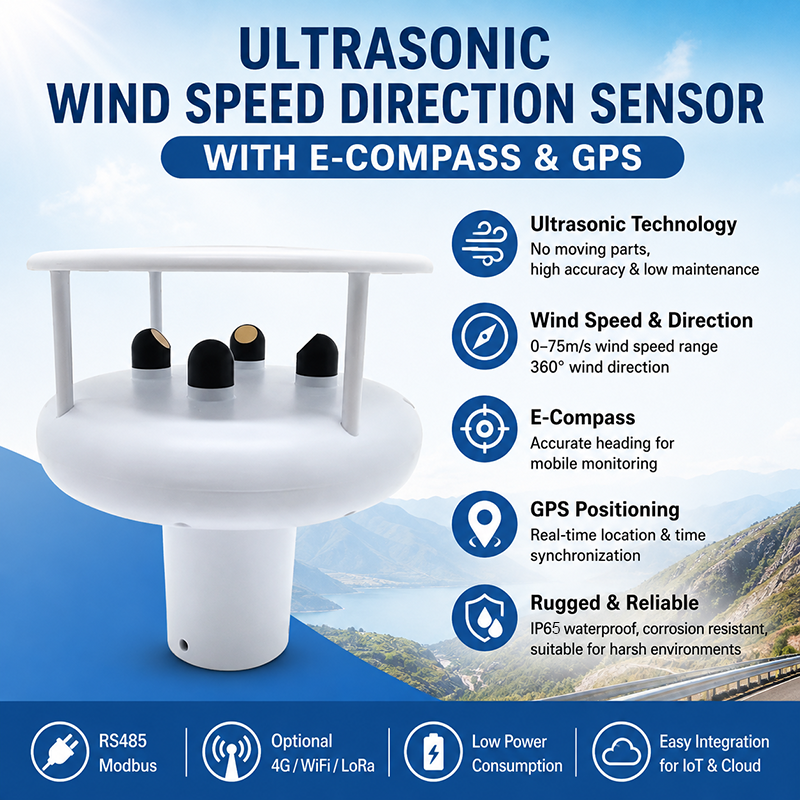
An ultrasonic wind speed and direction sensor with E-Compass and GPS is a compact meteorological measurement device that combines non-contact ultrasonic wind sensing with electronic heading and location information.
Unlike traditional mechanical anemometers, ultrasonic sensors have no rotating cups or mechanical bearings. They determine wind speed and direction by analyzing the propagation time of ultrasonic signals between transducers. This enables fast response, low maintenance, and reliable outdoor operation. Honde’s ultrasonic wind sensor range includes RS485/Modbus communication, wireless transmission options, and models with optional GPS for mobile monitoring.
For applications where the sensor itself may move—such as vehicles, ships, drones, emergency monitoring equipment, or portable weather stations—the combination of wind measurement + electronic compass + GPS can provide much more useful data than a conventional fixed wind sensor.
Why Combine Ultrasonic Wind Measurement with E-Compass and GPS?
A conventional wind sensor can tell you:
- How fast the wind is moving
- Which direction the wind is coming from
Where is the sensor, and what direction is the platform facing?
This is where GPS and an electronic compass become valuable.
| Function | Measurement | Application Value |
|---|---|---|
| Ultrasonic Wind Speed | Wind velocity | Weather and wind monitoring |
| Ultrasonic Wind Direction | Wind direction | Environmental analysis |
| E-Compass | Sensor/platform heading | Direction compensation |
| GPS | Position information | Mobile monitoring and location tagging |
| RS485/Modbus | Digital data transmission | System integration |
| Wireless Communication | Remote transmission | IoT monitoring |
Honde’s GPS-enabled mini ultrasonic anemometer can optionally integrate GPS for location synchronization during mobile monitoring.
How Does an Ultrasonic Anemometer Work?
Ultrasonic Time-of-Flight Measurement
The basic principle is known as Time of Flight (TOF).
Ultrasonic transducers transmit sound waves through the air. Wind changes the propagation time of sound traveling in different directions.
The sensor calculates the difference between these propagation times to determine wind velocity and direction.
There are no rotating mechanical components.
Traditional mechanical anemometers typically use rotating cups or propellers. Ultrasonic sensors instead use electronic measurement, reducing mechanical wear and maintenance requirements.
Honde’s ultrasonic sensor products use ultrasonic propagation principles and are designed for long-term monitoring without mechanical moving parts.
Ultrasonic Anemometer vs Traditional Mechanical Anemometer
| Feature | Ultrasonic Anemometer | Mechanical Anemometer |
|---|---|---|
| Moving Parts | None | Yes |
| Mechanical Wear | Very Low | Higher |
| Maintenance | Low | Regular maintenance may be required |
| Starting Wind Speed | No mechanical start-up limitation | Depends on mechanical design |
| Response | Fast | Depends on mechanical inertia |
| Wind Direction | Electronic measurement | Mechanical vane commonly used |
| Mobile Monitoring | Excellent | More difficult |
| Long-Term Outdoor Use | Excellent | Good |
| IoT Integration | Easy | Depends on interface |
Honde specifically highlights the absence of moving parts, maintenance-free operation, 360° measurement, and simultaneous wind speed and direction measurement as key advantages of its ultrasonic wind sensor technology.
Key Technical Specifications to Consider
When purchasing an ultrasonic wind speed direction sensor, buyers should not look only at the advertised wind-speed range. The following specifications are more important for system design.
1. Wind Speed Range
Different applications require different measurement ranges.
For example, one Honde ultrasonic model provides:
- Wind speed range: 0–75 m/s
- Resolution: 0.1 m/s
- Accuracy: ±0.5 m/s for ≤20 m/s and ±3% for >20 m/s
This makes it suitable for demanding outdoor applications such as meteorology, renewable energy, transportation, and environmental monitoring.
2. Wind Direction Accuracy
Wind direction is particularly important for:
- Wind energy
- Aviation
- Marine monitoring
- Agricultural spraying
- Pollution dispersion analysis
- Weather stations
Depending on the model, Honde ultrasonic sensors offer wind-direction measurement up to 360° with different accuracy specifications.
3. Protection Rating
Outdoor meteorological equipment may face:
- Rain
- Snow
- Dust
- Salt spray
- UV radiation
- High humidity
- Temperature fluctuations
For harsh environments, buyers should select a sensor with an appropriate IP protection level and corrosion-resistant enclosure.
For example, Honde offers a rugged ultrasonic wind sensor with IP68 protection and saltwater corrosion resistance for applications including marine environments and offshore monitoring.
Why an Electronic Compass Matters for Mobile Wind Monitoring
For a fixed weather station, wind direction can normally be referenced to geographic north through proper installation. Mobile applications are different. Imagine the sensor is installed on:
- A vehicle
- A ship
- A drone
- A portable monitoring platform
- An emergency response system
The platform can rotate while the wind remains unchanged. An E-Compass helps determine the orientation of the sensor/platform so that wind-direction data can be correctly interpreted relative to geographic heading. This is particularly useful when the equipment is continuously changing its orientation.
Why GPS Makes the System More Useful
GPS adds another important dimension: Location.
Instead of receiving only:
Wind speed = 8.2 m/s
Wind direction = 245°
a mobile monitoring system can associate the measurement with:
Position + Time + Heading + Wind Speed + Wind Direction
This creates a much more valuable environmental dataset.
Example
A mobile environmental monitoring vehicle could collect:
- GPS latitude and longitude
- Timestamp
- Vehicle heading
- Wind speed
- Wind direction
- Air temperature
- Humidity
- Atmospheric pressure
The resulting dataset can be uploaded to a GIS or cloud platform for spatial analysis. Honde’s mini 53 g ultrasonic anemometer supports optional GPS specifically for location synchronization during mobile monitoring.
Lightweight Design for Mobile Monitoring
Weight becomes an important specification when installing sensors on:
- UAVs
- Drones
- Portable weather stations
- Smart poles
- Buoys
- Vehicles
Honde’s mini ultrasonic anemometer is designed around a compact form factor and weighs approximately 53 g, with dimensions of about 66 × 64 mm. The manufacturer positions it for applications including drones, portable devices, weather observation, agriculture, environmental monitoring, photovoltaic plants, and marine buoys. This makes sensor weight a useful selection criterion when designing battery-powered or mobile monitoring equipment.
RS485 Modbus Makes System Integration Easier
For industrial and agricultural monitoring systems, RS485 Modbus RTU remains a practical communication method. It allows the ultrasonic anemometer to connect with:
- PLCs
- Data loggers
- Weather station controllers
- Industrial computers
- IoT gateways
- Solar-powered monitoring systems
Honde’s product range supports RS485 and other interfaces depending on the model, while wireless options can include LoRa/LoRaWAN, 4G, WiFi, and GPRS.
From Sensor to Cloud: Building an IoT Wind Monitoring System
A complete wind monitoring architecture can be structured as:
This architecture is suitable for remote monitoring projects where users need real-time data without visiting the installation site. Honde can also provide matched server and software solutions for remote data viewing depending on the product configuration.
Main Applications of Ultrasonic Wind Sensors
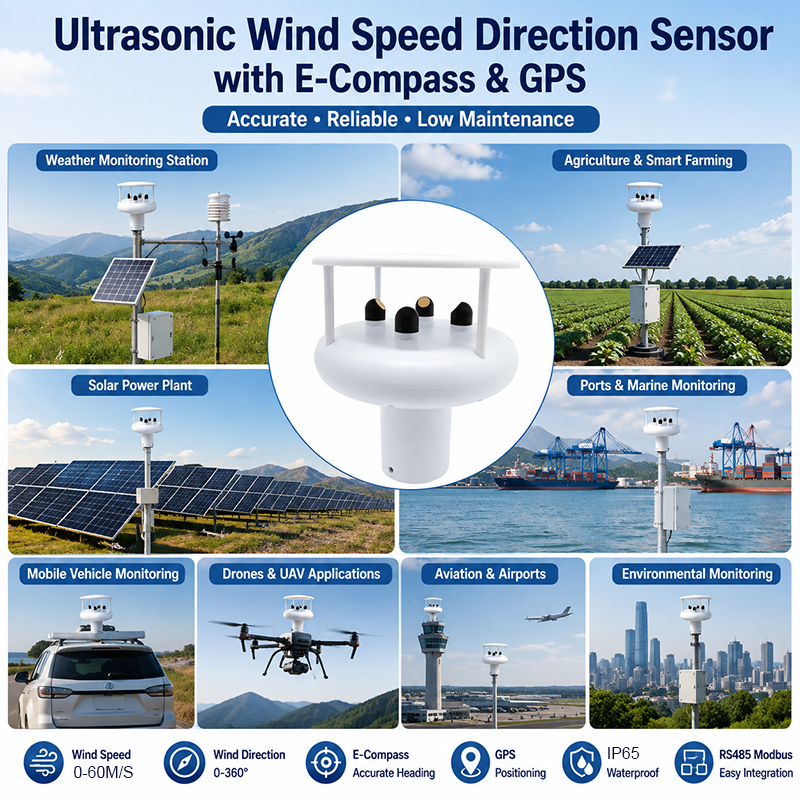
1. Meteorological Stations
Ultrasonic anemometers can provide continuous wind-speed and wind-direction information for automatic weather stations. They can also be integrated with:
- Temperature sensors
- Humidity sensors
- Barometric pressure sensors
- Rain gauges
- Solar radiation sensors
- PM2.5/PM10 sensors
Honde also offers integrated weather stations combining ultrasonic wind measurement with multiple atmospheric parameters.
2. Agriculture and Smart Farming
Wind information is important for:
- Agricultural weather monitoring
- Crop spraying
- Greenhouse management
- Evapotranspiration analysis
- Frost protection
- Precision agriculture
Combining wind data with soil and weather sensors creates a more complete agricultural IoT system.
3. Solar Power Plants
Wind speed and direction can support:
- PV plant environmental monitoring
- Solar resource assessment
- Equipment safety monitoring
- Weather correlation analysis
- Remote site monitoring
For large renewable-energy projects, the wind sensor can be integrated with solar radiation, temperature, humidity, and other meteorological sensors.
4. Ports and Marine Monitoring
Wind is one of the most important environmental parameters for:
- Ports
- Harbors
- Offshore platforms
- Ocean buoys
- Marine navigation
For marine applications, corrosion resistance and waterproof protection become especially important. Honde offers models designed for harsh environments, including saltwater exposure.
5. Airports and Aviation
Accurate wind information is essential for:
- Airport weather stations
- Runway monitoring
- Aviation weather observation
- UAV operations
The absence of moving parts also makes ultrasonic technology attractive for applications where long-term reliability and low maintenance are priorities.
6. Bridges, Tunnels and Transportation
Wind monitoring can be used for:
- Bridge safety monitoring
- Highway weather stations
- Tunnel ventilation monitoring
- Railway environments
- Road weather monitoring
For narrow spaces such as tunnels and pipelines, Honde also offers compact ultrasonic wind sensors with RS485/RS232/SDI-12 interface options.
How to Choose the Right Ultrasonic Wind Sensor
Before placing a bulk order, we recommend evaluating these seven factors:
1. Measurement Range
Check the maximum wind speed expected at the installation location.
2. Wind Direction Accuracy
Higher accuracy may be necessary for professional meteorological and wind-energy applications.
3. Communication Interface
Confirm whether your controller requires: RS485, RS232, SDI-12, Analog output, USB, or Ethernet.
4. GPS Requirement
GPS is particularly valuable for mobile monitoring.
5. Electronic Compass
E-Compass is useful when the sensor/platform orientation changes.
6. Environmental Protection
Consider IP rating, UV resistance, salt spray, operating temperature and humidity.
7. Power Consumption
Low-power models are particularly important for solar-powered stations, drones, buoys, and remote IoT stations.
Engineering Experience: Common Purchasing Mistakes
After years of supplying environmental monitoring equipment, we recommend that buyers avoid several common mistakes.
Mistake 1: Choosing Only by Maximum Wind Speed
A higher maximum range does not automatically mean better measurement performance.
Buyers should evaluate the complete specification: Range + Accuracy + Resolution + Response Time + Stability
Mistake 2: Ignoring Platform Movement
A standard fixed wind sensor may not be the best solution for a mobile vehicle or ship.
For mobile applications, consider: Wind Sensor + E-Compass + GPS
Mistake 3: Ignoring Communication Compatibility
Before purchasing, confirm the communication protocol with your data logger or controller.
For industrial projects, RS485 Modbus RTU is often a practical integration choice.
Mistake 4: Choosing a Sensor Without Considering the Environment
A sensor installed near the ocean faces very different conditions from one installed inside a greenhouse.
For offshore or coastal applications, prioritize: IP protection, Corrosion resistance, UV resistance, Wide operating temperature, and Stable long-term performance.
Honde Ultrasonic Wind Monitoring Solutions
Honde Technology Co., Ltd. provides ultrasonic wind-speed and wind-direction sensors for meteorological, agricultural, renewable-energy, transportation, marine, and environmental monitoring applications.
Our product portfolio includes:
- Mini ultrasonic anemometers
- RS485 Modbus wind sensors
- RS232/RS485/SDI-12 models
- GPS-enabled ultrasonic anemometers
- Electronic-compass wind sensors
- 3D ultrasonic wind sensors
- Heated ultrasonic wind sensors
- Integrated multi-parameter weather stations
Different models can support different ranges, interfaces, wireless communication options, and environmental requirements.
Honde Ultrasonic Wind Sensor Selection Guide
| Application | Recommended Configuration |
|---|---|
| Fixed Weather Station | Ultrasonic Wind Speed + Direction |
| Agricultural Weather Station | Ultrasonic Wind + Temperature/Humidity |
| Solar PV Monitoring | Wind Sensor + Solar Radiation + Weather Sensors |
| Drone/UAV | Mini Ultrasonic + GPS |
| Vehicle Monitoring | Ultrasonic + E-Compass + GPS |
| Marine Buoy | Low-Power Ultrasonic + GPS + Corrosion Protection |
| Airport Monitoring | High-Accuracy Ultrasonic + Industrial Interface |
| Offshore Wind | Heated/Corrosion-Resistant Ultrasonic Sensor |
| Tunnel Monitoring | Mini Ultrasonic + RS485/SDI-12 |
Frequently Asked Questions
Q What is an ultrasonic anemometer?
An ultrasonic anemometer measures wind speed and direction using ultrasonic sound-wave propagation rather than rotating mechanical components.
Q Does an ultrasonic wind sensor need calibration?
Calibration requirements depend on the specific model and application. Honde offers models designed for maintenance-free operation and some products are described as requiring no field calibration.
Q Why add GPS to an ultrasonic wind sensor?
GPS allows wind measurements to be associated with geographic position and time, which is especially useful for mobile monitoring.
Q Why use an electronic compass?
An electronic compass provides heading information, helping interpret wind direction when the sensor or monitoring platform changes orientation.
Q Can the sensor connect to a weather station?
Yes. Depending on the model, Honde ultrasonic wind sensors can communicate through RS485/Modbus and other interfaces and can be integrated into complete automatic weather stations.
Q Can Honde provide OEM or customized solutions?
Yes. Honde’s product range supports customization and integration of additional environmental parameters and communication modules depending on the project requirements.
Conclusion
An ultrasonic wind speed and direction sensor with E-Compass and GPS is more than a conventional anemometer. It is a compact environmental sensing component capable of combining wind measurement, heading, location and digital communication into a single monitoring architecture.
For fixed weather stations, ultrasonic technology offers a low-maintenance alternative to mechanical wind sensors. For mobile applications, adding GPS and E-Compass makes the system significantly more useful because every wind measurement can be associated with location and platform orientation.
Whether you are developing a smart agriculture system, solar PV weather station, UAV monitoring platform, marine buoy, airport weather system, transportation monitoring system, or IoT environmental station, selecting the right ultrasonic wind sensor should begin with the actual application requirements rather than simply comparing prices.
Get a Customized Ultrasonic Wind Monitoring Solution
Company Name: Honde Technology Co., Ltd.
Website: www.hondetechco.com
Email: info@hondetech.com
Contact Honde Technology for:
- Ultrasonic wind speed and direction sensor datasheets
- GPS and E-Compass configurations
- RS485/Modbus integration
- LoRa/LoRaWAN/4G/WiFi solutions
- OEM & ODM customization
- Complete automatic weather station solutions
- Project-based quotations
Get a custom quote for your wind monitoring project and choose the right ultrasonic anemometer for your application.
Post time: Aug-19-2026