

An ultrasonic wind speed and direction sensor with an electronic compass and LED display combines non-mechanical wind measurement, directional reference, and real-time visual data display in one compact monitoring solution. It is designed for applications where users need to measure wind speed and wind direction while also making the data easy to read locally.
Compared with traditional cup or vane anemometers, ultrasonic wind sensors have no rotating mechanical parts. Honde’s ultrasonic wind sensor solutions can provide wind speed and direction measurement, RS485/Modbus communication, optional electronic compass and GPS functions, and optional LED or touch-screen display configurations.
For agricultural weather stations, photovoltaic plants, transportation infrastructure, environmental monitoring, ports, wind-energy projects and other outdoor applications, the combination of ultrasonic wind measurement + electronic compass + LED display + digital communication provides a practical way to build a modern wind-monitoring system.
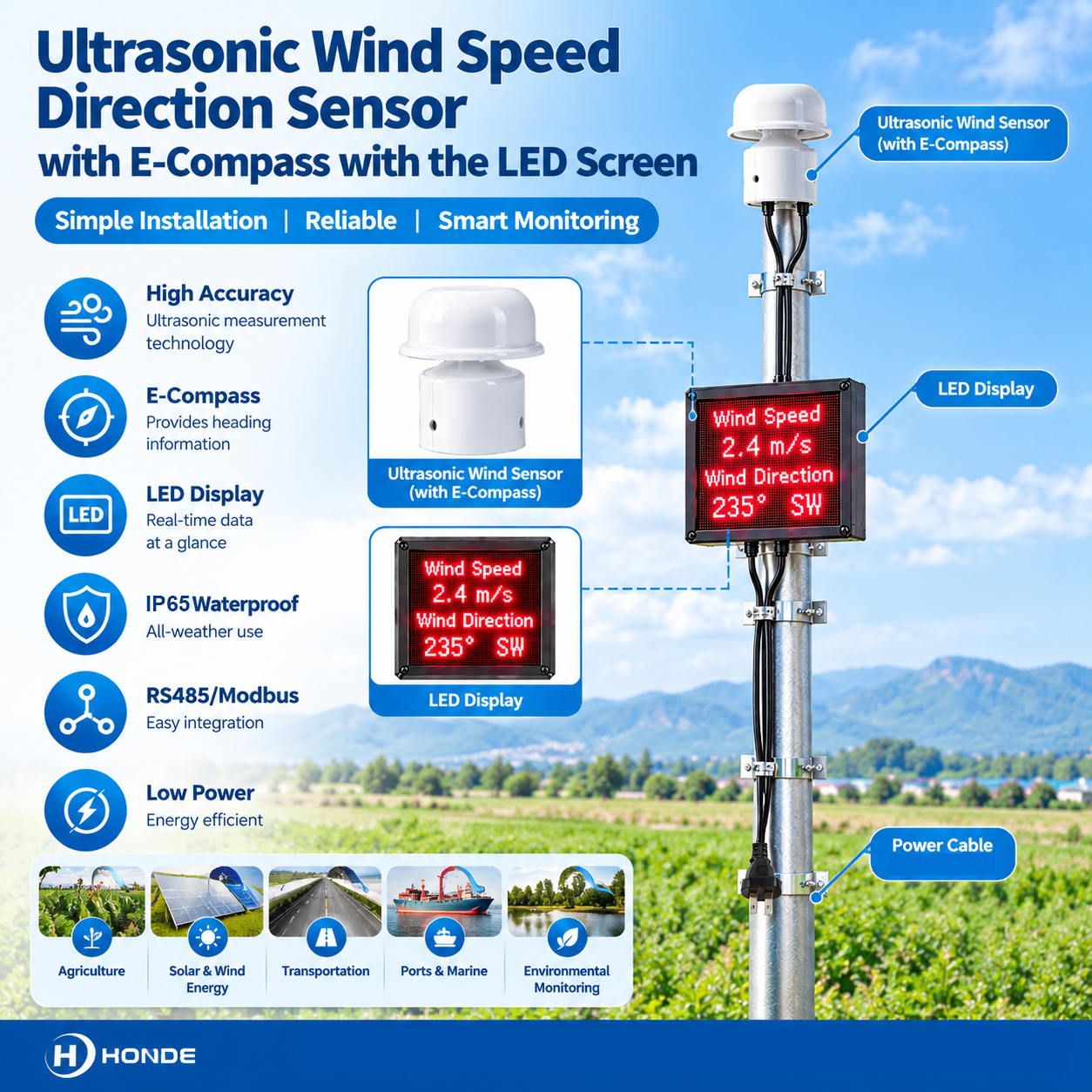
1. What Is an Ultrasonic Wind Speed and Direction Sensor with E-Compass?
An ultrasonic wind sensor measures wind speed and wind direction electronically by using ultrasonic sound-wave propagation rather than rotating cups or mechanical vanes.
The basic measurement principle is based on Time of Flight (TOF). Ultrasonic probes transmit sound waves through the air, and wind changes the propagation time between the transducers. The sensor calculates the difference to determine wind velocity and direction.
Because there are no rotating mechanical components, ultrasonic technology can reduce mechanical wear and maintenance requirements. Honde describes its ultrasonic wind sensors as maintenance-friendly solutions with simultaneous wind-speed and wind-direction measurement.
An electronic compass adds another measurement dimension.
The sensor can provide:
Wind Speed + Wind Direction + Heading Information
This becomes especially useful when the monitoring equipment is installed on a moving or rotating platform.
Key Functions
| Function | Purpose |
|---|---|
| Ultrasonic Wind Speed | Measures wind velocity |
| Ultrasonic Wind Direction | Measures wind direction |
| Electronic Compass | Provides heading/reference direction |
| LED Display | Shows real-time measurements locally |
| RS485 / Modbus | Connects the sensor to controllers and data loggers |
| GPS Optional | Adds position and time information |
| LoRa/LoRaWAN | Enables long-range wireless transmission |
| 4G / WiFi | Supports remote IoT monitoring |
The exact configuration depends on the selected model and project requirements. Honde offers different ultrasonic wind sensor and integrated weather-station configurations.
2. Why Choose an Ultrasonic Wind Sensor Instead of a Mechanical Anemometer?
Traditional mechanical anemometers normally use cups, propellers or mechanical vanes. Ultrasonic sensors use electronic measurement instead.
This difference can be important for long-term outdoor monitoring.
Ultrasonic vs Mechanical Wind Measurement
| Feature | Ultrasonic Sensor | Traditional Mechanical Sensor |
|---|---|---|
| Moving Parts | No rotating parts | Usually has moving parts |
| Mechanical Wear | Low | Higher over long-term operation |
| Maintenance | Low-maintenance design | Mechanical inspection may be required |
| Wind Direction | Electronic measurement | Usually mechanical vane |
| Response | Fast electronic measurement | Influenced by mechanical inertia |
| Mobile Monitoring | Suitable with compass/GPS | More difficult |
| IoT Integration | RS485/Modbus and wireless options | Depends on model |
| Compact Design | Available | Depends on mechanical structure |
For outdoor monitoring projects, eliminating rotating components can simplify equipment maintenance and reduce mechanical failure points.
Honde’s product range includes compact ultrasonic wind sensors as well as integrated weather stations. One mini model is specified at only 53 g with a 66 × 64 mm size, making it suitable for applications where weight and installation space are important.
3. Why Add an Electronic Compass to a Wind Sensor?
Wind direction is normally referenced to geographic direction.
For a fixed weather station, correct installation and orientation can establish the directional reference. However, mobile equipment presents a different challenge.
Imagine a wind sensor mounted on:
- A vehicle
- A ship
- A portable monitoring platform
- A mobile weather station
- A drone or UAV
- An emergency monitoring system
The platform can rotate while the actual wind direction remains unchanged.
An electronic compass can provide the platform’s heading information, helping the monitoring system interpret wind direction relative to the sensor’s orientation.
This creates a more complete dataset:
Wind Speed + Wind Direction + Sensor Heading
Honde specifically identifies electronic-compass configurations as useful for mobile monitoring because they maintain directional information when the platform changes orientation.
4. What Does the LED Display Add to a Wind Monitoring System?
A cloud-connected monitoring system is useful for remote data management, but some projects also need local real-time visibility.
An LED display can provide an immediate view of the measured information at the installation site.
For example, a monitoring system can display:
- Wind speed
- Wind direction
- Other configured weather parameters
- Real-time sensor status
Honde’s weather-station product range supports optional LED displays and 7-inch touch screens, allowing users to choose between local visual monitoring and remote digital monitoring.
Local Display + Remote Monitoring
A practical architecture can therefore be:
Ultrasonic Wind Sensor
↓
LED Display
↓
RS485 / Modbus
↓
Data Logger / Wireless Module
↓
LoRa / LoRaWAN / 4G / WiFi
↓
Cloud Server & Software
This creates two ways to access information:
- Local monitoring through the LED display.
- Remote monitoring through the cloud platform.
Honde’s weather monitoring solutions can also provide cloud software for real-time data viewing, historical data downloads and alarm functions when matched with wireless modules.
5. Key Specifications Buyers Should Check
When selecting an ultrasonic wind speed and direction sensor, maximum wind speed alone should not determine the purchasing decision.
B2B buyers should evaluate the complete technical configuration.
1. Wind Speed Range
The required wind-speed range depends on the application.
For example, Honde has ultrasonic wind sensor models with ranges including 0–60 m/s and other models specified up to 0–75 m/s.
2. Wind Direction Range
A full directional range of approximately 0–360° is commonly used for meteorological monitoring.
Different Honde models specify different resolution and accuracy values, so buyers should compare the exact model datasheet rather than assuming all ultrasonic sensors have identical performance.
3. Communication Interface
For industrial integration, communication compatibility is critical.
Common options include:
- RS485
- Modbus RTU
- RS232
- SDI-12
- TTL
- Wireless communication modules
Honde’s mini ultrasonic anemometer supports RS232, RS485 or TTL interfaces, with communication protocols including Modbus-RTU and SDI-12 depending on configuration.
4. Environmental Protection
Outdoor wind sensors may experience:
- Rain
- Dust
- UV exposure
- Humidity
- Snow
- Salt spray
- Temperature changes
The appropriate IP rating and material should therefore be considered according to the installation environment.
For example, Honde offers ultrasonic wind sensor configurations with IP68 protection and saltwater-corrosion resistance for demanding applications.
6. Typical Technical Parameters
The exact specifications depend on the model, but the following table illustrates the type of parameters B2B buyers should compare.
| Parameter | Example Honde Configuration |
|---|---|
| Wind Speed | 0–60 m/s or model-dependent |
| Wind Direction | 0–360° |
| Wind Speed Resolution | 0.1 m/s on selected model |
| Wind Direction Resolution | 1° on selected model |
| Interface | RS232 / RS485 / TTL |
| Protocol | Modbus-RTU / SDI-12 / NMEA0183 depending on model |
| Power | Low-power options available |
| Electronic Compass | Optional |
| GPS | Optional |
| LED Display | Optional |
| Wireless | LoRa / LoRaWAN / GPRS / 4G / WiFi |
| Housing | ASA or model-dependent |
| Outdoor Protection | Model-dependent |
| Cloud Software | Available with matched wireless solutions |
These figures are examples from Honde’s published product configurations, not universal specifications for every ultrasonic wind sensor. Buyers should confirm the final configuration before ordering.
7. How Does an Ultrasonic Wind Sensor Connect to an IoT System?
The sensor itself is only one part of a complete monitoring architecture.
A typical Honde IoT configuration can be structured as:
Ultrasonic Wind Sensor
↓
RS485 / Modbus
↓
Data Logger or Wireless Module
↓
LoRa / LoRaWAN / 4G / WiFi
↓
Cloud Server
↓
PC / Mobile Monitoring
This architecture allows the sensor to become part of a larger environmental monitoring system.
Honde’s published weather-station solutions support RS485/Modbus communication together with LoRa, LoRaWAN, GPRS, 4G and WiFi wireless transmission options.
For projects requiring local visualization, an LED display can be added to the system.
For projects requiring historical analysis, a data logger can store measurements.
For remote projects, a wireless module can transmit measurements to the cloud.
8. Ultrasonic Wind Sensor Applications
The combination of ultrasonic wind measurement, electronic compass and digital communication creates several potential application scenarios.
Agriculture and Smart Farming
Wind speed and direction are important environmental parameters for agricultural weather stations.
They can be combined with:
- Air temperature
- Air humidity
- Rainfall
- Solar radiation
- Soil moisture
- Soil temperature
- Soil EC
- PAR
This creates a broader environmental monitoring system for precision agriculture.
Honde’s existing smart-agriculture architecture combines weather stations, soil sensors and wireless communication for remote agricultural monitoring.
Wind and Solar Energy
Wind measurements can provide environmental information for renewable-energy installations.
For photovoltaic projects, wind data can also be combined with solar radiation and other weather parameters to create a complete site-monitoring station.
Honde lists photovoltaic plants and wind-energy applications among the application areas for its ultrasonic wind-sensing products.
Transportation and Highway Monitoring
Wind monitoring can be integrated into:
- Highway weather stations
- Bridge monitoring
- Tunnel environments
- Railway monitoring
- Road weather systems
Compact ultrasonic sensors can be useful where installation space is limited.
Ports and Marine Monitoring
Wind speed and direction are important environmental measurements for:
- Ports
- Harbors
- Coastal monitoring
- Marine buoys
- Oceanographic projects
For these environments, buyers should pay particular attention to corrosion resistance and waterproof protection.
Mobile Monitoring
The combination of:
Ultrasonic Wind Sensor + E-Compass + GPS
is especially relevant when the monitoring platform moves.
The collected dataset can associate:
Location + Time + Heading + Wind Speed + Wind Direction
This can support mobile environmental surveys and other location-based monitoring projects.
9. Common Buying Mistakes
Mistake 1: Comparing Only Maximum Wind Speed
A sensor with a higher maximum range is not automatically appropriate for every project.
Compare:
Range + Accuracy + Resolution + Response Time + Environmental Protection
instead of looking at one specification.
Mistake 2: Ignoring the Platform Orientation
If the sensor is installed on a mobile platform, a standard fixed-direction configuration may not provide the required reference information.
For mobile applications, consider:
Wind Sensor + Electronic Compass + GPS
Mistake 3: Choosing the Wrong Communication Interface
Before ordering, confirm whether your controller or data logger requires:
- RS485
- Modbus RTU
- RS232
- SDI-12
- TTL
- Wireless communication
This is particularly important for system-integrator projects.
Mistake 4: Treating the LED Display as the Complete Data System
An LED display provides convenient local visualization, but it does not replace data storage or remote communication.
For a complete IoT project, consider:
Sensor + LED Display + Data Logger + Wireless Module + Cloud Software
Mistake 5: Ignoring the Installation Environment
A sensor installed on an agricultural pole, photovoltaic plant, coastal buoy or highway structure can face very different environmental conditions.
Select the housing, protection level, material and optional functions according to the actual installation environment.
10. How to Build a Complete Weather Monitoring Solution
For a professional B2B project, the ultrasonic wind sensor can be treated as one component of a modular weather-monitoring system.
A basic configuration could be:
| Layer | Equipment | Function |
|---|---|---|
| Sensing | Ultrasonic Wind Sensor | Wind speed and direction |
| Direction | Electronic Compass | Heading reference |
| Display | LED Screen | Local real-time visualization |
| Communication | RS485 / Modbus | Data integration |
| Wireless | LoRaWAN / 4G / WiFi | Remote transmission |
| Data | Data Logger | Local data storage |
| Cloud | Server & Software | Remote monitoring |
| Power | Solar System | Off-grid operation |
Additional sensors can be integrated depending on the project.
Honde’s integrated weather-station platform can combine wind speed, wind direction, temperature, humidity, pressure, rainfall, radiation and other environmental parameters, while additional functions such as GPS, electronic compass, LED display and wireless communication can be configured according to the model.
11. Honde Technology’s Ultrasonic Wind Monitoring Solution
Honde Technology Co., Ltd. provides ultrasonic wind sensors and integrated environmental monitoring solutions for agriculture, meteorology, renewable energy, transportation, environmental monitoring, ports and other applications.
Our product range includes:
- Ultrasonic wind speed and direction sensors
- Mini ultrasonic anemometers
- Electronic-compass wind sensors
- GPS-enabled wind sensors
- RS485 Modbus wind sensors
- LoRa/LoRaWAN weather-monitoring solutions
- 4G and WiFi environmental monitoring systems
- Integrated automatic weather stations
- LED-display weather stations
- Customized OEM/ODM monitoring systems
Depending on the project, Honde can integrate additional environmental parameters and communication modules into the monitoring architecture.
12. FAQ
What is an ultrasonic wind speed and direction sensor?
It is a wind-measuring device that uses ultrasonic sound-wave propagation to calculate wind speed and direction without relying on rotating mechanical cups or vanes.
What is the purpose of an electronic compass?
An electronic compass provides heading information. It is particularly useful when the sensor is mounted on a mobile or rotating platform.
Why use an LED display?
An LED display allows users to view selected measurements locally without opening a computer or cloud platform.
Can the ultrasonic wind sensor connect to a data logger?
Yes. Depending on the model, RS485, Modbus, RS232, SDI-12 and other interfaces can be available for integration.
Can the sensor transmit data wirelessly?
Depending on the configuration, Honde offers LoRa, LoRaWAN, GPRS, 4G and WiFi communication options.
Can GPS be added?
Yes. GPS is available on selected configurations and can be useful for mobile monitoring and location synchronization.
Can Honde customize the monitoring system?
Yes. Honde provides OEM/ODM and system-integration options, including additional environmental sensors, wireless communication modules and display configurations.
Conclusion
An ultrasonic wind speed and direction sensor with E-Compass and LED display combines three practical functions: accurate digital wind measurement, directional reference and convenient local visualization.
The ultrasonic measurement principle eliminates rotating wind-sensing components, while the electronic compass can provide heading information for applications where the sensor orientation changes. An LED display provides immediate local data access, while RS485/Modbus and wireless communication options allow the sensor to become part of a larger IoT monitoring system.
For B2B projects, the key is not simply choosing a wind sensor by price or maximum wind-speed range. The complete system should be evaluated according to measurement requirements, communication protocol, environmental conditions, display requirements, power supply, wireless transmission and cloud integration.
Get a Customized Ultrasonic Wind Monitoring Solution
Company Name: Honde Technology Co., Ltd.
Website: www.hondetechco.com
Email: info@hondetech.com
Contact Honde Technology for:
- Ultrasonic wind speed and direction sensor datasheets
- Electronic compass configurations
- GPS-enabled wind monitoring
- LED display solutions
- RS485/Modbus integration
- LoRa/LoRaWAN/4G/WiFi communication
- OEM & ODM customization
- Complete automatic weather station solutions
- Project-based quotations
Get a custom quote for your wind monitoring project and select the configuration according to your measurement, communication and installation requirements.
Post time: Sep-20-2026