

For applications such as construction sites, industrial plants, agriculture, outdoor events, ports, and renewable energy facilities, this architecture helps users understand changing environmental conditions and respond to heat and wind risks in real time.
This guide explains the system architecture, sensor installation, LoRaWAN data transmission, major application scenarios, and key factors to consider when deploying a remote environmental monitoring system.
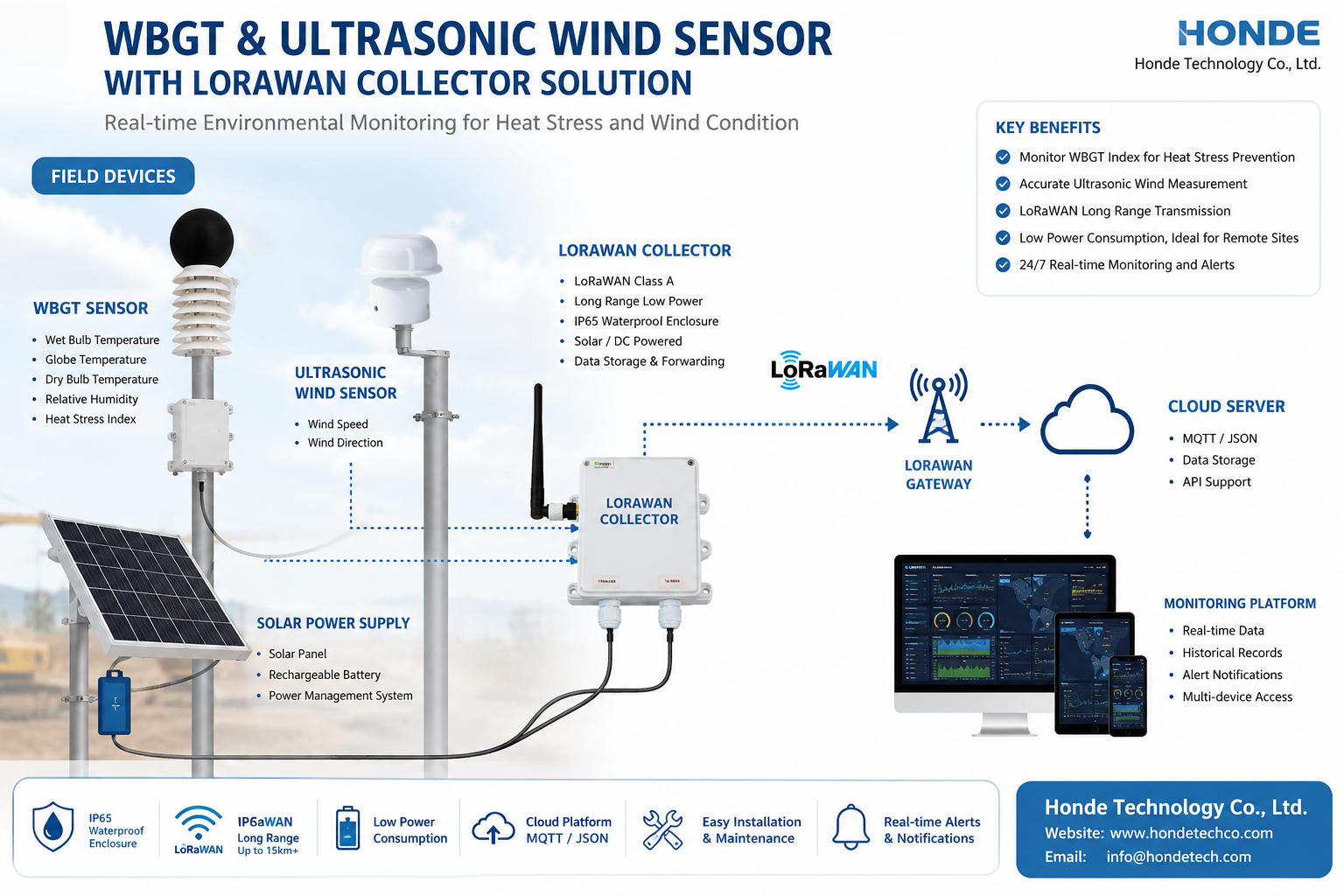
1. What Is a WBGT and Ultrasonic Wind Sensor System?
A WBGT monitoring system is designed to evaluate environmental heat stress. Unlike a conventional temperature sensor, a WBGT system can combine multiple environmental measurements to provide a more meaningful indication of thermal conditions.
The system can include:
-
- Wet Bulb Temperature
- Globe Temperature
- Dry Bulb Temperature
- Relative Humidity
- Heat Stress Index
-
- Wind Speed
- Wind Direction
-
- Wireless data collection
- Long-range communication
- Low-power operation
- Sensor data forwarding
- Remote monitoring connectivity
-
Solar Power Supply
- Solar panel
- Rechargeable battery
- Power management system
This modular architecture allows the monitoring station to operate in locations where wired power and communication infrastructure may be difficult to install.
2. How Does the LoRaWAN WBGT Monitoring System Work?
The basic data flow is:
The WBGT and wind sensors first measure environmental parameters at the monitoring point. The LoRaWAN collector receives and processes the sensor data before transmitting it wirelessly.
The LoRaWAN gateway then forwards the data to the cloud platform, where users can view:
- Real-time environmental data
- Historical records
- Heat stress information
- Wind speed and direction
- Alarm notifications
- Multiple monitoring locations
- Data export and API information
This makes the system suitable for both individual monitoring stations and larger multi-site environmental monitoring projects.
3. Installation Guide for the WBGT and Ultrasonic Wind Sensor
Correct installation is important because the sensor location can directly affect measurement quality.
STEP 1 Install the WBGT Sensor
Install the WBGT sensor on a stable mounting pole in an open outdoor location.
For the illustrated installation configuration, the recommended installation height is approximately 1.5–2 m above ground.
Avoid placing the WBGT sensor:
- Directly beside walls
- Under large structures
- Near strong artificial heat sources
- In locations with significant airflow obstruction
The objective is to measure environmental conditions that are representative of the actual working area.
STEP 2 Install the Ultrasonic Wind Sensor
The ultrasonic wind sensor should be installed in an unobstructed position with sufficient exposure to natural airflow.
The sensor should be:
- Properly leveled
- Firmly fixed to the mounting pole
- Installed away from tall obstacles
- Connected securely to the LoRaWAN collector
Because buildings, trees, cranes, and other structures can disturb airflow, installation location should be carefully selected when accurate wind measurement is required.
STEP 3 Install the LoRaWAN Collector
The LoRaWAN collector can be mounted on a pole or suitable wall.
During installation:
- Fix the enclosure securely.
- Keep the enclosure in a suitable outdoor position.
- Connect the WBGT and ultrasonic wind sensors.
- Connect the power supply.
- Check the antenna position.
- Confirm that all cable connections are properly sealed.
The collector acts as the communication hub between the field sensors and the LoRaWAN network.
STEP 4 Install the Solar Power Supply
For remote monitoring sites, a solar panel and rechargeable battery can provide an independent power source.
The solar panel should be positioned to receive sufficient sunlight throughout the day.
The basic power architecture is:
This configuration helps reduce dependence on grid power and simplifies deployment in remote areas.
4. Key Parameters and Functions
| Component | Main Function | Typical Data / Function |
|---|---|---|
| WBGT Sensor | Heat stress monitoring | Wet Bulb, Globe Temperature, Dry Bulb, RH, WBGT |
| Ultrasonic Wind Sensor | Wind monitoring | Wind Speed, Wind Direction |
| LoRaWAN Collector | Data collection and transmission | Wireless sensor data forwarding |
| Solar Power System | Off-grid power | Solar panel + rechargeable battery |
| LoRaWAN Gateway | Network communication | Receives LoRaWAN data |
| Cloud Server | Data management | Storage, visualization, API |
| Monitoring Platform | User interface | Real-time data, history, alerts |
The exact communication protocol, measurement range, accuracy, power configuration, and sensor interface should be selected according to the project requirements.
5. Why Combine WBGT and Wind Monitoring?
Monitoring temperature alone does not provide a complete picture of outdoor environmental risk.
A combined WBGT and wind monitoring station provides two important categories of information:
Heat Stress Information
WBGT-related measurements can help organizations identify periods of elevated heat stress and support decisions related to:
- Worker rest schedules
- Outdoor work management
- Heat safety procedures
- Event safety
- Environmental risk assessment
Wind Information
Wind speed and direction are particularly important for:
- Construction operations
- Crane activities
- Port operations
- Outdoor events
- Renewable energy sites
- Agricultural environments
By collecting both heat and wind information at the same location, users can build a more comprehensive environmental monitoring system.
6. Main Application Scenarios
Construction Sites
Construction workers may be exposed to direct sunlight, high temperatures, humidity, and changing wind conditions.
A WBGT and wind monitoring system can provide real-time environmental information to support:
- Heat stress prevention
- Outdoor work scheduling
- Safety management
- Weather condition monitoring
Industrial Plants
Industrial facilities may require continuous environmental monitoring around production areas, outdoor equipment, and worker activity zones.
The wireless architecture can reduce the need for extensive communication cabling while enabling centralized monitoring.
Agriculture and Greenhouses
Agricultural operations depend heavily on environmental conditions.
WBGT, temperature, humidity, and wind information can help users understand the microclimate around crops and outdoor working areas.
Possible applications include:
- Smart agriculture
- Crop environment monitoring
- Greenhouse management
- Agricultural worker safety
Outdoor Events
Large outdoor events can involve thousands of people exposed to changing weather conditions.
Real-time WBGT and wind information can support event organizers in monitoring environmental risks and responding to changing conditions.
Ports and Terminals
Wind conditions can affect loading, unloading, lifting, and other outdoor port operations.
An ultrasonic wind sensor provides real-time wind information, while LoRaWAN communication allows data to be transmitted from remote monitoring points to a centralized platform.
Renewable Energy Sites
Solar farms and wind farms often cover large areas where wired monitoring infrastructure can be expensive or difficult to deploy.
A solar-powered LoRaWAN monitoring station provides a practical approach for collecting environmental data from distributed locations.
7. Why Use LoRaWAN for Remote Environmental Monitoring?
For distributed outdoor sensors, communication distance, power consumption, and installation cost are important considerations.
LoRaWAN is particularly useful when monitoring stations are located far away from buildings or network infrastructure.
Key Advantages
LoRaWAN can connect remote sensor nodes to a gateway without requiring a separate wired communication cable for every monitoring point.
Low-power communication makes LoRaWAN suitable for solar-powered monitoring stations.
Sensors can be installed in construction sites, farms, ports, renewable energy facilities, and other outdoor environments.
Multiple monitoring stations can send data to a common platform, making it easier to manage distributed projects.
Additional LoRaWAN sensor nodes can be incorporated as the monitoring project expands.
8. LoRaWAN Collector vs. Traditional Wired Monitoring
| Feature | LoRaWAN Monitoring | Traditional Wired Monitoring |
|---|---|---|
| Communication | Wireless | Cable |
| Remote Deployment | Excellent | More difficult |
| Cabling Requirement | Low | High |
| Installation | Flexible | More infrastructure required |
| Solar Power | Suitable | Depends on system |
| Multi-Point Expansion | Easy to scale | More cabling required |
| Remote Sites | Highly suitable | May require additional infrastructure |
| Maintenance | Simplified field deployment | Cable maintenance may be required |
For large outdoor monitoring projects, the wireless architecture can significantly simplify sensor deployment.
9. Common Installation Mistakes to Avoid
Even a high-quality sensor can produce unreliable data if it is installed incorrectly.
Mistake 1: Installing the WBGT Sensor Too Close to Heat Sources
Concrete surfaces, machinery, walls, vehicles, and other heat sources may influence local temperature conditions.
Solution: Select a representative and open monitoring location.
Mistake 2: Blocking the Wind Sensor
Nearby buildings, trees, cranes, or equipment can disturb airflow.
Solution: Keep the ultrasonic wind sensor exposed and unobstructed.
Mistake 3: Poor Sensor Leveling
An incorrectly positioned wind sensor may affect wind direction measurements.
Solution: Check the mounting position and keep the sensor level.
Mistake 4: Poor Cable Protection
Outdoor installations are exposed to rain, humidity, dust, and temperature changes.
Solution: Ensure connectors are properly secured and waterproofed.
Mistake 5: Incorrect Solar Panel Position
Insufficient sunlight can reduce battery charging performance.
Solution: Install the solar panel in a location with good solar exposure and adjust its orientation according to the project location.
10. How to Choose a WBGT LoRaWAN Monitoring Solution?
Before purchasing a system, buyers should evaluate the following factors:
Sensor Configuration
Confirm whether the project requires:
- WBGT
- Temperature
- Relative Humidity
- Wind Speed
- Wind Direction
- Additional environmental sensors
Communication
Check compatibility with the required LoRaWAN network architecture, gateway, frequency plan, and deployment environment.
Power Supply
For remote installations, evaluate:
- Solar panel size
- Battery capacity
- Power consumption
- Operating environment
- Expected autonomy
Enclosure Protection
Outdoor monitoring equipment should have suitable environmental protection for the actual installation conditions.
Cloud Platform
Check whether the system supports:
- Real-time visualization
- Historical data
- Alarm notifications
- Multi-device access
- Data export
- MQTT/JSON or API integration
11. Recommended System Architecture
A complete Honde Technology solution can be configured as:
This architecture separates field measurement from data management, allowing users to build scalable monitoring networks for multiple sites.
12. Why Choose Honde Technology for Environmental Monitoring?
Honde Technology Co., Ltd. provides IoT-based solutions for smart agriculture, environmental monitoring, water monitoring, and outdoor sensing applications.
For WBGT and wind monitoring projects, Honde can provide an integrated solution combining:
- WBGT sensors
- Ultrasonic wind sensors
- LoRaWAN collectors
- Solar power systems
- Communication equipment
- Cloud monitoring
- Customized system integration
For distributors, system integrators, contractors, and industrial buyers, an integrated solution can simplify sourcing and project implementation.
13. Frequently Asked Questions
Q: What is a WBGT sensor used for?
A WBGT sensor is used to evaluate environmental heat stress by measuring relevant temperature and humidity parameters and calculating or supporting WBGT-related heat stress information.
Q: Why add an ultrasonic wind sensor?
Wind speed and direction provide additional environmental information that is valuable for construction, ports, outdoor events, agriculture, and renewable energy applications.
Q: Can the system operate in remote areas?
Yes. A LoRaWAN communication architecture combined with a solar panel and rechargeable battery is suitable for many remote outdoor monitoring applications.
Q: Can multiple monitoring stations be connected?
Yes. A LoRaWAN-based architecture can support distributed monitoring nodes, subject to the selected network, gateway, regional frequency requirements, and system configuration.
Q: Can the data be monitored remotely?
Yes. The system can be connected to a gateway and cloud platform so users can access real-time and historical information through a monitoring interface.
Q: Is the system suitable for construction sites?
Yes. Construction is one of the important application scenarios because WBGT information can support heat stress management while wind monitoring can provide additional environmental information for outdoor operations.
14. Final Takeaway
A WBGT and ultrasonic wind sensor with a LoRaWAN collector combines heat stress monitoring, wind measurement, long-range wireless communication, and remote data management into one scalable environmental monitoring architecture.
Compared with standalone temperature or wind sensors, the integrated solution provides a broader view of outdoor environmental conditions.
For construction sites, industrial plants, agriculture, outdoor events, ports, and renewable energy facilities, the combination of WBGT + ultrasonic wind sensing + LoRaWAN + solar power + cloud monitoring provides a flexible foundation for modern remote environmental monitoring.
If you are planning a new project, the most important factors to define first are the sensor parameters, installation location, LoRaWAN communication requirements, power supply, monitoring platform, and number of monitoring points.
Get a Customized WBGT LoRaWAN Monitoring Solution
Honde Technology can help configure the sensor combination, communication architecture, power supply, and monitoring solution according to your project requirements.
Company Name: Honde Technology Co., Ltd.
Website: www.hondetechco.com
Email: info@hondetech.com
Contact Honde Technology for a customized quotation, product specifications, or WBGT and LoRaWAN environmental monitoring solution.
Post time: Aug-13-2026