

Date: July 25, 2026
Walk through an intensive shrimp farm in Ecuador’s Guayas province, a super-intensive white-leg shrimp facility in Vietnam’s Ca Mau, and a Norwegian salmon RAS facility, and you will see three different businesses that happen to share the word “aquaculture.” The production models, the economics, and the sensor requirements are not interchangeable. The one thing they share is that all three are losing money to parameters they are not measuring — and all three are now buying sensors to close those gaps.
Ecuador: The Pond Count Problem
Ecuador grows white-leg shrimp (Litopenaeus vannamei) in large earthen ponds — typically 5 to 20 hectares each — under a semi-intensive model with low stocking density and tidal water exchange. The country exported 125,215 metric tons in January 2026, a 23% year-on-year increase, making it the world’s largest single-country shrimp exporter.
The Ecuadorian pond model has one dominant risk: dissolved oxygen stratification. In a 1.2-meter-deep earthen pond in Guayas province, the surface water can read 6.5 mg/L DO at 3 PM — saturated from photosynthesis — while the bottom water at the pond center reads 1.8 mg/L. The shrimp live on the bottom. They are experiencing chronic hypoxia while the farmer’s handheld meter, dipped at the pond edge, reports a healthy reading.
The demand in Ecuador is for optical dissolved oxygen sensors that measure continuously at depth, not handheld spot-checks. The second priority is salinity — Ecuadorian ponds sit close to estuaries where freshwater inflow after heavy rain can drop salinity from 32 ppt to 18 ppt in 24 hours, triggering mass molting and mortality. The sensor stack that Ecuadorian farms buy: optical DO, salinity/EC, pH, and temperature, deployed on floats at the pond center rather than at the edge.
Vietnam: The Density Problem
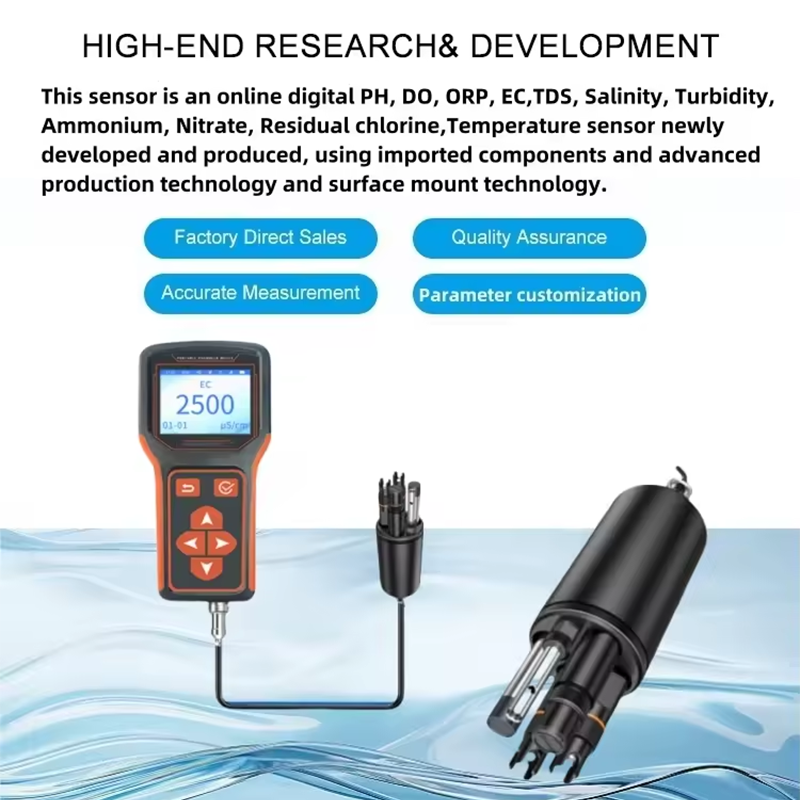
Vietnam’s Ca Mau and Bac Lieu provinces run super-intensive white-leg shrimp in small ponds — 1,000 to 4,000 square meters — at stocking densities of 200 to 400 post-larvae per square meter. At those densities, the pond is not a natural ecosystem. It is a chemical reactor. Feed inputs are massive, organic load accumulates daily, and the margin between optimum and catastrophic is narrow.The dominant risk in the Vietnamese model is ammonia. At high stocking density, the shrimp excrete nitrogen continuously, and the biological filter — whether in-pond or recirculating — must keep total ammonia nitrogen below 1 mg/L and non-ionized ammonia (NH₃) below 0.1 mg/L. The pH dependency is the trap: ammonia toxicity increases roughly 10-fold for every pH unit increase above 7.5. A pond that was safe at pH 7.6 at dawn can be lethal at pH 8.4 at noon, purely from photosynthesis-driven pH rise.The sensor stack for Vietnamese super-intensive farms: ammonia (NH₄⁺/NH₃) with pH compensation, optical DO, pH, and temperature — with the ammonia sensor’s pH and temperature inputs feeding a real-time toxicity calculation. This is why the Honde 6-in-1 ammonia sensor (NH₄⁺, NO₃⁻, pH, temperature, with built-in TAN toxicity algorithm) is the highest-demand single product in the Vietnamese market segment.
Norway: The Closed-Loop Problem
Norway’s salmon industry is converting from open net-pens toward semi-closed containment systems and land-based RAS facilities, driven by sea-lice pressure and escape concerns. A RAS facility is the most sensor-intensive aquaculture model in existence. Water recirculates through mechanical filtration, biofiltration, UV disinfection, and oxygenation, and every unit operation depends on continuous measurement.The dominant risk in RAS is nitrate accumulation and system imbalance. In a zero-discharge RAS, nitrate climbs steadily because biofiltration converts ammonia to nitrate but nothing removes the nitrate except water exchange. Above 100 mg/L, nitrate becomes toxic to salmon smolt. The second risk is ORP — the oxidation-reduction potential that determines whether the UV disinfection stage is working and whether ozone dosing is appropriate.The sensor stack for Norwegian RAS: optical DO, nitrate, ORP, pH, conductivity, and temperature, with multiple redundant DO sensors at each process stage. This is the only aquaculture market segment where nitrate and ORP sensors outsell DO sensors on a per-facility basis — simply because a RAS facility runs 20 to 50 sensor channels.
The Shared Failure Mode: Bio-fouling
The three models differ in everything except one shared problem: sensor fouling. In Ecuador’s nutrient-rich ponds, algae coats a sensor face within 72 hours. In Vietnam’s super-intensive ponds, biofilm and feed residue blind the optical windows of DO and ammonia sensors within 48 hours. In Norway’s RAS biofilters, bacterial slime accumulates on every submerged surface.A fouled sensor does not fail with an error message. It drifts. An optical DO sensor with 1mm of biofilm reads 15–20% low — and the farm manager responds by over-aerating, wasting electricity. An ammonia ISE with fouled membrane reads 30–50% low — and the farm manager misses a lethal ammonia spike that kills shrimp overnight.This is why the single most important accessory in aquaculture is the automatic cleaning brush. The Honde multi-parameter probes with integrated brushes wipe the sensor face every 15 minutes on a programmed schedule. In the three pilot deployments described below, this one feature reduced manual sensor cleaning from every-other-day to monthly.
The Honde Solution Architecture Across the Three Models
Field Results: The Three Pilots
Ca Mau, Vietnam — Super-Intensive Shrimp (June 2026)
Hardware: 30 six-in-one ammonia/pH/temperature sensors and titanium optical DO sensors with automatic cleaning brushes, on floating buoy systems.
Outcome: The alarm relay intercepted 14 nighttime hypoxia events and 6 ammonia toxicity warnings in the first 60 days. The farm achieved a 98% survival rate and a 15% electricity reduction from DO-guided aeration control. The automatic cleaning brush eliminated the every-other-day manual scrubbing routine.
Guayas, Ecuador — Semi-Intensive Shrimp (June 2026)
Hardware: 40 optical DO and salinity/EC sensors deployed at pond centers on floating buoys, transmitting via 4G.
Outcome: Continuous depth monitoring revealed that 11 of 40 ponds were experiencing bottom-water hypoxia below 3.0 mg/L during midday photosynthesis peaks — a condition invisible to edge-of-pond handheld sampling. Aerator placement was redistributed based on the data, and nighttime mortality dropped by an estimated 22% over the following two-month cycle.
Rogaland, Norway — Land-Based RAS (May 2026)
Hardware: 60 sensor channels across three RAS units: optical DO at each biofilter and tank, nitrate and ORP at the process loop, pH and conductivity at intake. RS485 wired to facility PLCs, MQTT Json for cloud reporting.
Outcome: Continuous nitrate monitoring revealed that the water-exchange schedule was conservative — nitrate never approached the 100 mg/L toxicity threshold under normal operation. The facility reduced water exchange from 8% to 5% of system volume per day, cutting freshwater consumption and discharge-treatment costs by an estimated $28,000 annually.
Contact Honde Technology for Aquaculture Solutions
Honde Technology is a Germany TUV & Alibaba verified manufacturer. We supply the optical DO sensors, ammonia/pH multi-parameter probes, nitrate and ORP sensors, and the automatic cleaning brush technology that aquaculture operations in 40+ countries depend on.
For more sensor information and customized IoT solutions, please contact Honde Technology Co., LTD.
- WhatsApp: +86-15210548582
- Email: info@hondetech.com
- Company Website: www.hondetechco.com
Post time: Aug-05-2026