

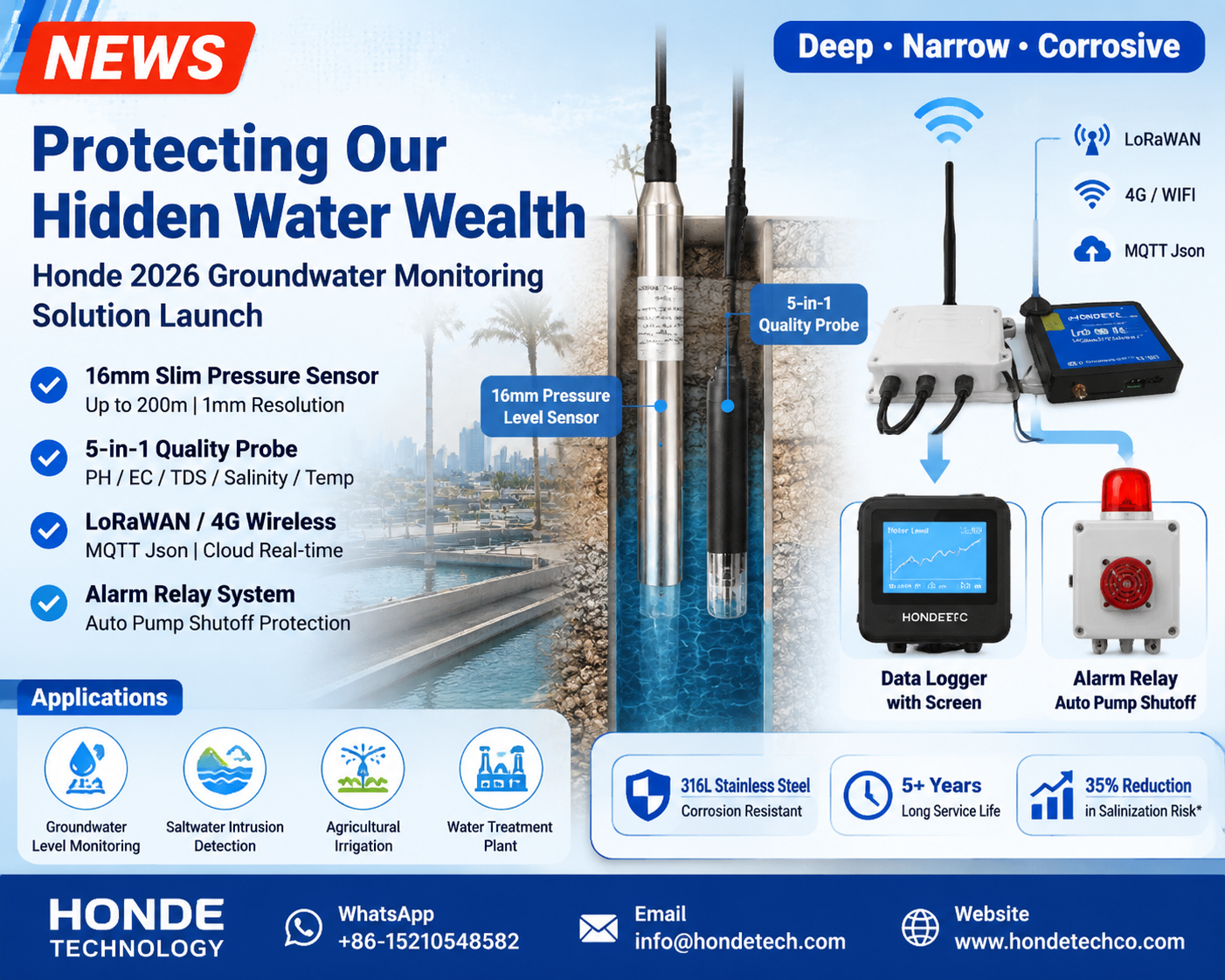
The Underground Bottleneck: Why “Standard” Sensors Fail in Deep Wells
In 2025 and 2026, the depletion of freshwater aquifers in regions like Saudi Arabia (Al-Ahsa), The UAE (Coastal Sharjah), and India (Rajasthan) has reached a tipping point. Managing these invisible reserves requires more than just “taking a reading”—it requires surviving the unique physical constraints of a borehole.
Most monitoring wells are “narrow-bore” (2 inches or less). Standard industrial sensors are too wide to pass, or they get stuck during retrieval. Furthermore, in deep-well environments, the static pressure and high mineral content (Salinity) corrode electronics within months.
Honde Technology’s 2026 Groundwater Series was engineered for the “Deep, Narrow, and Corrosive.”
The Perception Layer: 316L Stainless Steel & Micro-Engineering
Based on the Honde Hydrogeology Catalog, we have optimized three core hardware pillars:
1 The 16mm Micro-Pressure Level Sensor (RD-PWLT16-02)
- The Design: A specialized 16mm slim-body probe. Its diameter is specifically optimized for narrow observation wells where standard 25mm sensors cannot fit.
- The Power: Made of 316L Stainless Steel, it supports a measurement range of up to 200 meters with a resolution of 1mm. It tracks the “Recharge Rate” of the aquifer with industrial precision.
2 The Integrated 5-in-1 Deep-Well Probe (RD-PETSTS-01)
Instead of a bundle of cables, this single probe tracks pH, EC (Conductivity), Temperature, TDS, and Salinity.
- Seawater Intrusion Tracking: In coastal aquifers, the EC and Salinity data act as the “First Alert.” A 5% spike in salinity signals an incoming saltwater wedge, allowing the operator to stop pumping before the aquifer is permanently damaged.
3 High-Voltage Isolation (3000V)
All Honde groundwater sensors feature four-fold electrical isolation. This protects the sensor from ground loops and surges common in deep-well pumping stations, extending the sensor life to over 5 years.
The Honde Full-Stack Solutions Architecture
A borehole sensor is useless if the data can’t get out of the well. We provide a complete 3-tier digital architecture:
Local Awareness & Resilient Deployment
- Handheld Verification: Field engineers use the Handmeter for rapid spot-checks and annual calibration audits.
- Local Terminals: Every wellhead is anchored by our Data Logger with screen, allowing local crews to view real-time levels and 30-day graphical history on-site without needing a laptop.
- Anti-Fouling Support: In shallow wells or recharge pits where algae flourish, we utilize the Floating Buoy system and the Automatic cleaning brush for multi-parameter water sensor. The brush physically wipes the sensor face every 15 minutes, preventing biofilm from drifting the data.
The Wireless Nervous System (Transmission)
- Remote Connectivity: Data is transmitted from remote desert or delta sites using GPRS, 4G, WIFI, LORA, or LORAWAN wireless modules.
- The MQTT Logic: For national water grids, data is transmitted in the MQTT Json format. This ensures the data is “SCADA-ready,” allowing it to feed directly into hydraulic modeling software and Digital Twins without custom API work.
Cloud Management & Active Warning (The Safety Loop)
- All data is centralized on the Cloud server and software, providing 24/7 visibility into the aquifer’s state.
- The Alarm Relay System: This is the critical ROI tool. When the water level drops below the “Sustainability Threshold,” the cloud platform triggers a physical Alarm Relay system on-site. This automatically shuts down the deep-well pump, protecting the pump from running dry and the aquifer from salt-water suction.
Real-World Case Study: Combating Seawater Intrusion in Sharjah, UAE
The coastal aquifers of the UAE are the primary source for agricultural irrigation. However, over-pumping has allowed seawater to seep inland, ruining fertile land.
- The Hardware: Installed 40 units of the 16mm RD-PWLT16-02 Level Sensors and 5-in-1 Quality Probes in 2-inch monitoring wells.
- Networking: Due to the desert terrain, LoRaWAN was used to transmit data over 10km to a central 4G gateway in MQTT Json format.
- The Outcome: The 16mm micro-probe allowed for instant installation in existing wells without expensive drilling. The Alarm Relay System now automatically manages the regional pump grid; the moment the salinity sensors detect an incoming salt wedge, the pumps shut down, reducing permanent land salinization by 35% in the first year.
Contact Honde Technology for National Water Tenders
For more sensor information and customized IoT solutions, please contact Honde Technology Co., LTD.
Post time: Jun-23-2026