

The January 2026 EHS Regulatory Changes in Benelux bulletin was unambiguous: new emission limit values for COD and TOC at industrial discharge points take effect from April 2026 in both Belgium and the Netherlands. Sites that had been submitting quarterly lab results under the previous limits were, in some cases, suddenly out of compliance — not because their discharges had worsened, but because the measurement methodology had changed. Grab samples sent to a certified laboratory every three months are no longer sufficient evidence of continuous compliance under the updated VMM permit framework. The requirement now is continuous or near-continuous online measurement at the discharge point.
In the Antwerp chemical cluster — a 40-square-kilometer industrial port area housing over 300 chemical and petrochemical companies, including major operations from BASF, Covestro, Bayer CropScience, and Lanxess — that regulatory signal arrived simultaneously at hundreds of environmental compliance desks.
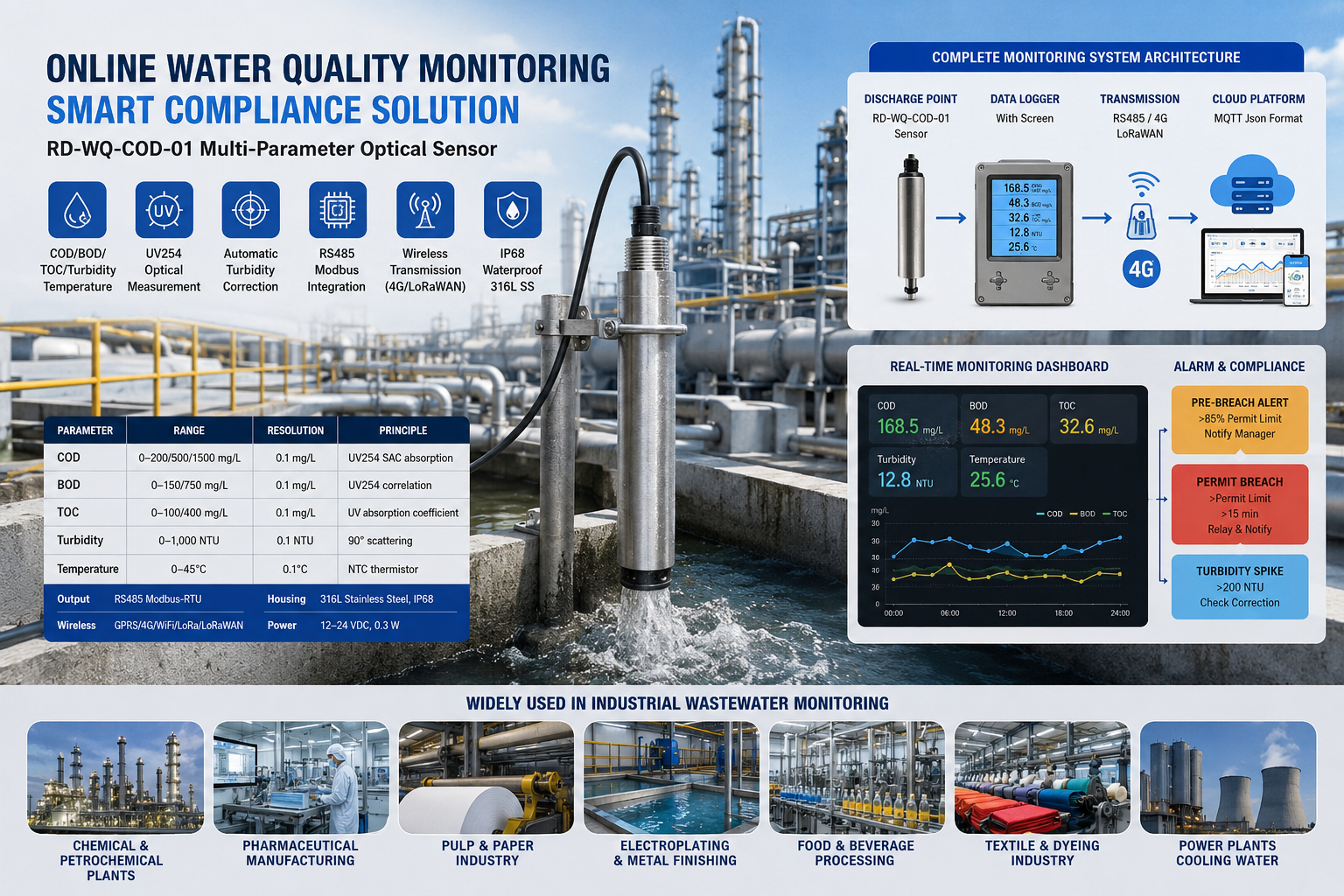
The Measurement Challenge at a Chemical Discharge
Chemical industrial wastewater is not municipal sewage. Its COD composition reflects the specific chemistry of the process: aromatic organic solvents, intermediate synthesis compounds, polymer precursors, and surfactants. These molecules absorb UV light at 254 nanometers — the principle underpinning the UV SAC (Spectral Absorption Coefficient) measurement — but they do so at different intensities than the humic acids and biological COD that the standard UV254 calibration was designed around.
A sensor calibrated on municipal effluent will under-read COD in an aromatic-rich chemical discharge. The calibration matrix matters as much as the measurement principle.
The RD-WQ-COD-01′s configurable calibration allows the sensor to be calibrated against the actual effluent matrix of the specific plant — a sample set of the plant’s own wastewater, paired against ISO 6060 lab COD values, and loaded into the sensor’s firmware. The instrument then reads COD in the plant’s water, not in generic municipal approximation.
The Product
| Parameter | Range | Resolution | Principle |
|---|---|---|---|
| COD | 0–200 mg/L / 0–500 mg/L / 0–1,500 mg/L | 0.1 mg/L | UV254 SAC absorption |
| BOD | 0–150 mg/L / 0–750 mg/L | 0.1 mg/L | Derived via UV254 correlation |
| TOC | 0–100 mg/L / 0–400 mg/L | 0.1 mg/L | UV absorption coefficient |
| Turbidity | 0–1,000 NTU | 0.1 NTU | 90° scattering |
| Temperature | 0–45°C | 0.1°C | NTC thermistor |
| Output / Housing | RS485 Modbus-RTU | 316L stainless steel, IP68 | |
| Wireless / Power | GPRS / 4G / WiFi / LoRa / LoRaWAN | 12–24 VDC, 0.3 W | |
The turbidity parameter is not supplementary — it is essential for COD accuracy in variable-loading effluents. Suspended solids scatter the UV beam, producing apparent absorbance that overstates the dissolved organic fraction. The 90° scattering turbidity channel allows the firmware to apply a turbidity correction to the UV254 COD reading in real time. Without this correction, a sudden suspended-solids event produces a false COD spike that triggers compliance alarms and consumes operator attention before the true organic load is understood.
The Belgian Discharge Threshold Context
| Discharge category | Old VMM COD limit | Post-April 2026 limit | Measurement requirement |
|---|---|---|---|
| Chemical process water to public sewer | 500 mg/L (quarterly grab) | 300 mg/L (continuous online) | Online measurement + SCADA logging |
| Direct surface water discharge | 125 mg/L (monthly lab) | 100 mg/L (daily online) | Online measurement + VMM e-report |
| Cooling water bleed to surface water | COD < 30 mg/L (weekly) | COD < 25 mg/L (online) | Online + alarm relay |
The Solution Architecture
The sensor installs in an immersion well on the effluent discharge channel — submerged at 0.5 to 1.0 meter depth, self-orienting to face the flow. The 316L stainless steel body handles the chemical exposure without degradation. A Data logger with screen in the plant’s environmental monitoring cabinet displays current COD, BOD, TOC, turbidity, and temperature for the duty environmental engineer. The environmental engineer conducts weekly Handmeter verification: a grab sample analyzed by ISO 6060 in the on-site laboratory, compared against the installed sensor reading, confirming calibration remains within the ±10% accuracy criterion that VMM’s continuous monitoring protocol requires.
Each sensor node connects to the plant’s process network via RS485 Modbus-RTU, integrating directly with the existing SCADA or DCS. For satellite discharge points remote from the main control room — an additional 4G or LoRaWAN module transmits data to the cloud platform in MQTT Json format, feeding both the plant dashboard and the VMM’s online reporting portal (where e-PRTR annual data and continuous monitoring records must be submitted).
The Cloud server and software consolidates COD, BOD, TOC, and turbidity data from all discharge points, showing real-time data and history data. The Alarm relay system implements a two-level compliance logic:
| Alert level | Trigger | Relay action |
|---|---|---|
| Pre-breach alert | COD > 85% of permit limit | Notify environmental manager (SMS/email); increase sampling |
| Permit breach | COD > permit limit for > 15 min | Plant shift manager notification; log event; prepare VMM notification |
| Turbidity spike | Turbidity > 200 NTU | Investigate suspended solids event; cross-check COD correction factor |
Field Results: Antwerp Chemical Campus, April–July 2026
A multi-tenant chemical production campus in the Antwerp port area — operating four separate process units with individual VMM discharge permits — deployed RD-WQ-COD-01 sensors at 12 effluent points between February and April 2026, commissioning before the April regulatory deadline.
Hardware: 12 sensors in immersion wells at effluent discharge channels, RS485 to plant SCADA, 4G modules to cloud platform.
Local: Data logger with screen in each unit’s environmental monitoring cabinet; ISO 6060 lab verification weekly.
Cloud: MQTT Json to VMM e-PRTR reporting portal.
Alarm: Pre-breach at 85% permit; breach relay at permit limit.
April–July 2026 monitoring performance:
| Metric | Lab/grab-sample baseline (Q1 2026) | Continuous sensor (Q2 2026) |
|---|---|---|
| COD measurements per discharge point | 3 (quarterly) | 11,520 (15-min interval) |
| Events exceeding permit limit detected | 1 (at quarterly sample) | 9 |
| Mean response time to exceedance | 45 days (next sample) | 18 minutes |
| Turbidity-correction events applied | N/A | 37 |
| ISO 6060 verification tests | 48 (all 12 points × 4 checks) | 48 (maintained as verification only) |
| Manual COD lab cost (indexed) | 100% | 12% (verification only) |
Operational outcomes:
- 9 COD exceedance events detected by continuous monitoring — against 1 detected by quarterly grab samples in the same period. All 9 were resolved within 2 to 6 hours by process adjustments. Under the quarterly regime, 8 of these 9 events would have been invisible until the next scheduled sample.
- The 18-minute mean response time from exceedance detection to operator notification replaced the previous 45-day lag. In 4 of the 9 events, process engineers identified and corrected the root cause (tank overflow, heat exchanger bypass) within 30 minutes — before the event could generate a VMM permit breach notification.
- 37 turbidity-correction events occurred during two process upsets that generated suspended solids pulses. Without the turbidity channel, these pulses would have produced apparent COD readings of 850–1,200 mg/L — well above permit limits — triggering false breach notifications. The corrected COD readings showed the dissolved organic fraction remained within permit at all 37 events.
- Manual COD laboratory expenditure fell to 12% of the pre-sensor baseline — the weekly verification samples replace the compliance reliance on lab analysis, but the volume is 88% lower.
- The campus’s Q2 VMM e-PRTR submission included continuous 15-minute COD data for all 12 discharge points — accepted by VMM without supplementary lab data, the first time the campus had submitted a fully instrumented compliance report.
Contact Honde Technology for Industrial Water Quality Monitoring
Honde Technology is a Germany TUV & Alibaba verified manufacturer. We supply UV254 multi-parameter optical sensors, matrix-calibrated for industrial wastewater, with the wireless compliance reporting architecture required by EU industrial emission permit frameworks.
For more sensor information and customized IoT solutions, please contact Honde Technology Co., LTD.
- WhatsApp: +86-15210548582
- Email: info@hondetech.com
- Company Website: www.hondetechco.com
The Demand Map Across Developed Industrial Wastewater Markets
The UV254 multi-parameter sensor specification is a procurement convergence point across developed countries with online industrial discharge monitoring mandates. Germany’s AbwV (Abwasserverordnung) requires COD monitoring at 57 categories of industrial wastewater discharge — the chemical sector being the highest-scrutiny category — and the 2025 update mandates online measurement at Class A discharges. The Netherlands, implementing identical April 2026 EHS emission changes as Belgium, has driven a parallel adoption wave across the Rotterdam petro-chemical corridor. Switzerland’s GSchV (Gewässerschutzverordnung) requires pharmaceutical manufacturers in the Basel region to monitor TOC continuously at discharge — the TOC output from the same sensor fills this requirement without additional instrumentation. South Korea’s Water Environment Conservation Act requires online COD monitoring at IPPC-classified industrial sites, generating the procurement volume that makes the sensor’s primary market listing accurate. Each regulatory framework names different parameters, different thresholds, and different reporting systems — but each converges on the same sensor specification: UV254 optical, matrix-calibrated, turbidity-corrected, with RS485 integration and MQTT cloud reporting.
Post time: Sep-01-2026