

Ammonia in a broiler house is not an occasional problem. It is a continuous chemical process. Uric acid in poultry litter breaks down through bacterial hydrolysis into ammonia gas. In a 1,800-square-meter tunnel-ventilated house holding 33,000 birds, NH₃ concentrations at floor level can climb from 5 ppm during the first week of a flock to 60 ppm by week five. The birds live in it. The workers breathe it.
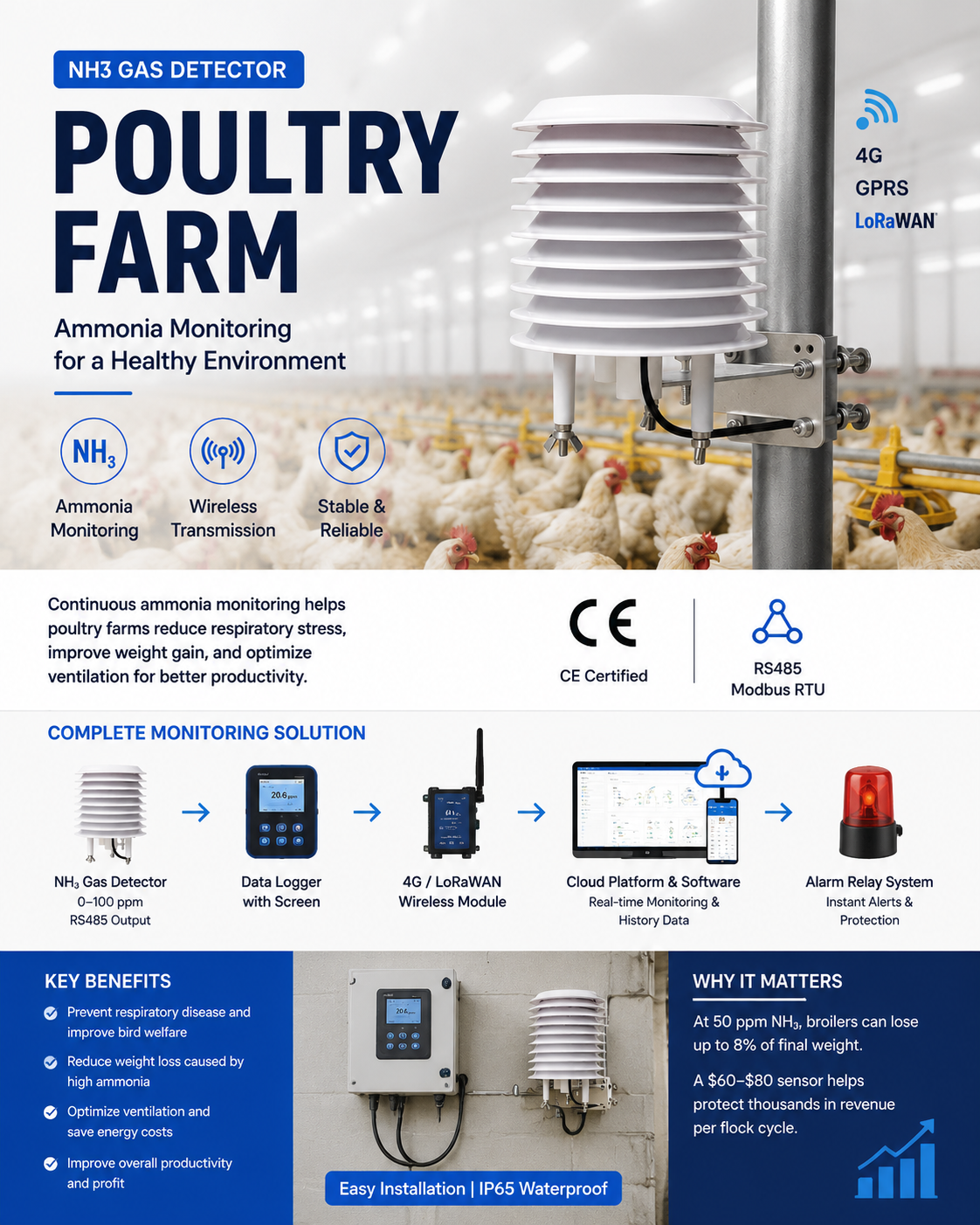
Honde Technology’s RS485 ammonia sensor has started appearing in Brazilian broiler integrations for a simple reason: ammonia-induced respiratory damage reduces slaughter weight by 3% to 8% across a flock, and nobody in the production chain had been measuring the gas that caused it.
What the Sensor Actually Does
The RD-IATHLB-03 is straightforward hardware. Wall-mounted inside the broiler house, powered by 9–24VDC from the control panel, measuring NH₃ from 0 to 100 ppm with RS485 Modbus-RTU output. IP65-rated housing. Operating range from -30°C to 70°C — the upper end matters more than the lower. A Brazilian broiler house in February, with 33,000 birds approaching slaughter weight generating metabolic heat, can reach 38°C inside even with fans at full speed.
Two specifications determine whether an ammonia sensor works in a poultry house or dies within months. The first is the electrochemical cell’s resistance to hydrogen sulfide cross-interference — poultry litter produces H₂S as well as NH₃, and a cheap sensor without cross-compensation drifts into false-high ammonia readings within weeks. The second is the housing’s ability to survive pressure-washing between flocks. Brazilian houses are stripped, washed, and disinfected in a 10–14 day turnaround. The IP65 rating means the sensor survives the wash-down crew’s high-pressure sprayer, provided the installer mounted it at the specified height.
The sensor outputs via RS485 Modbus. In a new house with a modern environmental controller, it connects directly to the controller’s RS485 input port and the ventilation logic reads ammonia as a control variable — the same way it reads temperature and humidity. In an older house with a basic thermostat-and-timer panel, the RS485 connects to a LoRaWAN or 4G wireless module and the data skips the environmental controller entirely, going directly to the cloud. This is not a theoretical architecture. Brazilian integrations have houses built in 1998 sitting 300 meters from houses built in 2024. The sensor bridges both.
The Economics Nobody Was Tracking
Broiler production has razor margins. A Brazilian integrator processing 2 million birds per week might operate on a net margin of 4% to 7%. Within that margin, ammonia is invisible on the P&L because nobody has instrumented it.
Here is what instrumenting it reveals. At 25 ppm NH₃ — the OSHA permissible exposure limit for workers — broilers show measurable reductions in daily weight gain. At 50 ppm, which is not unusual in a fifth-week house with wet litter, the reduction can reach 8% over the final 10 days before slaughter. An 8% weight loss on a 2.8-kilogram target bird is 224 grams. At Brazilian wholesale prices of approximately R
6.80perkilogramliveweight,thatisR1.52 per bird. Across a single 33,000-bird house, one flock cycle, the loss is R
50,160—roughly9,800.
The sensor costs less than R$350 per unit installed.
This is why Brazilian integrators are paying attention. Not because ammonia monitoring is a regulatory obligation — Brazil’s Ministry of Agriculture does not mandate continuous NH₃ monitoring in broiler houses. Because someone finally connected the gas concentration to the slaughter weight data and the economics were undeniable.
How the Network Works Across 200 Houses
An integrator in western Paraná managing 200 broiler houses across 50 contract growers faces the same infrastructure problem as every distributed agricultural operation: some houses have fiber, some have patchy 4G, and three sit in a valley where cellular doesn’t reach at all.
The RS485 sensor’s output is protocol-agnostic at the module layer. Houses with good 4G coverage get a cellular module transmitting MQTT Json directly to the integrator’s cloud platform. Houses in signal valleys get a LoRaWAN module that relays data to a gateway on the nearest hilltop, then to the internet. Houses with existing WiFi from the farm office get a WiFi module. The sensor does not change. Only the communication module changes.
At the house level, the grower does not need a cloud dashboard. A Data logger with screen mounted in the control room shows the current ammonia reading, the 24-hour trend, and the 30-day history — enough to make ventilation decisions without opening an app. During the quarterly veterinary visit, the field technician uses a Handmeter to verify the installed sensor against a calibrated reference, the same way they verify temperature probes.
At the integrator level, the Cloud server and software maps ammonia across all 200 houses in real time. The operations manager can sort by NH₃ concentration and dispatch the litter-management crew to the houses above 35 ppm before the birds inside those houses lose another gram of daily gain.
The Alarm relay system closes the loop. If a house exceeds 50 ppm — the threshold where acute respiratory damage begins — the relay triggers a local audible alarm. The grower is notified immediately, not the next morning when someone checks a dashboard. If the ammonia does not drop within 30 minutes, the system escalates to an SMS alert to the integrator’s veterinary team.
Field Results: Western Paraná Integration, March–June 2026
An integrator in the Toledo region of western Paraná installed Honde ammonia sensors in 120 broiler houses across 30 contract growers between March and June 2026.
System Setup:
- Hardware: 120 RD-IATHLB-03 RS485 ammonia sensors, each paired with a communication module (70% 4G, 30% LoRaWAN).
- House-level: A Data logger with screen in each control room.
- Cloud: MQTT Json to the integrator’s central platform.
- Alarm: Relay modules configured at 50 ppm threshold.
Four-month operational results:
- Before the sensor network, the integrator assumed most houses stayed below 30 ppm based on ventilation schedules. After installation, 23 houses were found to exceed 45 ppm during the fifth week of at least one flock cycle — typically between 2 AM and 5 AM, when outside temperatures were lowest and ventilation was reduced to conserve heat.
- The litter-management schedule was reorganized based on sensor data instead of a fixed rotational calendar. Houses with persistent ammonia above 35 ppm received priority litter replacement. After the first full cycle under data-driven scheduling, average ammonia exposure during week five dropped from 42 ppm to 18 ppm across the monitored houses.
- Slaughter weight data from the first complete flock cycle after sensor installation showed an average 2.8% improvement in live weight compared to the same houses’ previous cycle — an increase the integrator’s production director attributed primarily to reduced respiratory stress during the critical final growth phase.
- The relay system triggered 14 audible alarms during the trial period. In each case, the grower increased ventilation within minutes. No flock experienced sustained exposure above 50 ppm after the alarm threshold was reached.
Contact Honde Technology for Livestock Monitoring Solutions
For more sensor information and customized IoT solutions, please contact Honde Technology Co., LTD.
- WhatsApp: +86-15210548582
- Email: info@hondetech.com
- Company Website: www.hondetechco.com
Post time: Jul-30-2026